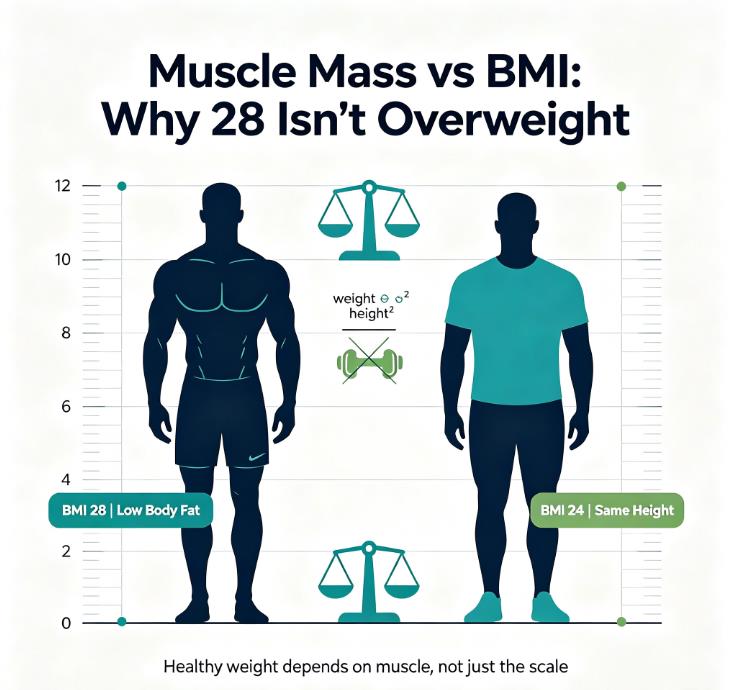
At a Glance: Muscle mass fundamentally alters how healthy weight standards apply to your body. While the CDC defines adult BMI categories using fixed height-to-weight ratios, these ranges cannot distinguish dense muscle tissue from excess fat. For strength athletes, gym enthusiasts, and physically active adults, this creates a metabolic paradox: an "overweight" BMI may actually signal robust insulin sensitivity and lower cardiometabolic risk. This guide explains the physiological mechanisms behind muscle-adjusted weight standards, why the American Medical Association now cautions against using BMI alone, and how to accurately assess your health using body composition tools aligned with CDC screening principles.
Most Americans treat BMI like a medical verdict. But BMI is a screening measure, not a diagnostic tool. The CDC is crystal clear about this: BMI does not distinguish between fat, muscle, and bone mass. For the general population, that simplification works well enough. For muscular individuals, it is often dead wrong.
Two people at 5'10" and 190 pounds can have completely different health profiles. One is a sedentary office worker with 28% body fat. The other is a regular gym-goer with 12% body fat and significantly more lean mass. Their BMIs are identical. Their health risks are not even close.
Data from the 2017–2020 National Health and Nutrition Examination Survey (NHANES) shows that among men with a BMI of 25 kg/m² — technically the threshold for "overweight" — actual body fat percentage ranges from 14% to 35%. That is not a small margin of error. It is a clinical chasm. Without body composition data, BMI becomes a blunt instrument that misclassifies muscular individuals while missing metabolically unhealthy people in the "normal" range.

Why the Scale Lies: The BMI Blind Spot for Muscular Bodies
How many of us have stepped on a scale, punched our numbers into a BMI calculator, and felt that familiar twinge of disappointment when it said "overweight"? But what if that number was lying to you?
Think about it. A pound of muscle and a pound of fat weigh the same. But muscle takes up about 18% less space and burns three times more calories at rest. So two people at 5'10" and 190 pounds can have completely different health profiles — identical BMIs, but completely different risks.
Here is the data that actually matters: Data from the 2017–2020 National Health and Nutrition Examination Survey (NHANES) shows that among men with a BMI of 25 kg/m² — technically the threshold for "overweight" — actual body fat percentage ranges from 14% to 35%. That is not a small margin of error. It is a clinical chasm. Without body composition data, BMI becomes a blunt instrument that misclassifies muscular individuals while missing metabolically unhealthy people in the "normal" range.
The Metabolic Shield: What Muscle Does Beneath the Surface
Muscle mass does not just change how you look in the mirror. It rewires your metabolism from the inside out. Understanding these hidden mechanisms is the key to understanding why healthy weight standards must shift for muscular individuals.
Insulin Sensitivity Independent of Fat Mass
Skeletal muscle is the body's largest glucose disposal site. When you have more lean mass, you effectively create a larger sink for blood sugar. A 2020 NIH-funded study published in the International Journal of Obesity found that men in the highest tertile of appendicular lean mass had insulin sensitivity nearly twice as high as those in the lowest tertile — even after controlling for visceral fat, liver fat, and other adipose depots.
Translation: muscle mass protects against insulin resistance in ways that BMI cannot predict. A muscular man with a BMI of 27 may handle carbohydrates more efficiently than a sedentary man with a BMI of 22. The number on the scale never captures this metabolic advantage.
The Inflammation Buffer
Adipose tissue is not inert. It secretes inflammatory cytokines that drive chronic disease. Muscle tissue, conversely, acts as an endocrine organ releasing myokines — proteins like irisin and IL-6 that reduce systemic inflammation. Research published in BMC Public Health demonstrates that adults with high muscular fitness show lower cardiometabolic risk than their unfit peers, even when both groups share an overweight or obese BMI category.
This creates what researchers call the "metabolically healthy overweight" phenotype. These individuals carry extra weight on the scale but maintain normal blood pressure, lipid profiles, and inflammatory markers. Their muscle mass functions as a biological buffer against the diseases typically associated with obesity.
Cardiometabolic Risk Reclassification
In June 2023, the American Medical Association adopted formal policy recognizing that BMI alone is an imperfect clinical measure. The AMA specifically noted that BMI loses predictability at the individual level and should be paired with measures of visceral fat, body composition, and metabolic factors. For muscular individuals, this policy shift validates what gym regulars have long suspected: your doctor's BMI reading may not reflect your actual risk.
The National Heart, Lung, and Blood Institute (NHLBI) reinforces this by recommending waist circumference alongside BMI. For men, a waist under 40 inches and for women under 35 inches suggests lower metabolic risk — regardless of what the BMI chart says. If your waistline is trim but your BMI reads "overweight," your muscle mass is likely the culprit, not your health.
When One Size Fits None: Race, Age, and Sex Matter Too
If BMI struggles with muscular bodies, it is not the only scenario where the standard chart misses the mark. The AMA's 2023 policy explicitly calls out that BMI cutoffs do not represent racial group risks appropriately. Let us break down three populations where BMI interpretation requires extra nuance.
Ethnicity and Body Composition
Here is something most Americans do not know: the BMI thresholds you are used to were developed using data from non-Hispanic white populations. That is it. The AMA policy highlights that Asian, Hispanic, and Black patients often face higher metabolic risk at lower BMIs compared to white patients.
The WHO Expert Consultation on BMI in Asian populations (2004) identified that many Asian ethnicities have higher body fat levels at any given BMI than do whites — up to 5% higher. This means an Asian adult with a BMI of 23 (still in the "healthy" range by standard charts) may carry the same metabolic risk as a white adult at BMI 25. The American Diabetes Association now recommends diabetes screening for Asian Americans starting at BMI 23, not 25.
The WHO report is now two decades old, yet most clinic scales still have not adjusted. For an Asian female who is 5 feet 2 inches tall, that means screening should begin at 126 pounds. By standard CDC charts, she would not even be flagged until 136 pounds. That is a 10-pound blind spot with real clinical consequences.
The Sarcopenia Problem in Older Adults
Now flip the script. While young athletes get misclassified as overweight, older adults get misclassified as healthy when they are not. It is called sarcopenia — age-related muscle loss — and it throws BMI in the opposite direction.
A 2024 study published in PMC/Nutrients found that among older adults with a normal BMI (18.5–24.9), a staggering 43.8% of women and 29.0% of men had sarcopenia — clinically low muscle mass. Their BMI looked fine. Their body composition was not. Another 2024 study in the same journal showed that sarcopenic obesity (low muscle + high fat) was associated with nearly threefold higher odds of functional disability compared to healthy older adults.
The lesson: for adults over 65, a "healthy" BMI can mask serious muscle loss. The NIH-funded research on sarcopenia recommends that older adults focus on maintaining muscle mass through resistance training and higher protein intake (1.0–1.2 g/kg body weight) rather than chasing a low BMI number.
Sex Differences in Body Fat
At any given BMI, women typically carry 5–8% more body fat than men. This is not a flaw — it is biology. Essential fat supports hormonal function, reproductive health, and bone density. Yet standard BMI charts apply the exact same 18.5–24.9 range to both sexes.
A woman at BMI 24 with 25% body fat is metabolically healthy. A man at the same BMI with 25% body fat is a very different picture. For active women, a healthy body fat range is 18–28%, while for active men it is 10–20%. BMI does not know the difference.
How Muscle Mass Shifts Your Personalized Healthy Weight Range
Standard healthy weight charts assume average body composition. They do not account for the 10 to 15 pounds of lean mass that consistent strength training can add. So how do you set realistic goals?
First, stop chasing a generic BMI of 24.9 if you have been lifting for six months or more. The American College of Sports Medicine (ACSM) recognizes that athletic populations require different body composition standards. For active men, 10–20% body fat represents excellent health. For active women, 18–28% is optimal. Within these ranges, a higher scale weight driven by lean mass is not a liability — it is an asset.
Second, track trends, not single data points. If you started strength training in January and your weight climbed from 165 to 178 by June while your waist stayed the same or decreased, you gained muscle. A body fat calculator can help quantify this shift without expensive lab work. For competitive athletes or serious lifters, an athlete BMI calculator adjusts standard ranges to account for training status and muscle density.
Third, consider context. A powerlifter at 220 pounds and 8% body fat faces different health considerations than a marathon runner at 165 pounds and 10% body fat. Both are athletic. Both are healthy. Their "ideal" weights diverge by 55 pounds because their muscle architecture serves different purposes. Your healthy weight is the one that supports your activity, energy levels, and metabolic markers — not the one that fits a 1970s insurance table.
How BMI Misclassification Shows Up in Real Life
Consider a common scenario: a 32-year-old man, 5'10", 200 pounds, training four days a week — squats, bench press, deadlifts, overhead presses. His BMI is 28.7 — officially "overweight." His doctor initially recommended weight loss. But his body fat percentage was only 9%. His fasting glucose was 82 mg/dL. His blood pressure was 118/76. His LDL cholesterol was 110 mg/dL. By every metabolic marker that actually matters, he was in peak condition.
After reviewing his DEXA scan results alongside the AMA's 2023 policy on BMI limitations, his physician changed course. Instead of weight loss, they agreed on a plan focused on maintaining his current body composition and monitoring his blood markers annually. His "overweight" BMI was not a health problem. It was a math problem.
Now, BMI is not completely useless. It remains a valuable tool for population-level screening. But when it comes to individual health, it is just one piece of the puzzle. And for people with significant muscle mass, it is a piece that often does not fit.
Myths vs. Reality: Muscle and the Weight Conversation
Misinformation about muscle and weight runs deep. Let us clear the air with evidence.
| Common Myth | Evidence-Based Reality |
|---|---|
| "Muscle turns to fat if you stop training." | Muscle and adipose are distinct tissues. Muscle atrophies through disuse; fat accumulates through caloric surplus. One never converts into the other. |
| "A higher BMI always means higher health risk." | Metabolic risk correlates more strongly with body composition and waist circumference than with BMI alone. Muscular individuals often show lower risk despite a higher BMI. |
| "You must stay within the 18.5–24.9 BMI range to be healthy." | The CDC defines this range for population screening. Individual healthy weight varies by body composition, genetics, and activity level. The AMA explicitly warns against using BMI as a sole criterion. |
| "The scale is the best progress tracker for fitness goals." | Body weight fluctuates with hydration, glycogen storage, and sodium intake. Body fat percentage, strength benchmarks, and clinical markers (fasting glucose, blood pressure) provide superior insight. |
| "Older adults should aim for the same BMI as younger adults." | Research shows 43.8% of older women with "normal" BMI have sarcopenia. For seniors, maintaining muscle mass is more important than achieving a low BMI. |
Expert Perspective: Why Clinicians Are Rethinking the Number
"There are numerous concerns with the way BMI has been used to measure body fat and diagnose obesity, yet some physicians find it to be a helpful measure in certain scenarios," said Dr. Jack Resneck Jr., AMA Immediate Past President, in the association's official 2023 policy announcement. "It is important for physicians to understand the benefits and limitations of using BMI in clinical settings to determine the best care for their patients."
Public health analysts at the CDC continue to emphasize that BMI remains valuable for epidemiological tracking and initial screening. However, the agency acknowledges its limitations for muscular individuals and recommends follow-up assessments for anyone whose BMI category seems inconsistent with their physical activity level or visible leanness.
One thing often overlooked in the BMI debate is the psychological impact. Being told you are "overweight" or "obese" when you are actually healthy can have a devastating effect on self-esteem and body image. It can even lead to disordered eating patterns. That is why looking beyond the number on the scale is not just good medicine — it is good mental health practice, too.
Your Muscle-Adjusted Action Plan
Knowledge without action changes nothing. Here is how to translate these principles into your next doctor's visit, gym session, and grocery run.
Find Your Starting Point
Strength athletes and powerlifters: You have probably already noticed that your BMI is useless. You are likely sitting at 26–30, which puts you in the "overweight" or even "obese" category on paper. Do not chase that number. Instead, prioritize a DEXA scan or hydrostatic weighing every six months. Track your body fat percentage — aim for 8–15% if you are a man, 16–22% if you are a woman — and keep an eye on your fasting glucose and lipid panel. Those are the numbers that actually matter.
Recreational lifters: You are probably floating in the BMI 24–27 range. That is fine. Grab a bioimpedance scale or skinfold calipers and check monthly. You should expect roughly 12–18% body fat as a man, or 20–26% as a woman. Your waist circumference and whether you can add five pounds to your squat this month are far better health signals than BMI.
Endurance athletes: You might actually fall within standard BMI ranges because you carry less muscle density. But that does not mean you are off the hook. Pair your BMI with an iron panel and bone density screening. Low body weight can mask low energy availability, especially in runners and cyclists, and that is a problem BMI will not catch.
Weekend warriors or anyone new to training: If your BMI recently crossed into "overweight" after you started a lifting program, do not panic. Recalculate using a muscle-adjusted tool and measure your waist circumference after twelve weeks of consistent training. If your waist went down or stayed flat while the scale climbed, you are recomping.
For adults over 65: The goalposts move entirely. A BMI of 23–27, combined with resistance training twice a week and protein intake of 1.0–1.2 grams per kilogram, may be significantly healthier than BMI 21 with sarcopenia. The research is clear: muscle preservation beats weight suppression in your golden years.
For Asian American adults: Request diabetes screening at BMI 23, not 25. Monitor your waist circumference — keep it at or below 35.5 inches for men and 31.5 inches for women — regardless of what your BMI category says. The standard chart was not built for your body composition, and waiting until BMI 25 could mean missing early intervention.
This Week, Try This
Monday: Measure waist circumference at the navel first thing in the morning. Record it.
Wednesday: Calculate your body fat percentage using a reliable digital tool. Compare it to BMI.
Friday: Schedule your annual physical and request fasting glucose, lipid panel, and blood pressure — metabolic markers that tell the truth regardless of BMI.
Sunday: Meal prep protein-rich options (chicken breast, Greek yogurt, lentils) to support lean mass maintenance. Aim for 0.8–1.0g protein per pound of body weight for recreational lifters, and 1.0–1.2g per pound for competitive strength athletes. This aligns with the American College of Sports Medicine's recommendations for muscle maintenance and growth.
14-Day Body Composition Awareness Starter Plan
Days 1–3: Baseline. Weigh yourself, measure waist, and estimate body fat. Do not judge. Just record.
Days 4–7: Add two full-body resistance sessions. Keep cardio moderate. Eat protein at every meal.
Days 8–10: Re-measure waist and weight. Expect minimal scale change but possible waist reduction.
Days 11–14: Review trends. If weight is stable or up slightly but waist is down, you are gaining muscle and losing fat. That is the recomposition sweet spot.
Content Integrity Review: The metabolic mechanisms, BMI limitations, body composition standards, and population-specific considerations in this article have been checked for alignment with CDC adult BMI guidelines (2024), NIH-funded metabolic research (2020, 2024), AMA policy on BMI clinical use (2023), WHO Expert Consultation on Asian populations (2004), and ACSM body composition recommendations. Individual medical advice should always be obtained from your physician or a qualified healthcare provider.
Developed using: CDC adult BMI screening standards, NIH metabolic and sarcopenia research protocols, WHO ethnic-specific BMI guidelines, and AMA clinical policy on body composition assessment.
References & Sources
CDC: Adult BMI Categories — BMI as a Screening Measure (2024)
NHLBI: Aim for a Healthy Weight — BMI and Waist Circumference Guidelines
AMA: Adopts New Policy Clarifying Role of BMI as a Measure in Medicine (2023)
NIH/PMC: The Utility of Body Composition Assessment in Nutrition and Clinical Contexts (2018)
WHO: Expert Consultation on Appropriate Body Mass Index for Asian Populations (2004)
NIH/PMC: Current Perspectives on Protein Supplementation in Athletes — Sports Medicine (2024)
Frequently Asked Questions About Muscle Mass and BMI
Why does BMI misclassify muscular people as overweight or obese?
BMI calculates weight divided by height squared. It cannot distinguish between adipose tissue and lean muscle mass. Because muscle is denser than fat, highly muscular individuals often register a BMI in the overweight or obese range despite having low body fat and excellent metabolic health. The CDC explicitly lists this as a known limitation of BMI screening.
Can you be healthy with a BMI over 25 if you have significant muscle mass?
Yes. Research published in the International Journal of Obesity shows that men with higher appendicular muscle mass can have insulin sensitivity nearly double that of lower-muscle individuals — regardless of BMI. When waist circumference is within healthy limits and metabolic markers (glucose, lipids, blood pressure) are normal, a higher BMI driven by muscle is not a health liability.
What is the difference between BMI and body fat percentage?
BMI is a mathematical ratio of weight to height. Body fat percentage measures what portion of your total weight is actual fat tissue. Two people with identical BMIs can have wildly different body fat percentages. BMI is useful for population screening; body fat percentage is far more accurate for individual health assessment.
How often should I measure my body composition?
For recreational lifters, once per month using bioimpedance or skinfold calipers is sufficient. For competitive athletes, DEXA or hydrostatic weighing every 3–6 months provides the most reliable tracking. Consistency matters more than frequency — use the same method, same time of day, and same hydration status each time.
Can I improve my metabolic health without losing weight?
Absolutely. Research from the Copenhagen City Heart Study shows that maintaining or increasing muscle strength is independently associated with lower cardiovascular mortality — even without weight loss. Resistance training, adequate protein intake, and sleep quality can improve insulin sensitivity, blood pressure, and lipid profiles while the scale stays flat or even climbs.
What are the best ways to increase muscle mass?
Progressive resistance training (increasing weight or reps over time) is the primary driver. Pair it with adequate protein intake — 1.2–2.0 g/kg body weight per day for most athletes, per ACSM guidelines. Prioritize sleep (7–9 hours), as muscle repair occurs during rest. For older adults, resistance training twice weekly plus protein intake of 1.0–1.2 g/kg helps counter sarcopenia.
Should I tell my doctor that BMI may not apply to me?
Absolutely. Bring data. Show your waist measurement, body fat percentage, and training history. Cite the AMA's 2023 policy stating that BMI should not be used as a sole criterion for clinical decisions. Request metabolic screening (fasting glucose, lipid panel) to demonstrate your actual cardiometabolic risk profile.
Is the "metabolically healthy overweight" concept scientifically valid?
Yes, though it remains an active research area. Studies in BMC Public Health and International Journal of Obesity confirm that high muscular fitness predicts lower cardiometabolic risk independent of BMI category. However, researchers caution that this protective effect depends on sustained physical activity and healthy adipose distribution — not just muscle mass alone.
BMI Calculator Blog. This content is provided for educational and informational purposes only. We encourage sharing with proper attribution to our site. Unauthorized commercial use is prohibited. Medical Disclaimer: This content does not replace professional medical advice, diagnosis, or treatment. Always seek the advice of a qualified physician or other licensed health provider with any questions regarding your body composition, weight status, or health goals.