Quick answer: BMI = weight ÷ height². Metric uses kilograms and meters; US units use pounds, inches, and a 703 multiplier to align unit scales.
Getting clean weight and height readings
Small measurement mistakes throw off your final number before you do any math. Weight: digital scale on hard floor, morning, after the bathroom, no shoes. Carpet compresses the base and shifts the read by a pound or two. Height: barefoot against a wall, hardcover book flat on your head, mark, measure mark-to-floor with a metal tape. Cloth tapes stretch — 1 cm off moves BMI about 0.3 points.
The metric calculation
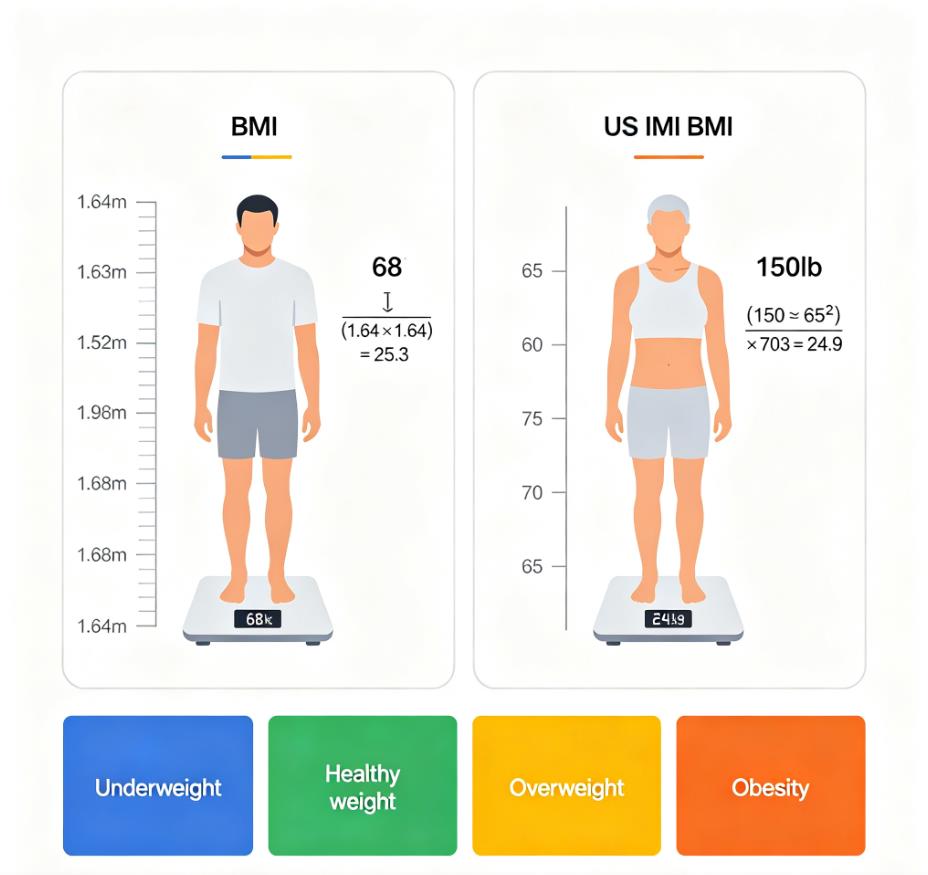
Divide kilograms by height in meters, squared. At 68 kg and 1.64 m: 68 ÷ (1.64 × 1.64) = 25.3.
Pounds, inches, and the 703 factor
Divide pounds by inches squared, then multiply by 703. The number is a unit-conversion constant — it puts lb/in² onto the kg/m² scale that WHO and CDC publish. Some older references list 704; the difference is under 0.1 point.
At 150 lb and 65 in: 65 × 65 = 4,225, then 150 ÷ 4,225 = 0.0355, then × 703 = 24.9.
Drop the 703 and you get 0.03. It's the single most common error in manual BMI math.
Reading your number against the categories
WHO and CDC both use the same four categories for adults aged 20 and older, regardless of sex or race. What changes is the interpretation, not the cutoff.
| BMI | Category |
|---|---|
| Below 18.5 | Underweight |
| 18.5 to under 25 | Healthy weight |
| 25 to under 30 | Overweight |
| 30 and above | Obesity |
The three errors that cost people the most points
These slip-ups show up time and again from people trying manual BMI math at home.
Centimeters used as meters. Type 164 instead of 1.64 and the result is roughly 10,000× too small.
Mixed systems. Kilograms with inches, or pounds with meters, returns nonsense.
BMI mistaken for body fat. A 5'6" lifter and a desk worker at the same size both read 22.6 — different bodies, identical number.
Pair your result with a body fat calculator and a waist measurement.
Turning one result into a habit
A single reading says little; the trend over weeks is what matters. Re-check every 4–6 weeks on the same scale, same morning conditions. Hand math teaches you the formula; a calculate BMI tool is for when you want the answer fast.
The cutoffs drift for people over 65, of Asian descent, pregnant, or carrying unusual muscle. BMI is a screening number, not a diagnosis — discuss it with your provider before changing how you eat or train.
Frequently Asked Questions
Is the formula different for men and women?
No. A 5'6" man and woman at 140 lb both get 22.6. Sex changes the interpretation, never the arithmetic.
Where does 703 come from?
It is a unit-conversion constant that shifts lb/in² onto the kg/m² metric scale. A few older texts use 704 with negligible effect.
Does BMI work the same for everyone?
No. It works from a pure math standpoint, but interpretation shifts widely. It can misclassify athletes, older adults, and certain ethnic groups. Waist measurements and body composition data fill in what raw BMI misses.
Does BMI work for children and teens?
Not with adult cutoffs. Under 19, assessment uses age-and-sex CDC growth percentiles instead.
How often should I recalculate?
Every 4–6 weeks for weight-management tracking. Weekly weigh-ins are fine; run the full math monthly.
Does rounding early mess up the result?
Yes. Rounding 1.68 m to 1.7 m before squaring shifts the answer by about half a point. Keep decimals to the end.
Sources
This article is for informational and educational purposes only. It does not constitute medical advice, diagnosis, or treatment. Always consult a qualified healthcare provider regarding your individual health and weight goals. Individual results will vary. The BMI Calculator Blog Team maintains editorial independence and does not sell health products.