A 5'4" woman at about 157 pounds lands on BMI 27.0. The chart tags that "overweight" — but for women in their 50s, that tag is doing too much work. Research on older women shows a BMI between 25 and 27 often sits at the lowest mortality risk. At 27, you're near the top of that protective band. What matters more is where you carry your weight — and how much muscle you've kept.
Where Does BMI 27 Land for a Woman Over 50?
BMI 27 sits in the middle of the 25.0–29.9 range that the CDC classifies as overweight. On the standard chart, that reads as "overweight" — full stop.
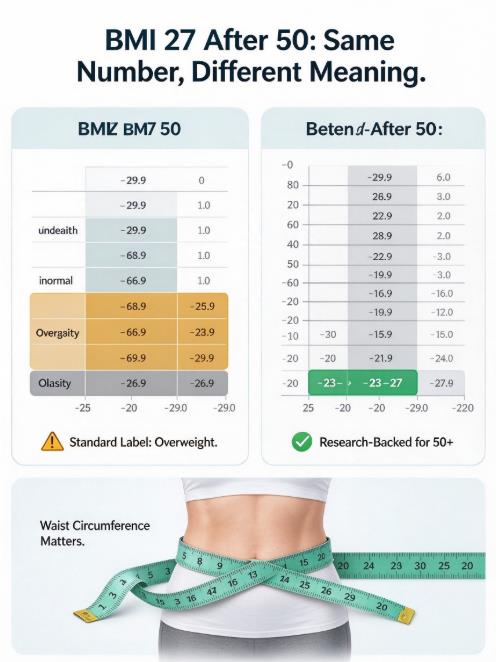
But that chart wasn't built for women in their 50s and 60s. Several large studies show a U-shaped relationship between BMI and mortality in older women. Both very low and very high BMIs carry higher risk, while the middle band appears protective. A meta-analysis of older adults found the lowest all-cause mortality at BMI 23–27 — higher than the standard "healthy" cutoff for younger adults.
A label on a chart will not tell your full story. What matters is what makes up that number.
The Waist Number That Changes Everything
BMI can't distinguish muscle from fat or show where fat is stored. For women over 50, that blind spot grows wider. Menopause shifts fat storage away from the hips and thighs, moving it toward the abdomen. That deep visceral fat is metabolically active and linked to higher risk of type 2 diabetes, heart disease, and chronic inflammation.
The NIH sets the risk threshold for women at 35 inches. Above that, risk climbs regardless of what BMI says. Below it — with a BMI of 27 — your weight may be coming from lean mass or a naturally larger frame, not harmful visceral fat.
One thing worth knowing: tape readings can vary by an inch depending on time of day. Morning vs. evening can swing it. That's normal — just measure at the same point each time, morning, after using the bathroom, before eating. Many women we hear from only track scale weight and never check their waist. That single omission can hide the most important change happening in their body.
What the Research Actually Shows
Some analyses place the mortality uptick threshold for women around BMI 27–28. At 27, you're right at that boundary — not past it.
Other research points in a more protective direction. The same meta-analysis of older adults found the lowest all-cause mortality at BMI 23–27, and the authors concluded the standard "overweight" label from 25–29.9 shouldn't apply to older adults because that range was linked to the lowest death rates.
Muscle loss sits behind a lot of this. Women over 50 lose roughly 3% of lean mass per decade, per NIDDK data. That shift pushes BMI higher without any weight gain — and it's why two women at BMI 27 can have very different metabolic profiles.
How to Assess Your Own BMI 27
One BMI figure alone tells very little about your real health. Work through these practical checks to build the bigger view.
Measure your waist circumference. Under 35 inches, you're likely in a lower-risk zone. Over 35 inches, that's a stronger signal than BMI alone — worth a conversation with a qualified healthcare provider.
Check your weight trend over time. Gradual gain across years is different from a sudden jump. Stability at BMI 27 is less concerning than a rapid climb from 22 to 27 in a short window.
And look at your activity level. Cardiorespiratory fitness is a powerful modifier. A fit woman at BMI 27 often has better metabolic markers than a sedentary woman at BMI 23. If you want a baseline for body composition beyond BMI, a body fat calculator gives you an estimate the scale can't.
What to Do Next
If your waist is under 35 inches, you're active, and your annual labs look normal, BMI 27 is likely not a health concern on its own. Keep doing what you're doing.
If your waist is elevated, or your energy and markers suggest something is off, the answer isn't a crash diet. Resistance training two to three times per week, adequate protein, and a modest calorie adjustment — not starvation — is the evidence-backed path. Run your numbers through an online BMI calculator for a baseline, then re-check your waist quarterly at the same time of morning. Two data points beat one.
Frequently Asked Questions
Is BMI 27 unhealthy for a woman over 50?
Not necessarily. Some analyses place the mortality uptick threshold for women around BMI 27–28 — you're right at the boundary, not past it. A meta-analysis of older adults found the lowest mortality at BMI 23–27, and noted that falling below BMI 23 carried 12–19% higher mortality versus the 23–24 reference band. That's why 27 reads very differently once age is in the frame.
What waist size is risky for a woman over 50?
The NIH threshold for women is 35 inches. A waist above that signals elevated visceral fat, which carries higher metabolic risk regardless of BMI.
Does menopause change how BMI should be interpreted?
Yes. Menopause shifts fat toward the abdomen, so two women with the same BMI can have very different risk profiles depending on where the fat sits:
Before menopause: fat tends to sit on hips and thighs (lower metabolic risk)
After menopause: fat moves toward the abdomen, raising visceral fat and metabolic risk
What to track: waist circumference becomes a stronger signal than BMI after 50
Should I lose weight at BMI 27 and over 50?
Not based on BMI alone. If your waist is under 35 inches and your markers look normal, there's no BMI-driven reason to lose weight. If your waist is elevated, that's a different conversation — one worth having with a qualified healthcare provider.
Is BMI 27 dangerous after 65?
Research suggests a BMI of 23–27 may be protective for older adults. At 27, you're at the upper end of that range. The focus shifts toward preserving muscle and mobility rather than hitting a lower number.
Sources
This article is for informational and educational purposes only. It does not replace professional medical advice. Consider discussing your results with a qualified healthcare provider. The BMI Calculator Blog Team maintains editorial independence.