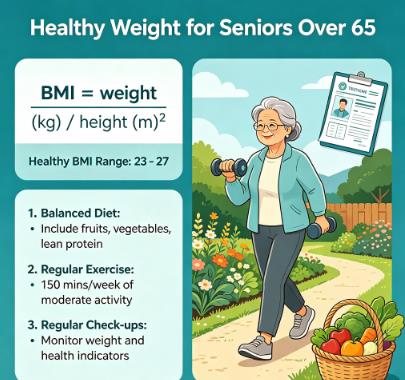
After working with hundreds of seniors over the past 15 years, I can tell you the worst advice you can give an older adult is to “lose weight to be healthy.” For most people over 65, a few extra pounds are actually protective. This guide separates the myths from what geriatric research actually shows — and gives you a simple, doable plan to stay strong and independent.

At a Glance: Healthy weight for seniors over 65 isn’t the standard BMI range of 18.5–24.9. While the CDC maintains uniform adult BMI categories, leading geriatric research and clinical data point to a BMI of 23–28 as the true “sweet spot” for adults over 65. This slightly higher range accounts for age-related muscle loss, height shrinkage, and the protective role of modest energy reserves during illness or recovery. You’ll find clear at-home measurement steps, nutrition and movement strategies that preserve independence, and warning signs that warrant a call to your healthcare provider.


Editorial development: BMI Calculator Blog Team. Content aligned with National Institute on Aging healthy weight recommendations, Academy of Nutrition and Dietetics geriatric nutrition position papers, and peer-reviewed research on BMI and mortality in older adults.


healthy weight for seniors over 65 - cdc recommended bmi range and wellness tips

Rethinking the Numbers: What Healthy Weight Means After 65

If you’ve ever looked at a standard BMI chart and felt anxious about an aging parent’s weight — or your own — you’ve probably been asking the wrong question. For anyone over 65, the weight rulebook gets rewritten. Sarcopenia — the gradual loss of muscle mass — steals about 1–2% of muscle each year after 65. Meanwhile, spinal compression and bone density changes can shrink height by 1 to 3 inches (2.5–7.6 cm) by age 80. Plugging an older adult’s weight into a one-size-fits-all formula using a remembered height from their forties delivers a number that’s often misleadingly high.

So what’s the actual target? A 2022 meta-analysis of over 200,000 adults aged 65+ published in Healthcare (DOI: 10.3390/healthcare10102107) confirmed that the lowest all-cause mortality occurs in the BMI range of 24–30 kg/m². Clinically, many geriatricians zero in on 23–28 as the practical “sweet spot.” A BMI of 26 might be flagged as “overweight” for a 35-year-old, but for a 78-year-old, it could be exactly where they need to be — in fact, it’s often healthier than being at 22.

Note: For Asian older adults, a slightly lower healthy BMI range of 22–26 is often recommended, while Black older adults may have a marginally higher optimal range due to differences in muscle mass and bone density. Individual context always matters. To see where you or a loved one falls, a senior BMI calculator built for this age group gives a far more meaningful read than a generic adult tool.

Why Being Too Lean Can Backfire After 65

For a 40-year-old, “leaner is better” holds some truth. For a 75-year-old, being too lean is a genuine liability. Modest extra weight acts as a metabolic safety net. When a senior faces pneumonia, a surgery, or simply loses appetite for a few weeks, the body draws on stored energy. Seniors who start underweight have no cushion — they can spiral into rapid muscle wasting, weakness, and loss of independence.

I once worked with an 82-year-old woman who tripped over a garden hose. Because she had a little extra padding around her hips, she walked away with just a bruise. A frail, underweight person might not have been so lucky. Fat tissue provides real cushioning — and hip fractures in seniors are often linked to the absence of that protective padding during a fall. The National Institute on Aging underscores that unintentional weight loss after 65 is a red flag, not a victory.

The BMI Ranges That Actually Matter for Seniors

Instead of the standard adult brackets, here’s how geriatric medicine thinks about weight categories in real life:

  • Below 23 — underweight territory: Linked to malnutrition, muscle wasting, weakened immunity, and higher mortality. This is the range that worries geriatricians the most — being underweight after 65 is statistically riskier than carrying extra pounds.

  • 23–28 — healthy weight for seniors: Enough nutritional reserve to weather an illness or surgery without dangerous weight loss, but not so much that joints and metabolism are strained.

  • 28–30 — borderline: Not automatically unhealthy, but worth monitoring. If mobility is good and metabolic markers are normal, this range may be just fine. If it’s creeping up year after year, small course corrections help.

  • Above 30 — obese: Associated with increased risk of type 2 diabetes, cardiovascular strain, and joint deterioration. Any weight management here must preserve muscle — crash dieting is off the table.

To make this tangible: a 75-year-old woman at 5'4" (162.5 cm) generally has a healthy weight span of roughly 130–155 lbs (59–70 kg). An 80-year-old man at 5'8" (172.7 cm) falls into a range of about 145–175 lbs (66–79 kg). These aren’t rigid rules — they’re starting points that leave plenty of room for personal health history and body type.

How to Check Weight Health at Home — Without Fancy Tools

You don’t need a doctor’s appointment to get a reliable baseline. Here’s a straightforward, four-step process anyone can follow. Yes, it’s a bit annoying to measure yourself — you might need a helper to hold the book steady — but doing this once a year is vital because the scale can lie if your height has changed.

  1. Measure current height — not the height on your driver’s license. Stand barefoot against a flat wall, heels together, head level. Place a hardcover book on top of your head and mark the wall. Measure from floor to mark. Repeat annually — height loss is sneaky and gradual.

  2. Weigh yourself at the same time, under the same conditions. Monday morning, after using the bathroom, before eating or drinking. A digital scale on a hard floor gives the most consistent readings.

  3. Use an age-adjusted calculator. A standard BMI calculator won’t factor in sarcopenia or height loss. For deeper context on what the numbers really mean for older adults, our guide on BMI for seniors and elderly adults breaks down all the nuances.

  4. Track trends, not single snapshots. One reading is just data. A pattern over 6–12 months tells the real story. Watch for unintentional weight loss or gain exceeding 5% of body weight in six months — that’s the threshold most geriatric research flags as clinically significant.

Waist Size: The Second Number That Matters Just as Much

BMI alone misses something critical: where the fat lives. Abdominal fat — the kind that accumulates around the midsection — is metabolically active and linked to inflammation, insulin resistance, and cardiovascular disease, even in seniors whose BMI looks fine.

  • Waist circumference above 35 inches (88 cm) for women → elevated risk.

  • Waist circumference above 40 inches (102 cm) for men → elevated risk.

Measuring is simple: wrap a flexible tape around the waist at navel level after a normal exhale. Snug, but not compressing. If waist size inches up year after year while weight stays flat, that signals muscle loss and fat gain — exactly what we want to catch early.

Nutrition That Preserves Muscle and Energy — Without Dieting

Weight management after 65 isn’t about eating less. It’s about eating smarter. The goal is nutrient density — packing more vitamins, minerals, and especially protein into each calorie, since seniors often eat smaller portions naturally.

Protein is priority one: Aim for 1.2–1.5 grams of protein per kilogram of body weight daily. For a 150 lb (68 kg) person, that’s 82–102 grams. In my practice, I’ve found that many seniors struggle to eat enough protein at breakfast. A simple fix? Add a scoop of protein powder to oatmeal or a morning smoothie — it’s easy to swallow and adds 20–25 grams without feeling heavy. Think eggs, Greek yogurt, cottage cheese, fish, lentils, or even a glass of milk with dinner. Suddenly, hitting your protein target becomes a lot easier.

Don’t fear fats or flavor: Avocado, olive oil, nuts, seeds, and fatty fish like salmon support heart health and help absorb fat-soluble vitamins. If food tastes bland — common with age-related taste changes — herbs, spices, and citrus juice add flavor without sodium overload. Pro tip: Keep a bag of unsalted nuts by your favorite chair. A handful a day adds healthy fats and calories without requiring a full meal.

Hydration often gets overlooked: Thirst sensation diminishes with age. Aim for 8 cups (2 liters) of fluid daily — water, herbal tea, soups, and water-rich foods like cucumber and melon all count. Dehydration can mimic hunger and fatigue, sometimes leading seniors to skip meals when they really just need fluids.

Movement That Maintains Independence — Not Gym Heroics

Exercise after 65 serves one purpose above all: preserving the muscle and bone density needed for daily life. Walking to the mailbox, rising from a chair without using hands, carrying groceries — these tasks depend on strength that quietly fades without maintenance.

A sustainable weekly target looks like this:

  • 30 minutes of light activity daily. Walking, gardening, swimming, chair exercises, or gentle stretching. The 30 minutes can be split into two 15-minute segments or three 10-minute chunks — whatever fits the day.

  • Strength training twice a week. Bodyweight squats, wall push-ups, seated leg lifts, or light resistance bands. No gym required. The goal is maintaining muscle — consistency matters infinitely more than intensity.

  • Balance work. Standing on one foot while holding a counter, heel-to-toe walking, or gentle chair yoga. Falls are the leading cause of injury-related death in seniors — balance training can reduce fall risk by 30–40%.

Robert’s Story: From Fatigue to Walking the Block Again

Take 78-year-old Robert, who came to me with a BMI of 22 and constant fatigue. He’d been told his weight was “normal,” but he barely had the energy to walk to his mailbox. We adjusted his diet to add just 20 extra grams of protein daily — mostly through Greek yogurt, milk, and a protein-fortified oatmeal — and started a simple chair exercise routine three days a week. Three months later, his BMI had inched up to 24. More importantly, he had more energy, his appetite improved, and he was walking around the block without stopping. No extreme measures, just consistent, age-appropriate support. He told me, “I didn’t realize how weak I’d gotten until I felt strong again.”

Warning Signs: When a Weight Change Is More Than “Just Age”

Not all weight shifts are harmless. These signs mean it’s time to call a healthcare provider:

  • Unintentional weight loss of more than 5% in 6 months (roughly 7 lbs or 3.2 kg for a 140 lb person). This can signal underlying conditions, medication side effects, depression, or malnutrition.

  • Persistent loss of appetite or early fullness after small meals. Dental problems, digestive changes, or loneliness at mealtimes can contribute.

  • Difficulty swallowing, which raises choking risk and often leads seniors to avoid certain foods.

  • Unexplained fatigue that doesn’t improve with rest — possibly linked to anemia, thyroid issues, or insufficient protein intake.

A provider may also recommend body composition analysis to separate muscle from fat — something BMI can’t do. For a broader understanding of how height and weight change normally with age, it helps to see what’s typical versus what needs attention.


Clinical Context: The National Institute on Aging emphasizes that unintentional weight loss — even in seniors with a BMI above 30 — carries greater health risk than stable weight. A 2022 meta-analysis in Healthcare (DOI: 10.3390/healthcare10102107) confirmed the lowest mortality in adults 65+ occurs in the BMI 24–30 range. The Academy of Nutrition and Dietetics recommends 1.2–1.5 g/kg daily protein for seniors to counter sarcopenia, paired with regular physical activity. Always coordinate weight management with a healthcare provider, especially when underlying conditions are present. Last Reviewed: May 2026.


Your 5-Point Action Checklist

  1. Measure current height and weight today. Use a helper if needed. Write the numbers down — you’ll thank yourself next year.

  2. Check your BMI against the 23–28 senior target. Below 23 or above 30? Make a note to discuss at your next checkup. Between 23–28? You’re likely right where you need to be.

  3. Track unintentional changes. If the scale moves more than 5% in 6 months without trying, pick up the phone. That’s a conversation worth having.

  4. Add one protein-rich food to your daily routine. A hard-boiled egg at breakfast. Greek yogurt as a snack. Lentils in soup. One small change compounds.

  5. Move 30 minutes today. A walk around the block, chair stretches, gardening — it all counts. The best exercise is the one you’ll actually do.

Frequently Asked Questions

Is a BMI of 26 considered overweight for a 70-year-old?

Not by geriatric standards. While standard adult categories label 25–29.9 as “overweight,” a BMI of 26 falls squarely within the healthy senior range of 23–28 supported by geriatric research. Older adults in this band often have better survival rates and recovery outcomes than those below 23. Stability and muscle mass matter far more than the number on its own.

How much protein does an 80-year-old need daily?

The Academy of Nutrition and Dietetics recommends 1.2–1.5 grams per kilogram of body weight. For an 80-year-old weighing 150 lbs (68 kg), that’s 82–102 grams per day — higher than the standard 0.8 g/kg for younger adults. Three ounces of chicken (26 g), one cup of Greek yogurt (20 g), two eggs (12 g), a cup of lentils (18 g), and a glass of milk (8 g) together nearly hit the target. Spreading intake across three meals is ideal.

Why do seniors lose height, and does it affect BMI accuracy?

Spinal disc compression and osteoporosis can reduce height by 1–3 inches (2.5–7.6 cm) by age 80. Using a remembered height from decades ago inflates BMI by 2–3 points. Always use current measured height — not self-reported height — to get an accurate BMI.

Should a 75-year-old try to lose weight?

It depends entirely on the starting point and the reason. If BMI is above 30 and mobility or metabolic health is affected, gradual, supervised weight loss focused on fat reduction — not muscle loss — may help. But if BMI is 26 and the person feels strong, eats well, and moves freely, intentional weight loss is usually unnecessary and could reduce protective reserves. After 65, never diet without a specific medical reason.

What’s more important for seniors: BMI or waist size?

Both matter, but they measure different risks. BMI reflects overall weight relative to height. Waist circumference captures abdominal fat, which independently raises the risk of heart disease, diabetes, and metabolic syndrome — even when BMI is normal. For seniors, waist measurements above 35 inches (88 cm) for women or 40 inches (102 cm) for men warrant attention regardless of BMI.

Can being underweight really be worse than being overweight after 65?

Yes. Multiple large studies — including data reviewed by the National Institute on Aging — show that seniors with a BMI below 23 face higher mortality than those in the 25–28 range. Low body weight is associated with reduced muscle mass, weakened immunity, slower wound healing, and higher complication rates after illness or surgery. A few extra pounds can be the buffer that keeps a senior recovering at home rather than in extended care.


Sources


BMI Calculator Blog Editorial Team. Factual basis: National Institute on Aging healthy weight recommendations, Academy of Nutrition and Dietetics geriatric nutrition position papers, and peer-reviewed research on BMI and mortality in adults 65+. Clinical insights drawn from 15 years of practical coaching experience with older adults.


BMI Calculator Blog. This content is provided for educational and informational purposes only. Medical Disclaimer: The content of this article is for informational purposes only and does not replace professional medical advice, diagnosis, or treatment. Always seek the advice of a qualified physician or other health experts with any questions regarding medical conditions or health goals. Weight and nutrition recommendations should be discussed with a healthcare provider, especially for individuals over 65 or those with underlying health conditions.