Quick summary: A height and weight chart for girls shows where your child lands compared to healthy peers of the same age and sex—using percentiles, not pass/fail grades. Track the curve, not a single number.
Let’s be real: growth charts look intimidating. All those squiggly lines, percentiles, and age columns. But here’s the truth—they’re just reference maps. Nothing more.
A height and weight chart for girls simply takes measurements from thousands of healthy girls and plots them into percentile curves. The 50th percentile? That’s the exact middle. Half of girls are taller/heavier, half are shorter/lighter. The 5th percentile means 95% of girls her age are larger. The 95th means she’s larger than 95% of peers. All are normal.
Want a quick reality check? Use our CDC‑compliant BMI percentile calculator for children—it combines height, weight, age, and sex automatically.
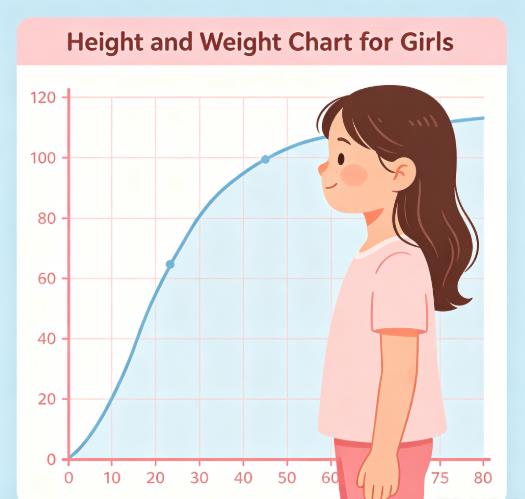
Average Height & Weight by Age (Girls 0–20)
I’ve included these numbers because parents always ask, but please don’t compare your child to them too closely. Think of them as a rough map, not a ruler.
Birth: 19.4 in (49.2 cm), 7.3 lb (3.31 kg)
6 months: 25.9 in (65.7 cm), 16.6 lb (7.53 kg)
12 months: 29.2 in (74.1 cm), 20.4 lb (9.25 kg)
2 years: 33.7 in (85.5 cm), 26.5 lb (12.02 kg)
4 years: 39.5 in (100.3 cm), 34.0 lb (15.42 kg)
6 years: 45.5 in (115.5 cm), 44.0 lb (19.96 kg)
8 years: 50.5 in (128.2 cm), 57.0 lb (25.85 kg)
10 years: 54.5 in (138.4 cm), 70.5 lb (31.98 kg)
12 years: 59.0 in (149.8 cm), 91.5 lb (41.5 kg)
14 years: ~63 in (160 cm), 105 lb (47.6 kg)
16–20 years: ~64 in (162.5 cm), 118–126 lb (53.5–57.2 kg)
Data adapted from WHO Child Growth Standards (2023) and CDC Clinical Growth Charts (2024).
How to Read Percentiles (The Right Way)
Here’s the thing most parents miss: one measurement is just a snapshot. What really matters is the curve over time.
Think of a growth chart like a highway. The 50th percentile is the main road, but many perfectly healthy girls ride on the 25th or 75th percentile scenic routes. The problem isn’t which road they’re on—it’s if they suddenly swerve onto a different road without a ramp.
What to watch for: steady growth along roughly the same percentile channel. A girl at the 40th percentile at age 2 and still near 40th at age 8? That’s perfect. A sudden drop from 60th to 20th, or a jump from 30th to 80th, is worth a closer look.
In my years of working with families, I’ve seen countless parents panic over a single number. One mom was distraught because her 8‑year‑old was at the 22nd percentile. But looking back, she had been steadily at the 20th percentile since birth. That’s not a problem—that’s her normal. The story is in the trend, not the snapshot.
For a deeper dive into what’s proportionate, check our guide on healthy weight ranges for girls by age and height.
When Might You Want Extra Input?
Being below 5th or above 95th percentile does not automatically mean anything is wrong. Some kids are just naturally smaller or larger. But there are a few patterns that are worth discussing with a child health professional:
Weight‑for‑height consistently under the 2nd percentile
BMI‑for‑age above the 95th percentile for several visits
Crossing more than two major percentile lines (e.g., from 40th to 90th or 60th to 20th) within 6–12 months
No height gain for 3–4 months in a child under 2, or no growth at all for a full year in an older child
These are just observation points—not diagnoses. Always trust a professional’s full evaluation.
Frequently Asked Questions (Real Questions from Real Parents)
1. Wait, so the 50th percentile is not the goal?
Exactly. Let’s bust that myth right now. The 50th percentile is just the middle. A child at the 25th percentile isn’t “behind”—she’s on a different, equally healthy curve. The only real goal is staying on her curve.
2. My daughter is 80th for height but 40th for weight. Is that weird?
Not at all. That usually means she’s naturally lean. Think of a tall, athletic frame. What matters is that her BMI percentile is stable and she’s growing consistently. A mom recently asked me this exact question—her daughter looked perfectly healthy, and after checking the BMI chart, everything was fine.
3. How often should I actually measure her?
Every 6–12 months is plenty. I once had a mom who measured her daughter every week and drove herself crazy. Don’t be that mom. Every 6 months is plenty. Kids grow in spurts, not straight lines. A measurement a month apart might bounce around—that’s normal.
4. Can these charts tell me how tall she’ll be as an adult?
Nope. Growth charts describe current status, not future height. Adult height is mostly genetics plus nutrition and puberty timing. Girls who start puberty later often keep growing for a longer time.
5. What’s the difference between WHO and CDC charts again?
Simple: WHO charts are for babies 0–2 years old, based on healthy breastfed infants in optimal conditions. CDC charts are for ages 2 and up, reflecting how U.S. kids actually grew. Most professionals switch at age 2.
For a precise BMI percentile that combines all the numbers, try our kids BMI percentile tool—it’s built specifically for children and teens.