The ideal body weight formula is a clinical dosing tool from the 1960s and 1970s — not a health target. Three equations dominate: Devine (1974), Robinson (1983), and Hamwi (1964). They disagree by 7–12 lbs for the same height. They omit muscle, frame, and age. Yet millions of people treat their output as a personal verdict. It never was one.
What the ideal body weight formula actually is
IBW is a height-based estimate developed to calculate safe drug doses for hospitalized adults. Devine’s 1974 equation was derived specifically for gentamicin dosing in adults with obesity; pharmacokinetic studies correlated the drug’s distribution with IBW, and the formula followed. The later clinical use of IBW for creatinine clearance and other renally cleared drugs kept the equation in circulation, but the original purpose never changed: dose drugs, not define health.
Hamwi’s 1964 method was a quick bedside estimate for desirable body weight, especially in people with diabetes. Robinson’s 1983 refinement derived new coefficients from Metropolitan Life Insurance height-weight tables, explicitly for drug dosage calculations — its published title says so. None of the three was built to answer “what should I weigh for long-term health.”
Here are the equations, with worked numbers for a 5′9″ man:
| Formula | Year | Men (kg) | Women (kg) | 5′9″ man | Original purpose |
|---|---|---|---|---|---|
| Hamwi | 1964 | 48.0 + 2.7 × inches over 5 ft | 45.5 + 2.2 × inches over 5 ft | ~72.3 kg (159 lb) | Quick clinical estimate |
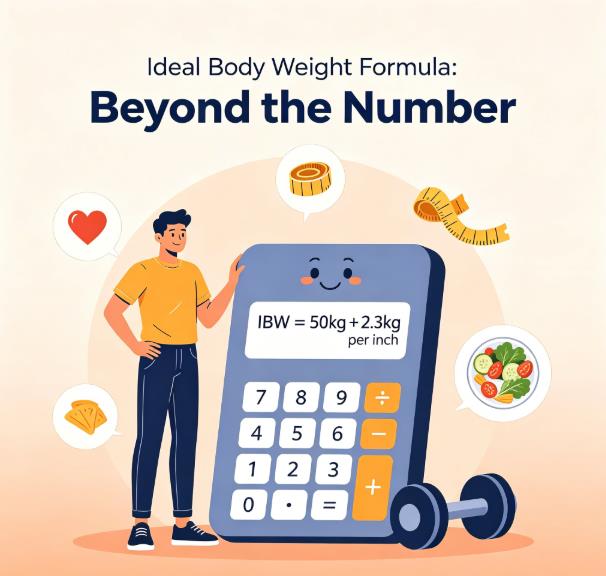
| Devine | 1974 | 50.0 + 2.3 × inches over 5 ft | 45.5 + 2.3 × inches over 5 ft | ~70.7 kg (156 lb) | Gentamicin dosing |
| Robinson | 1983 | 51.65 + 1.85 × inches over 5 ft | 48.67 + 1.65 × inches over 5 ft | ~69.1 kg (152 lb) | Drug dosage calculations |
Three formulas. Three different answers. A 7-lb spread for the same body. The disagreement is not a flaw in the math — it is a signal that the question (“what is my ideal weight?”) was never the one these equations were built to answer.
Where the formula breaks down: muscle, age, and ethnicity
The formula assumes a standard body. Real bodies diverge from that assumption in predictable, measurable ways.
Muscle mass is the first gap. A 5′9″ lifter at 190 lbs with 12% body fat reads BMI 28 — overweight by the chart — while a sedentary adult at 160 lbs with 30% body fat reads BMI 23.6 — “healthy.” The formula cannot see the difference. Waist circumference can: a 32-inch waist versus a 38-inch waist tells you more about metabolic risk than the weight itself.
Age bends the curve the other way. Winter et al’s meta-analysis of 32 prospective cohorts, covering 197,940 adults aged 65 and older, found that using BMI 23.0–23.9 as the reference, mortality risk was 12% higher at BMI 21.0–21.9 and 19% higher at BMI 20.0–20.9. Being in the 25–30 band was not associated with increased mortality in this older group. A formula that targets 156 lbs for a 5′9″ man may be steering a 75-year-old toward a weight that carries higher risk, not lower.
Ethnicity shifts the thresholds. The WHO 2004 expert consultation identified public health action points at 23.0 and 27.5 kg/m² for Asian populations, lower than the standard 25 and 30 lines, because metabolic risk appears at lower BMI values in many Asian groups. A 5′6″ Asian adult at BMI 24 reads “normal” on the global table and “increased risk” on the adjusted frame. An asian bmi calculator applies those lower lines.
What to use instead: a range, a tape, and a trend
Three measurements replace the single formula number. Each takes less than a minute.
First, your BMI band. The CDC defines healthy weight as BMI 18.5 to under 25. For a 5′9″ adult, that translates to roughly 125–168 lbs — a 43-pound window that accommodates frame, muscle, and natural variation. The band is the starting point, not a verdict. An BMI calculator places your number inside it.
Second, your waist. NHLBI draws the risk line at more than 35 inches for women and more than 40 inches for men. A 5′9″ man at 170 lbs with a 38-inch waist and a 5′9″ man at 180 lbs with a 33-inch waist are not in the same risk category, even if their BMIs are close. The tape measures where fat sits. The formula measures nothing about fat distribution.
Third, your trend. A weight that holds steady across seasons — same waist, same strength, same energy — carries more signal than a single reading. One reader wrote in after tracking for six months: her weight had moved less than three pounds, but her waist had dropped two inches. The scale said nothing had changed. The tape told a different story.
If you want the tissue-level layer, a body fat calculator adds the fat-versus-lean breakdown the formula cannot provide.
Who should ignore the formula entirely
For some groups, the IBW equation is not just imprecise — it is the wrong tool.
Strength athletes and bodybuilders: muscle mass pushes weight above the formula’s output without any elevation in health risk. Waist and body fat are the relevant screens.
Adults over 65: the mortality-optimal BMI sits higher than 18.5–24.9, and the formula does not adjust for age-related muscle loss.
Asian adults: the WHO action points at 23.0 and 27.5 mean a weight that reads “normal” on the global table may already signal elevated risk.
Pregnant and breastfeeding women: weight targets are set by obstetric guidance, not by a height-based formula.
For everyone else, the formula’s number is a historical artifact that happens to land near the middle of a healthy BMI band. It was never designed to be the target.
Frequently Asked Questions
What is the most accurate ideal body weight formula?
None is “accurate” for health. Devine is the most widely used in clinical settings, but it was built for drug dosing. Robinson and Hamwi produce different numbers for the same height. For personal health purposes, a BMI-based range cross-checked with waist circumference is more defensible than any single formula output.
Why do Devine, Robinson, and Hamwi give different numbers?
Because they were derived from different data for different purposes. Devine was built for gentamicin dosing. Robinson used Metropolitan Life Insurance tables to refine coefficients for drug dosage calculations. Hamwi was a quick clinical estimate. The coefficients differ because the underlying samples and goals differ.
Can I be healthy above my formula weight?
Yes. If your waist is under the threshold and your body fat is in the healthy range for your age and sex, a weight above the formula output may reflect muscle or a larger frame. The formula does not measure either. Compare waist and body fat before treating the formula number as a ceiling:
Waist: under 35 inches (women) / 40 inches (men).
Body fat: commonly cited healthy ranges run roughly 14–17% for men and 21–24% for women in midlife.
Trend: stable weight and waist across 6–12 months.
Is ideal body weight the same as BMI?
No. IBW gives a single target weight from a height-based equation. BMI places weight and height into a category band. BMI is a screening tool; IBW is a dosing tool. For health assessment, the band is more useful than the point.
Does the formula work for adults over 50?
Poorly. Muscle mass declines with age and body fat tends to rise, so the same weight represents a different body composition at 55 than at 25. For adults 65 and older, the mortality-optimal BMI sits higher than the standard band. Waist circumference and strength are better signals than a formula output.
Sources
CDC: Adult BMI Categories — Healthy Weight 18.5–24.9 and Screening Guidance
NHLBI: Healthy Weight and BMI — Standard Adult Categories and Waist Circumference Thresholds
This article is for informational and educational purposes only. It does not constitute medical advice or replace professional health assessment. Always consult a qualified healthcare provider regarding your individual health and weight-related goals. Individual results will vary. The BMI Calculator Blog Team maintains editorial independence and does not sell health products.
Related Articles
What Is Ideal Body Weight? Why Formulas Give Different Numbers
Normal Ideal Body Weight: Why Formulas Disagree and the Range Wins
Your Ideal Body Weight Is a Range, Not a Number: What Formulas Miss and What to Track
Last updated: October 18, 2026.