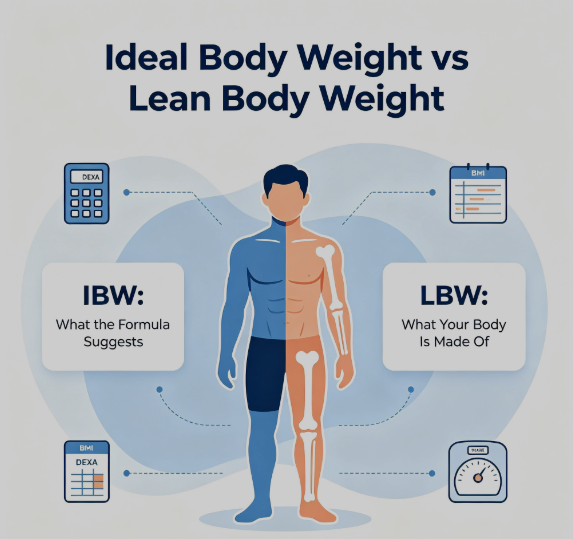
Quick summary: Ideal body weight (IBW) is a height-based number—often from the Devine or Hamwi formula—that estimates what you “should” weigh. Lean body weight (LBW) is the weight of everything in your body except fat: muscle, bones, organs, and water. IBW is a theoretical target based on height and sex; LBW is a measurable component of your actual body composition. One tells you where you might want to be; the other tells you what you're actually made of.
Ideal body weight: what it is and where it came from
Ideal body weight (IBW) is a calculated number based primarily on height and sex. The most commonly used formula is the Devine equation, developed in 1974: 50 kg + 2.3 kg for each inch over 5 feet for men, and 45.5 kg + 2.3 kg for each inch over 5 feet for women.
According to a 2000 review in Annals of Pharmacotherapy, IBW was interpreted to represent a "fat-free" weight and was used as a surrogate for lean body weight—even though the two are not the same.
Here is the critical context most guides leave out: IBW formulas were not designed to define health. The Devine formula was created for drug dosing calculations. A 2021 article in the American Journal of Health-System Pharmacy notes that Devine introduced the equations to help pharmacists make appropriate gentamicin dose modifications. Other than stating the equations were surrogates for estimates of lean body weight, there was no mention of the origin of the equations. The Hamwi formula (1964) came from life insurance tables. Neither was built around what makes a person healthy.
Other formulas exist—Robinson (1983), Miller (1983)—and they produce different numbers for the same person. For a 5'10" man, Devine gives about 73 kg (160 lbs), while Hamwi gives about 78 kg (172 lbs). This spread alone should tell you something: IBW is not a precise biological truth.
Lean body weight: your actual non-fat mass
Lean body weight (LBW) is the mass of everything in your body except fat: muscle, bones, organs, ligaments, tendons, and water. It is sometimes used interchangeably with "fat-free mass" (FFM). A 2024 critical review in Advances in Nutrition concluded that LBM as originally proposed by Behnke has the same chemical composition as FFM, thus answering a longstanding ambiguity in the body composition literature.
LBW is calculated differently from IBW. The James equation, published in 1985 in the Proceedings of the Nutrition Society, is one common method: for men, 1.1 × total body weight − 128 × (total body weight / height)²; for women, 1.07 × total body weight − 148 × (total body weight / height)².
The James equation is a population-level estimating formula with a typical error range of ±5–8%. It is most reliable for non-athletic adults aged 18–65. For precise measurements, DEXA scans are the gold standard. It is not suitable for pregnant people, competitive athletes, or adults over 65 — groups outlined in more detail below.
Unlike IBW, LBW is not a target—it is a measurement of what you actually carry. For a non-obese adult, lean body weight is roughly 80% of total body weight for men and 75% for women, based on research by Gallagher and colleagues in the American Journal of Clinical Nutrition. This proportion shifts with age, activity level, and body composition changes.
LBW accounts for body composition in ways IBW cannot. Two people of the same height and weight can have very different LBW—one with more muscle, one with more fat. IBW does not see this difference. LBW does.
IBW vs LBW: a real-life comparison
Consider two women who are both 5'6" and weigh 140 lbs. One is a recreational runner with 25% body fat. The other is sedentary with 35% body fat. Their IBW is identical—Devine gives about 57 kg (125 lbs) for both. Their LBW differs by over 10 lbs: the runner carries more muscle and bone; the sedentary woman carries more fat. Same IBW. Different bodies. This is why LBW matters more than IBW for actual health.
IBW and LBW formulas at a glance
The table below compares ideal body weight formulas and estimated lean body weight at common heights for men and women. All values are approximate and for educational reference only, not clinical use. Note that LBW depends on total body weight and body fat percentage, so these are illustrative estimates.
LBW percentages shown are based on the specific total weights used in each example (140 lbs for the 5'5" woman, 180 lbs for the 5'10" man). Your actual percentage will depend on your total weight and body fat composition. The population averages cited in the text (75–80%) reflect adults with a BMI near the upper end of the normal range.
| Height | Devine IBW | Hamwi IBW | Robinson IBW | Miller IBW | Estimated LBW (James) | LBW % of Total Weight |
|---|---|---|---|---|---|---|
| 5'5" (woman) | ~57 kg (125 lbs) | ~61 kg (134 lbs) | ~59 kg (130 lbs) | ~60 kg (132 lbs) | ~45–47 kg (99–104 lbs) | ~71–74% |
| 5'10" (man) | ~73 kg (160 lbs) | ~78 kg (172 lbs) | ~75 kg (165 lbs) | ~77 kg (170 lbs) | ~60–62 kg (132–137 lbs) | ~73–76% |
The key difference in plain terms
Ideal body weight answers the question: “What should I weigh based on my height?” It is a population-level estimate, not a personalized health verdict. It gives you a single number to aim for, but it ignores your frame, your muscle mass, and your actual body composition.
Lean body weight answers a different question: “What is my body made of?” It is a measurable fact about your current composition. It tells you how much of your weight is non-fat tissue—muscle, bone, organs—and how much is fat.
Use IBW as a rough reference point. Use LBW to understand your actual body composition. One is a guess. The other is a measurement.
Practical applications: when to use which
IBW is still used in clinical settings for dosing medications that distribute mainly in lean tissue, such as certain antibiotics and anesthetics. LBW is often used for nutritional assessment and for adjusting medication doses in patients with obesity.
These dosing references are for clinical professional use only. Do not use IBW or LBW formulas to adjust your own medication dosages. Always follow your healthcare provider's instructions.
For your own health monitoring, LBW trends over time—not a single IBW target—are more meaningful. Tracking your body fat percentage and lean mass gives you a clearer picture of whether you are gaining muscle, losing fat, or both. For most people, tracking LBW every 3–6 months is sufficient to see meaningful trends without daily noise.
Pair these metrics with waist circumference. Per NIH guidelines, a waist measurement over 35 inches for women or over 40 inches for men signals elevated metabolic risk, regardless of weight.
Check your BMI with an online BMI calculator to see where you stand. Then pair it with a body fat calculator to estimate your body fat percentage and, by extension, your lean mass. A healthy weight range tool gives you a broader picture than any single formula.
Limitations: who these formulas don't fit
These standard formulas may not apply equally to all groups.
Asian adults
Asian adults face elevated metabolic risks at lower body weights per WHO guidelines. Overweight begins at BMI 23 for this population, not 25.
African American adults
Research based on U.S. CDC NHANES population data suggests that African American adults tend to have higher lean muscle mass at the same weight compared to white adults, meaning standard formulas may slightly overestimate body fat for this group.
Pacific Islander adults
Pacific Islander populations may also have different body composition thresholds, with higher lean mass and different fat distribution patterns compared to other ethnic groups.
Adults over 65
For adults over 65, slightly higher body weight is often linked to lower mortality and frailty risk. Per NIH and ACSM clinical guidelines, adults over 65 may have the lowest mortality risk at a BMI of 21–27, slightly higher than the standard adult range. Standard IBW formulas may set an overly low target for older adults.
Other groups
These formulas also do not apply to pregnant women, competitive athletes, or individuals with chronic conditions such as thyroid disorders or diabetes. Additionally, these formulas do not apply to people with amputations, wheelchair users, or individuals taking corticosteroids or antipsychotic medications that significantly alter body composition.
Do not use IBW or LBW formulas to set extreme weight loss or gain goals on your own. Always work with a healthcare provider or registered dietitian for personalized guidance.
Many consumer smart scales sold in the U.S. include a lean mass estimate using bioelectrical impedance, which works well for tracking trends over time. Note that consumer BIA scales have a typical error range of ±3–5% and are most reliable for tracking trends over time, not for single absolute readings. For clinical accuracy, DEXA (dual-energy X-ray absorptiometry) is the gold standard and is available at many clinics and fitness centers across the U.S. DEXA provides a detailed breakdown of your body composition, including lean mass, fat mass, and bone density. In the U.S., DEXA scans are widely available at imaging centers, hospitals, and many boutique fitness studios, with costs typically ranging from $150 to $300 without insurance. Many insurance plans cover DEXA scans when ordered by a physician for medical reasons. Your healthcare provider can help determine if a DEXA scan is medically indicated for your situation.
References & Sources
Pai MP, Paloucek FP. The origin of the "ideal" body weight equations. Ann Pharmacother. 2000
Erstad BL. Predicted body weight: A rose by any other name. Am J Health-Syst Pharm. 2021
PMC: Formulae for calculating fat-free body mass and ideal body weight (free full text available)
Frequently Asked Questions About Ideal Body Weight vs Lean Body Weight
What is the difference between ideal body weight and lean body weight?
Ideal body weight is a calculated number based on height and sex, originally developed for drug dosing. Lean body weight is the actual mass of everything in your body except fat—muscle, bones, organs, and water. IBW is a target; LBW is a measurement.
Which is more important for health, ideal body weight or lean body weight?
Lean body weight is generally more informative for health because it reflects actual body composition. Two people with the same IBW can have very different health profiles depending on their lean mass versus fat mass. IBW is a rough guide; LBW tells you what you are actually made of.
What is the Devine formula for ideal body weight?
For men: 50 kg + 2.3 kg for each inch over 5 feet. For women: 45.5 kg + 2.3 kg for each inch over 5 feet. It was developed in 1974 for drug dosing, not for defining health.
How is lean body weight calculated?
One common method is the James equation. For men: 1.1 × total body weight − 128 × (total body weight / height)². For women: 1.07 × total body weight − 148 × (total body weight / height)². It requires total body weight and height.
Is lean body mass the same as muscle mass?
No. Lean body mass includes muscles, bones, organs, ligaments, tendons, and water. Muscle mass is just one component of lean body mass. They are not interchangeable terms.
Why do different ideal body weight formulas give different numbers?
Different formulas were developed from different data sets and time periods. Hamwi came from insurance tables; Devine came from drug dosing research; Robinson and Miller were refinements. They all produce slightly different results for the same person.
Can I estimate my lean body weight at home?
Yes. You can use a bioelectrical impedance (BIA) scale at home for an estimate. For clinical accuracy, DEXA is the gold standard and is available at many clinics and fitness centers across the U.S. DEXA provides a detailed breakdown of your body composition, including lean mass, fat mass, and bone density.
Should I aim for my ideal body weight or focus on lean body mass?
Focus on lean body mass and body composition rather than chasing a specific IBW number. Preserving or building muscle while maintaining a healthy fat level is more important for long-term health than hitting a weight calculated from a 1970s formula.
How can I increase my lean body weight?
Resistance training and adequate protein intake are the most evidence-backed methods. Per the Academy of Nutrition and Dietetics and ACSM guidelines, aim for at least 1.2–1.6 g of protein per kg of body weight daily, combined with progressive strength training 2–3 times per week. Good sources include lean meats, fish, eggs, Greek yogurt, legumes, and tofu. Consult a registered dietitian for personalized recommendations.
Related Articles
What Is My Ideal Body Weight? A Complete Guide to Finding Your Healthy Range
Your Ideal Body Weight: A Realistic Guide to Finding Your Healthy Range
BMI vs Ideal Body Weight: Key Differences, Limits, and Which One to Trust for Your Health
BMI Calculator Blog. This content is provided for educational and informational purposes only. We encourage sharing with proper attribution to our site. Unauthorized commercial use is prohibited. Medical Disclaimer: This content does not replace professional medical advice, diagnosis, or treatment. Always seek the advice of a qualified physician or other licensed health provider with any questions regarding your body composition, weight status, or health goals.