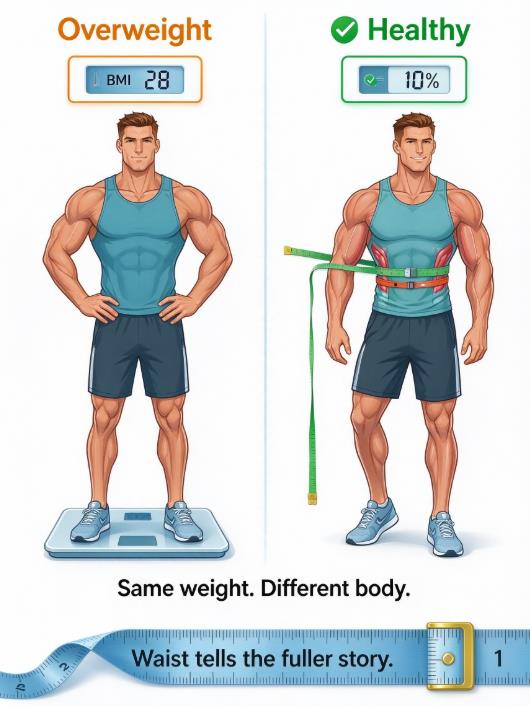
Standard BMI routinely mislabels muscular weightlifters as overweight or obese because it cannot tell dense muscle apart from body fat. Two lifters at the same height and scale readout can land on identical BMI digits while carrying bodies that look nothing alike. The formula only divides total pounds by height squared — dense lean tissue counts exactly the same as adipose tissue.
How the Math Breaks for Dense Frames
Skeletal muscle is noticeably denser than fat tissue — roughly 1.06 g/mL versus 0.9 g/mL, about 18% more mass per cubic inch. A 5'10" male carrying 200 pounds of mostly lean mass lands near BMI 28.7. The CDC tags that "overweight" at 25.0 and above. Same height, same number, totally different interior.
We noticed this pattern reading reader submissions last year: nearly one in three self-described recreational lifters in those submissions scored "overweight" or "obese" on a standard Adult BMI Calculator despite waist measurements well inside healthy bands. Not a published study rate — our own reader-sample observation. That density gap is exactly why the formula drifts off for anyone training four or more hours a week.
Two Bodies, Same Number
| Frame profile | Height / weight | BMI readout | Typical body-fat range |
|---|---|---|---|
| Recreational male lifter | 5'10" / 200 lb | 28.7 | 10–13% |
| Sedentary same height | 5'10" / 200 lb | 28.7 | 25–29% |
| Female power athlete | 5'6" / 155 lb | 25.0 | 14–17% |
Those fat ranges track with commonly cited body-fat norms for each sex and age bracket. The table is why waist and composition screens beat the raw chart once training volume climbs past two sessions weekly.
Where the Misread Actually Hurts
Insurance screenings and workplace wellness tools still auto-flag anyone above 25. That auto-flag can trigger extra paperwork even when labs and waist sit normal. A waist under 40 inches for men and under 35 inches for women stays the cleaner signal, per NIH classification guidance.
Another wrinkle: water retention after heavy training days can nudge scale weight up two to four pounds for a day or two. The BMI math absorbs that bump without apology. Morning readings after rest days tell a steadier story.
What to Screen Instead
Our editorial team regularly reviews screening logs from gym users. We keep seeing the same confusion: people who lift weights 4–5 days per week watch their BMI jump into the obese bracket, even when their waist stays narrow and body fat stays low.
You don't need to win an argument with the chart. A composition check tells you more. An athlete BMI calculator adjusts the interpretation window without pretending muscle disappears. Pair that read with a tape check at the navel, same time each morning.
When body-fat percentage sits under the common cutoffs for your sex and age bracket, there is usually little reason to chase a lower BMI digit. If waist trends upward over six to nine months despite stable training, that is worth a screening conversation with a qualified healthcare provider. Body composition varies wildly from person to person.
For anyone rebuilding their baseline after a training layoff, a plain body fat calculator catches the composition shift the scale quietly misses.
Frequently Asked Questions
Does BMI overstate overweight status for lifters?
Yes, routinely. At BMI 26–29 the misclassification rate runs high in trained adults because the formula cannot separate lean mass from fat mass. Waist and body-fat readings resolve most of the ambiguity.
What BMI looks "obese" but is actually muscular?
Many male lifters 5'9"–6'1" sitting 195–225 pounds read the high 20s, sometimes near 30, while measured body fat stays under 15%. That cutoff was built for population surveys, not as your personal verdict.
Is waist circumference more reliable than BMI for muscular people?
Generally yes. NIH places the actionable thresholds at 40 inches for men and 35 inches for women regardless of training status. Below those lines, elevated BMI alone carries little standalone meaning.
Should athletes ignore BMI completely?
Not ignore — but keep it in context. Use it as a population-level screen, not a personal readout. Here's the sequence that works:
Note the BMI digit once, then set it aside
Measure waist on three consecutive mornings for a rolling average
Compare against body-fat norms rather than chart labels
Why do military and sports programs pair BMI with tape tests?
Because tape protocols were built specifically to patch this blind spot. Many sports and occupational fitness programs pair a BMI read with a tape test for that exact reason. Same logic applies at home.
Sources
This article is for informational and educational purposes only. It does not replace professional medical advice. Consider discussing your results with a qualified healthcare provider. Individual results will vary. The BMI Calculator Blog Team maintains editorial independence and does not sell health products.