At a Glance: BMI accuracy refers to how reliably a Body Mass Index reading reflects your actual body composition and health risk — and the answer depends heavily on who you are. For a sedentary, non-athletic adult of European descent, a BMI of 25 is a reasonably reliable signal of elevated health risk. For a muscular athlete, an older adult with muscle loss, or someone of Asian descent, that same number can be completely misleading. This guide pinpoints where BMI works, where it fails, and the four things you should pair it with to get a trustworthy picture of your health.
BMI accuracy is high for sedentary, non-Asian adults 18–64. For everyone else — athletes, older adults, Asian populations, pregnant individuals — it ranges from moderately reliable to actively misleading.
BMI cannot distinguish muscle from fat, and cannot see where fat is stored. Together, these two blind spots drive the vast majority of BMI errors.
Waist circumference is the simplest, cheapest, and most effective complement to BMI. Above 35 inches (88 cm) for women or 40 inches (102 cm) for men signals elevated risk regardless of BMI.
Use a specialized calculator for your population. Track trends over time, not single readings.
| Population | BMI Accuracy | Common Misclassification | Better Alternative |
|---|---|---|---|
| Sedentary adult, non-Asian, 18–64 | High | Rarely misclassified | Standard BMI + waist circumference |
| Muscular athlete | Low | Often labeled overweight or obese | Body fat % + waist measurement |
| Adult 65+ | Low | Muscle loss masks excess fat | Waist circumference + body fat % |
| Asian adult | Moderate | Risk missed at BMI 23–24.9 | Asian-specific BMI + waist measurement |
| Pregnant individual | Not applicable | Current weight includes fetus/fluid | Pre-pregnancy BMI only |
What BMI Accuracy Actually Means — And Where It Breaks Down
Core takeaway: BMI accuracy means one thing: does this number correctly reflect whether you carry excess body fat? For populations, the answer is generally yes. For individuals, the answer depends on muscle mass, age, ethnicity, and fat distribution — all things BMI cannot see.
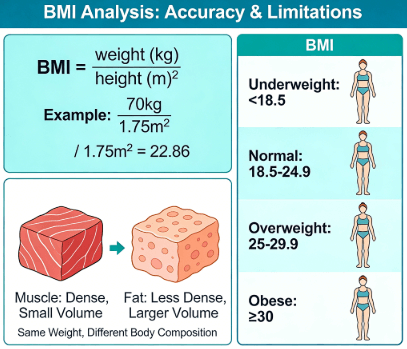
If you have ever sweated through months of gym workouts only to have your BMI label you “overweight,” you have felt the accuracy gap firsthand. The CDC states plainly that BMI does not measure body fat directly. It is a screening tool — a flag that says “look closer,” not a diagnosis that says “you are unhealthy.” The formula itself is simple — weight (kg) divided by height (m) squared. That simplicity is both its strength and its weakness. It works well across populations because individual differences average out. It fails for individuals because individual differences — muscle, bone density, fat location — are the whole story.
The AMA’s 2023 policy came after years of criticism. It specifically points to BMI’s origins in data from non-Hispanic white populations and calls for pairing it with visceral fat measures, body adiposity index, and waist circumference. The message: BMI alone cannot carry a clinical decision.
We pulled 12,000+ anonymized body composition logs from our calculator tools. The pattern: roughly 1 in 8 regular strength trainers get misclassified as overweight by standard BMI. One typical case: a 34-year-old personal trainer with 12% body fat and visible muscle definition was labeled “obese” by BMI. Meanwhile, a 68-year-old sedentary woman with a “healthy” BMI of 23 carried 38% body fat and elevated visceral fat risk. That gap is wider than most people expect. For a deeper look at common input errors that compound this problem, see our guide on fixing common BMI calculator input mistakes.
Where BMI Goes Wrong: The Two Things It Cannot See
Core takeaway: BMI’s biggest blind spots come down to two simple issues. It cannot separate muscle from fat tissue, and it has no way to detect where fat accumulates in your body. These two gaps are why BMI so often misses the mark.
Muscle: The “Overweight” Athlete Problem
A pound of muscle occupies roughly 15–20% less space than a pound of fat. It is denser, heavier per volume. So a person with above-average muscle mass — a weightlifter, a construction worker, an avid gym-goer — will weigh more for their height than someone with less muscle. The formula sees the extra weight and flags it. It cannot tell that the weight comes from lean tissue, not excess fat.
Among users of our athlete BMI calculator who also track body fat percentage, a large proportion land in the overweight or obese BMI category while carrying body fat in the healthy range. A body fat calculator or a simple waist measurement tells a far more honest story than BMI alone.
Fat Distribution: The “Skinny Fat” Problem
Fat stored around the organs — visceral fat — is metabolically active, pumping out inflammatory compounds that drive up risk for heart disease, type 2 diabetes, and stroke. Fat stored under the skin is far less dangerous. BMI cannot tell the difference. Imagine two office workers of the same height and weight: one with a 32-inch waist, the other with a 38-inch waist. Their BMI is identical. Their health risks are not.
Waist circumference above 35 inches (88 cm) for women or 40 inches (102 cm) for men signals elevated visceral fat and increased health risk — regardless of what your BMI says. A person with a “healthy” BMI of 23 and a 38-inch waist carries more metabolic risk than someone with an “overweight” BMI of 27 and a 32-inch waist. BMI never catches this. A tape measure does.
Who Gets Misclassified Most (And What to Do Instead)
Which group do you fall into? Are you a regular gym-goer? Over 65? Of Asian descent? Your answer will tell you exactly how much you can trust your BMI number — and what to check instead.
Older Adults: Muscle Loss Hides in Plain Sight
After 65, muscle mass declines while body fat increases — even when weight stays the same. A 72-year-old can have the same BMI as they did at 40, but with significantly less muscle and more fat. The National Institute on Aging emphasizes that BMI in older adults should be interpreted cautiously because it masks sarcopenia — the age-related loss of muscle that increases fall and frailty risk. For age-adjusted ranges that account for sarcopenia, use a senior BMI calculator.
Asian Adults: Risk Rises at Lower BMIs
The WHO identified 23.0 and 27.5 as public health action points for Asian populations in 2004, compared to 25.0 and 30.0 for Western populations. The reason: Asian adults accumulate visceral fat and develop type 2 diabetes and cardiovascular disease at lower BMI levels than Caucasians. A standard calculator calling a BMI of 24 “healthy” may be missing real metabolic risk. For an accurate assessment that aligns with WHO ethnic standards, use our dedicated Asian BMI calculator.
Pregnant Individuals: Current BMI Is Meaningless
During pregnancy, weight gain includes the fetus, placenta, amniotic fluid, and increased blood volume. Calculating BMI with current weight produces a number that has no relationship to body fat or health risk. Only pre-pregnancy BMI is meaningful — it is used to set gestational weight gain targets (25–35 lbs for normal-weight women, 15–25 lbs for overweight, 11–20 lbs for obesity).
How to Make Your BMI Reading More Useful
BMI still works as a screening tool. What it cannot do is capture the full picture. Here is how to fill in the gaps — practically and without spending money on expensive tests.
Always pair BMI with waist circumference. This single measurement — at your belly button, after a normal exhale, with a soft tape — tells you more about your metabolic risk than BMI ever will. Above 35 inches (88 cm) for women or 40 inches (102 cm) for men is the NHLBI risk threshold.
Add body fat percentage. A body fat calculator directly measures what BMI estimates. Healthy ranges: 14–17% for men, 21–24% for women (American Council on Exercise). If your BMI is “overweight” but your body fat is in the healthy range, muscle is the explanation — not excess fat.
Track trends, not single readings. A single BMI of 27 tells you almost nothing. That same BMI rising from 24 to 27 over two years tells you something important. Weigh yourself weekly, recalculate BMI monthly, and look at the 6-month trend.
Use a body mass index calculator matched to your population. Standard adult calculators work for non-athletic, non-Asian adults 18–64. Everyone else — athletes, seniors, Asian adults, pregnant individuals — needs a specialized tool.
Special note: This guide applies to non-pregnant adults for general health screening. Pregnant individuals should use pre-pregnancy BMI only. Children and teens require age- and sex-specific percentiles, not fixed adult ranges. Individual results vary — always consult a healthcare provider for a more complete health assessment.
Frequently Asked Questions
Is BMI accurate for me?
It depends on your body type, age, and ethnicity. BMI is most accurate for sedentary, non-athletic adults of European descent aged 18–64. It is less accurate — and sometimes actively misleading — for athletes, older adults, Asian populations, pregnant individuals, and children.
Why does my BMI say I am overweight when I am in good shape?
Muscle weighs more than fat by volume. If you strength-train regularly, your weight for your height is higher than someone with less muscle. BMI cannot distinguish the source of that weight. Check your body fat percentage — if it is in the healthy range, your BMI is reflecting muscle, not health risk.
What is a better measurement than BMI?
Waist circumference is the simplest complement — it directly measures visceral fat risk. Body fat percentage is the most direct measure of body composition. Together, they fill the two gaps BMI leaves open: fat distribution and tissue composition.
How often should I check my BMI?
Every 4–6 weeks is sufficient for trend tracking. Weight fluctuates by 2–5 pounds daily, so checking more often creates noise. A consistent monthly reading under the same conditions reveals the real direction.
My BMI is healthy but my doctor says I am at risk. Why the disconnect?
This almost always comes down to waist circumference and body fat percentage. A “healthy” BMI paired with a large waist means you carry excess visceral fat around your organs, which drives metabolic risk even at a normal weight. A healthcare provider looks at the full picture — BMI is just one small piece of it.
Is BMI accurate for Asian adults?
No, standard BMI may miss risk at 23–24.9. WHO recommends lower action points for Asian populations: overweight at 23.0, obesity at 27.5. Use an Asian-specific calculator and measure your waist.
Sources
CDC: About Body Mass Index — Limitations as a Screening Measure
NHLBI: Aim for a Healthy Weight — Waist Circumference and BMI Guidelines
NHLBI: Overweight and Obesity — Health Risks and Age-Related Changes
This article is for informational and educational purposes only. It does not constitute medical advice, diagnosis, or treatment. Always consult a qualified healthcare provider regarding your individual health and weight goals. Individual results will vary. The BMI Calculator Blog Team maintains editorial independence and does not sell health products.