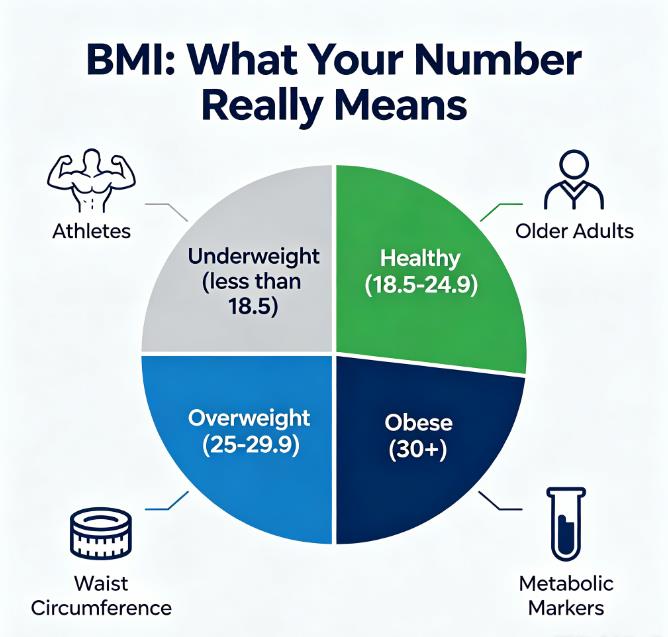
Quick summary: Your BMI is a number derived from your height and weight that places you in one of four categories: underweight, healthy weight, overweight, or obese. Per CDC classification, a healthy BMI for most adults falls between 18.5 and 24.9. But BMI has significant limitations — it cannot distinguish muscle from fat, ignores where fat sits on your body, and does not account for age, sex, or ethnicity. The 2023 AMA policy now recommends using BMI alongside waist circumference and metabolic markers. This guide breaks down official CDC BMI ranges, key limitations for athletes, seniors, and Asian adults, plus how to pair BMI with our body fat and Asian BMI calculators for full health context.
Your BMI is a screening tool, not a diagnostic tool. It simply tells you if your weight falls into a range that may be associated with health risks. All adult BMI cutoffs in this section follow official CDC classification standards.
Standard BMI categories for adults 20 and older:
Underweight: BMI less than 18.5
Healthy weight: BMI 18.5 to 24.9
Overweight: BMI 25.0 to 29.9
Obese: BMI 30.0 or higher
Adults with BMI ≥30 face higher odds of type 2 diabetes and hypertension compared to healthy-BMI peers, per CDC chronic disease data.
Why BMI Is Misleading For Athletes, Seniors & Asian Adults
BMI has a major blind spot: it cannot tell the difference between fat and muscle. Muscle is denser than fat. A muscular person can have a high BMI but very low body fat. A sedentary person can have a normal BMI but carry excess fat.
In 2023, the American Medical Association (AMA) adopted a new policy recognizing the significant limitations of using BMI alone as a clinical measure. The AMA now recommends that BMI be used in conjunction with other valid measures of risk, such as waist circumference, body fat percentage, and metabolic factors.
Here are the groups most likely to get a misleading BMI reading:
Athletes and muscular individuals: BMI often overestimates body fat in people with high muscle mass. A muscular person can be classified as overweight or obese while having excellent metabolic health.
Older adults: BMI often underestimates body fat in older people who have lost muscle mass. An older adult with a normal BMI can have low muscle mass and excess fat — a condition called sarcopenic obesity. Sarcopenic obesity raises risk of falls, insulin resistance, and joint pain in adults over 65; routine body composition screening is recommended annually. Adults over 65 with sarcopenic obesity should consult a geriatric dietitian for personalized protein and activity plans.
Asian adults: The WHO recommends lower BMI thresholds for Asian populations. For Asian adults, overweight begins at a BMI of 23, not 25. These lower overweight cutoffs come from official WHO regional BMI guidelines for Asian ethnic groups. This is because Asian populations tend to develop metabolic risks at lower BMI levels. Note that within Asian populations, risk can vary; for instance, South Asians often face higher metabolic risks at the same BMI compared to East Asians. Use our dedicated Asian BMI calculator built around WHO lower cutoff standards to avoid misclassifying metabolic risk for East, Southeast, and South Asian adults.
What to check alongside your BMI
Your BMI is a starting point, not the final word. To get a more complete picture of your health, consider these additional measures:
Waist circumference: This measures abdominal fat, which is closely linked to metabolic risk. Per NIH, a waist circumference over 35 inches for women or over 40 inches for men increases health risk, regardless of BMI. When tracking metrics every six months, record waist circumference at the narrowest point above your belly button for consistent comparison across measurements.
Body fat percentage: This tells you how much of your weight is fat versus muscle. It is a more accurate reflection of body composition than BMI alone.
Blood work: Fasting glucose, cholesterol, and blood pressure provide direct information about your metabolic health.
Use a body fat calculator to estimate your body fat percentage. Pair that with a healthy weight range tool to see where you fall. And use a gender-adjusted BMI calculator to get your baseline number — but remember, it is just one piece of the puzzle. For more detailed interpretation, see our guide on what BMI calculator results mean.
Your BMI result: what it actually means for you
Your BMI result is not a verdict on your health. It is a signal to look deeper. If your BMI falls outside the healthy range, ask yourself these questions:
Do I exercise regularly, including strength training? If yes, your higher BMI may reflect muscle mass.
What is my waist circumference? If it is under the NIH thresholds, your risk may be lower than your BMI suggests.
What do my blood work results show? Normal glucose, cholesterol, and blood pressure are stronger health indicators than BMI alone.
If your BMI is in the healthy range but you are sedentary, eat a poor diet, and have a high waist circumference, you may still be at risk. If your BMI is in the overweight range but you are active, eat well, and have normal blood work, your health may be better than the number suggests.
4-Step Full Metabolic Health Assessment (Beyond Standard BMI):
Calculate baseline BMI via our adult BMI calculator
Measure waist circumference against NIH gender thresholds
Test body fat percentage with our dedicated body fat tool
Review fasting glucose and lipid blood work with a provider
Record your BMI, waist size, and blood test results together every 6 months to track long-term metabolic trends.
For adults over 65, research suggests a slightly higher BMI (between 25 and 27) may be associated with better survival rates, as it indicates preserved muscle mass. Focus on mobility and strength rather than just the number.
References & Sources
CDC: BMI Frequently Asked Questions — Screening and Interpretation
CDC: What Is Body Mass Index (BMI)? — Limitations and Screening Use
AMA: New Policy Clarifying Role of BMI as a Measure in Medicine (2023)
NIH: Assessing Your Weight and Health Risk — Waist Circumference
Frequently Asked Questions About BMI
Is my BMI accurate if I exercise regularly?
Not always. If you have significant muscle mass from regular strength training, your BMI may overestimate your body fat. BMI cannot distinguish between muscle and fat, so it can misclassify fit, muscular individuals as overweight or obese.
What is a healthy BMI for my age?
For adults 20 and older, the same BMI categories apply regardless of age. However, for adults over 65, a BMI between 25 and 27 may be linked to better survival rates. Focus on mobility and strength rather than just the number.
Is BMI different for men and women?
The BMI categories are the same for both men and women. However, men and women have different body compositions. Women naturally have more body fat than men at the same BMI.
What BMI is considered overweight for Asian adults?
The WHO recommends lower BMI thresholds for Asian populations. Overweight begins at a BMI of 23, not 25.
Should I worry if my BMI is in the overweight range?
Not necessarily. If you are active, have a healthy waist circumference, and your blood work is normal, your health may be fine. The AMA recommends using BMI alongside other measures like waist circumference and metabolic factors.
What should I do if my BMI is outside the healthy range?
Start by measuring your waist circumference and checking your blood work. These give you a clearer picture of your metabolic health. A BMI outside the healthy range is a signal to look deeper, not a reason to panic.
Related Articles
What Do BMI Calculator Results Mean? A Clear, No-Jargon Health Breakdown
What Is BMI? Understanding the Basics, Ranges, and Why It's Not the Full Picture
BMI Calculator Guide: 5 Key Features for Accurate, Gender-Adjusted Results
BMI Calculator Blog. This content is provided for educational and informational purposes only. We encourage sharing with proper attribution to our site. Unauthorized commercial use is prohibited. Medical Disclaimer: This content does not replace professional medical advice, diagnosis, or treatment. Always seek the advice of a qualified physician or other licensed health provider with any questions regarding your body composition, weight status, or health goals.