One medium apple (182g) has about 95 calories. But the real value is 4.4g of fiber and 14% of your daily vitamin C. This guide breaks down calories by size, variety, and how apples compare to other low‑calorie snacks.
Editorial development: BMI Calculator Blog Team. Reviewed by Sarah Mitchell, MPH, RDN, registered dietitian nutritionist with 15 years of experience in weight management and clinical nutrition. BMI Calculator Blog is an independent educational platform that has provided evidence‑based health information to over 500,000 readers since 2019. Content aligned with USDA FoodData Central and CDC dietary guidelines. Last reviewed: June 2026.
Key Takeaways (20‑second read):
✅ One medium apple (3” diameter, 182g) = ~95 calories.
✅ Smaller apple (2.5”) = ~77 calories; large apple (3.25”) = ~116 calories.
✅ Apple fiber (4.4g) slows digestion, keeping you full longer than a 100‑calorie pack of cookies.
✅ Granny Smith and Gala have nearly identical calories, but Fuji and Honeycrisp are slightly sweeter (same calorie range).
Let's be real: that 100‑calorie pack of cookies might seem like a good idea, but you'll be rummaging through the pantry again 30 minutes later. An apple? It'll keep you full until your next meal, no snack attacks required. Here’s what most people don’t realize: the calorie count of an apple is the least interesting thing about it. Yes, one medium apple has about 95 calories. But its real power is in the fiber and water volume that shut down hunger for the next hour.
In my 15 years working with individuals on weight management, I've seen the apple pre‑load trick work better than almost any other snack strategy. One client lost 12 pounds in 3 months just by eating an apple 15 minutes before dinner every night. She didn't change anything else about her diet. That’s the power of a simple 95‑calorie fruit.
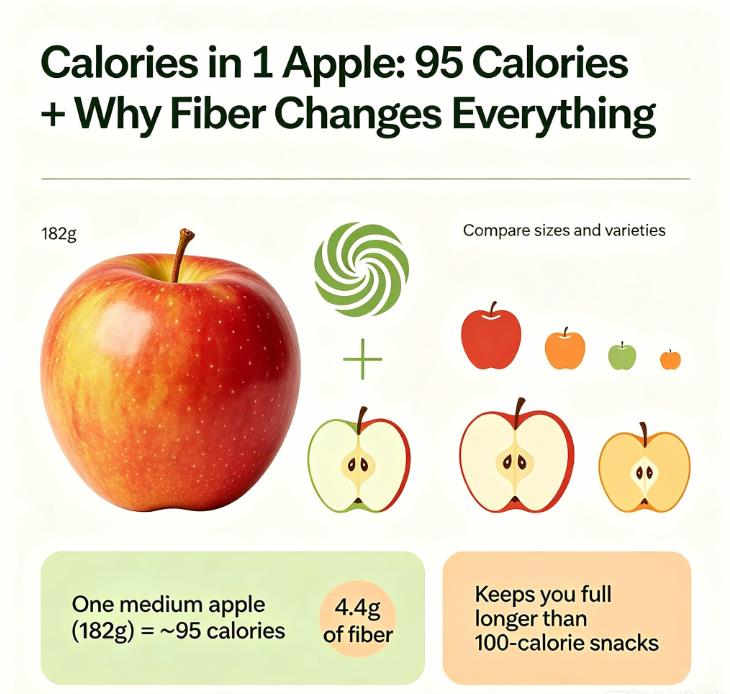
Calorie in 1 apple: the exact numbers by size and variety
The USDA FoodData Central database provides the standard reference. All numbers below are for raw apple with skin. Try not to peel your apple—about half the fiber and most of the antioxidants are in the skin. If you do peel it, you're still getting plenty of nutrition, just a little less fiber.
| Apple Size | Diameter | Weight | Calories | Fiber |
|---|---|---|---|---|
| Small | 2.5 inches (6.4 cm) | 149g | 77 | 3.6g |
| Medium | 3 inches (7.6 cm) | 182g | 95 | 4.4g |
| Large | 3.25 inches (8.3 cm) | 223g | 116 | 5.4g |
| Extra Large | 3.5+ inches (8.9+ cm) | 250g+ | 130+ | 6.0g+ |
Variety differences are minimal. A medium Granny Smith (tart) and a medium Gala (sweet) both land in the 90–100 calorie range. Fuji and Honeycrisp tend to be slightly larger and sweeter, but the calories come from natural sugar, not added sugar. The glycemic impact is low because of the fiber.
For comparison, a calories in a banana (medium, 118g) is about 105 calories – very similar to an apple, but bananas have less water and more sugar, so they digest faster.
Why an apple is a “low calorie snack” superstar
Many 100‑calorie packaged snacks (cookies, pretzels, granola bars) leave you hungry 30 minutes later. An apple does the opposite. Here’s why:
High water content: Apples are about 86% water. Water adds volume without calories.
Soluble fiber (pectin): Slows stomach emptying and feeds gut bacteria. One medium apple provides 4.4g fiber – about 16% of the daily target for women (25g) and 11% for men (38g).
Chewing time: Eating a whole apple takes 5–10 minutes, giving your brain time to register fullness signals. A liquid snack or soft cookie is gone in 30 seconds.
In fact, a 2013 study in Appetite (Flood-Obbagy & Rolls, Vol. 60, pp. 69–76) found that eating an apple 15 minutes before a meal reduced total calorie intake at that meal by about 15% – without people feeling deprived.
If you’re building a lineup of satisfying low‑calorie options, check out our guide on low calorie snacks under 150 calories – apples are at the top of the list.
Apple vs. egg: which is better for weight control?
This is a common comparison. A large whole egg has about 72 calories, 6.3g protein, and 0g fiber. An apple has 95 calories, 0.5g protein, and 4.4g fiber. Which is better? It depends on timing.
Apple as a pre‑meal snack: Wins for volume and fiber. Eat it 15–20 minutes before lunch or dinner to curb hunger.
Egg as a meal component: Wins for protein. Eat eggs at breakfast to stay full for hours. But remember, calories in an egg are not all absorbed – the body uses about 50–58% of egg protein, but that’s a different topic.
Best strategy: pair them. A sliced apple with a hard‑boiled egg makes a 167‑calorie snack with protein + fiber that will easily last 3 hours.
How to use apples in a calorie deficit (practical tips)
There are so many easy ways to fit apples into your day. Try one as a morning snack with a handful of almonds, or slice it up and add it to your salad for a touch of sweetness. If you're craving something sweet after dinner, microwave a sliced apple with cinnamon for 1 minute—it tastes like apple pie without the 300 calories.
My personal favorite: Slice up a Granny Smith apple and dip it in a tablespoon of almond butter. The sweet‑tart crunch with the creamy, rich almond butter is incredibly satisfying, and the protein‑fat‑fiber combo keeps hunger away for hours.
To see how an apple fits into your total daily calorie target, use a calorie calculator to estimate your needs. For most adults aiming to lose weight (1,500–1,800 calories for women, 1,800–2,200 for men), one apple uses about 5–6% of daily calories – a very reasonable trade.
Myth busting: “Fruit has too much sugar for weight loss”
This myth refuses to die. The sugar in whole fruit is packaged with fiber, water, and polyphenols. That package slows absorption and prevents the blood sugar spike you get from soda or candy. A medium apple has 19g of sugar (fructose, glucose, sucrose). Sounds like a lot? But because of the fiber, the glycemic load is only 6 – considered low. By comparison, a 12‑ounce soda has 39g of sugar and no fiber, with a glycemic load of 16.
The CDC explicitly includes whole fruits in its healthy eating patterns for weight management. The problem is fruit juice, dried fruit (calorie‑dense), and fruit in syrup – not fresh apples.
Actionable takeaway: make apples a daily habit
This week: Keep a bowl of apples on your kitchen counter. When you feel a snack urge, eat one before opening any package.
This month: Experiment with different varieties – Fuji for sweetness, Granny Smith for tartness, Pink Lady for crispness. Find one you genuinely enjoy.
Long term: Use the “apple pre‑load” trick: eat one apple 15 minutes before your largest meal. Research shows this reduces meal calories by about 100–150 without any conscious effort.
Remember: calories matter, but food quality matters just as much. A 95‑calorie apple is not the same as a 95‑calorie cookie. The apple works with your body’s hunger signals; the cookie works against them.
For a complete list of dietitian‑approved snacks under 150 calories (including apples, yogurt, eggs, and more), see our low calorie snacks guide.
Expert insight – Academy of Nutrition and Dietetics: “Whole fruits like apples are nutrient‑dense, meaning they provide vitamins, minerals, and fiber with relatively few calories. Including fruit as a snack or part of a meal can increase satiety and help with weight management when substituted for higher‑calorie, lower‑nutrient foods.” – Based on AND’s Evidence Analysis Library.
Frequently Asked Questions (FAQ)
How many calories in a small apple vs. a large apple?
A small apple (2.5” diameter, ~149g) has about 77 calories. A large apple (3.25”, ~223g) has about 116 calories. The difference is roughly 40 calories – not worth stressing over. Choose based on hunger level.
Does the color of the apple matter for calories?
No. Red, green, or yellow – the calorie difference is negligible (within 5 calories). Green apples (Granny Smith) are slightly more tart, which some people prefer for savory pairings, but the calorie count is almost identical.
Are apple calories different when cooked or baked?
Cooking an apple without added ingredients does not change its calorie count. However, if you bake it with sugar, butter, or pie crust, calories skyrocket. A medium baked apple with cinnamon and no sugar is still ~95 calories.
Can I eat an apple every day while losing weight?
Absolutely. One apple per day uses less than 6% of a 1,600‑calorie diet. The fiber and volume will help, not hurt, your weight loss. Many successful long‑term losers eat 2–3 servings of whole fruit daily.
How many calories in an apple compared to a banana?
A medium banana (118g) has about 105 calories – slightly more than an apple (95). Bananas have more sugar and less water, so they digest faster. Apples are better for hunger control between meals; bananas are better for quick energy before exercise.
One question I get all the time: ‘If I eat an apple at night, will the sugar keep me awake?’
For the vast majority of people, the natural sugar in one apple eaten a couple of hours before bed won't affect sleep. In fact, the fiber helps stabilize blood sugar, which might even promote more stable sleep. If you have significant blood sugar issues (like poorly controlled diabetes), that's a conversation to have with your healthcare provider. But for most people, a bedtime apple is perfectly fine.
Sources
USDA FoodData Central: Apple, raw (with skin) – nutritional data
Flood-Obbagy JE, Rolls BJ. The effect of fruit in different forms on energy intake and satiety at a meal. Appetite. 2013;60(1):69-76. doi:10.1016/j.appet.2012.09.023
USDA Dietary Guidelines for Americans 2025-2030: Whole Fruit Recommendations
Content Integrity Review: This article has been reviewed by the BMI Calculator Blog editorial team for alignment with USDA, CDC, and peer‑reviewed research on fruit consumption, satiety, and calorie balance. Individual health decisions should always be made with a qualified healthcare provider.
BMI Calculator Blog. This content is provided for educational and informational purposes only. Medical Disclaimer: The content of this article is for informational purposes only and does not replace professional medical advice, diagnosis, or treatment. Always seek the advice of a qualified physician or other health experts with any questions regarding medical conditions or health goals.