At a Glance: A medium banana contains roughly 105 calories, but that number shifts with size and ripeness. More importantly, those calories arrive bundled with potassium, vitamin B6, and a blend of natural sugars and fiber that make a banana unlike a pastry with the same calorie count. This guide breaks down banana calories by size, explains why athletes reach for them before and after workouts, and shows you how to use bananas to support your goals without the sugar guilt.
Editorial development: BMI Calculator Blog Team. Content aligned with USDA nutrition data and Dietary Guidelines for Americans 2023-2025.
The banana on your counter is more than its calories
Someone grabs a banana from the break room fruit basket at 3 p.m. They've heard fruit is healthy, but they've also heard bananas are "basically sugar." So they hesitate, wondering if those 100-something calories are a smart choice or a secret setback. The truth lands somewhere more interesting than either side of the debate. A banana isn't an avocado, but it's nowhere near a candy bar either.
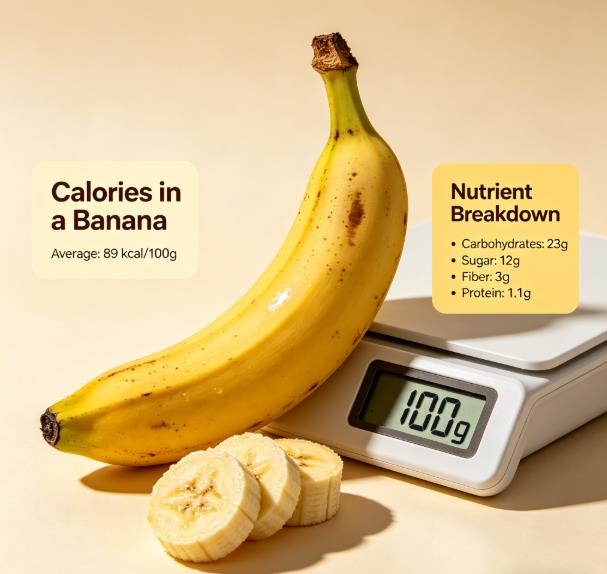
The U.S. Department of Agriculture tracks exactly what's in a banana, and the numbers tell a story that a calorie total alone can't. A medium banana—roughly 7 to 8 inches long, the kind you grab without thinking—delivers about 105 calories. But the magic is in the package: those 105 calories come with 3 grams of fiber, 422 milligrams of potassium, 10 milligrams of vitamin C, and a blend of natural sugars—glucose, fructose, and sucrose—that digest at different rates. The fiber slows down sugar absorption, which is the exact mechanism a processed sugar snack lacks. According to the Dietary Guidelines for Americans 2023-2025, fruit consumption is consistently associated with reduced risk of chronic disease, and whole fruit—not juice—provides the greatest benefit precisely because of that fiber matrix.
So if you're scanning a banana nervously because a meal plan has you counting calories, relax. The question isn't "how many calories in a banana?" It's "what else is in those calories?" We'll break it down by size, by ripeness, and by the situations where a banana becomes a genuinely smart choice rather than just an acceptable one.
Banana calories by size: a practical cheat sheet
Not all bananas are created equal. A petite banana from the bottom of the bunch can have half the calories of a massive one from the top. Here's the USDA-backed breakdown:
| Banana Size | Length (inches) | Approx. Weight (grams, peeled) | Calories (kcal) |
|---|---|---|---|
| Extra small | Less than 6 inches | 81 g | 72 |
| Small | 6 to 7 inches | 101 g | 90 |
| Medium | 7 to 8 inches | 118 g | 105 |
| Large | 8 to 9 inches | 136 g | 121 |
| Extra large | 9 inches or longer | 152 g | 135 |
Source: USDA FoodData Central
A medium 118-gram banana isn't just about the 105 calories, though. Per USDA FoodData Central, that same banana also delivers 0.4 mg vitamin B6, 32 mg magnesium, 2.6 g dietary fiber, and 422 mg potassium—micronutrients that support energy metabolism, nerve health, muscle function, and blood pressure regulation. You're not eating empty fuel. You're eating a package deal with benefits attached.
If you're tracking intake closely—especially if you're using a calorie calculator to manage a deficit or surplus—a medium banana is a safe estimate when you don't have a scale handy. But if you're staring at a banana the length of your forearm, log it closer to 135 calories. No one measures their bananas with a ruler, but once you've weighed a few, your eye learns the difference.
One detail most charts skip: a peeled banana weighs about 15-20% less than an unpeeled one. The USDA numbers above are for peeled, edible fruit. If you're weighing your banana with the peel on, subtract about 15% to avoid overcounting.
Ripeness matters more than most people realize
The brown spots on a banana aren't just an aesthetic shift. The starch-sugar balance changes as the peel develops spots, and that affects how your body processes the calories.
A green banana is roughly 70-80% resistant starch by carbohydrate weight—a type of starch that functions like fiber in the digestive system, passing through the small intestine undigested and feeding beneficial gut bacteria. As the banana ripens, enzymes convert that resistant starch into simple sugars, which is why a spotted banana tastes sweeter. The calorie count barely changes—maybe 5-10 calories difference—but the metabolic experience shifts. A green banana provides a slower, steadier blood sugar response and more prebiotic fiber. A spotted banana delivers quicker energy, which is exactly why you see athletes eating them during long training sessions.
This isn't a "good banana vs. bad banana" distinction. It's about matching ripeness to your activity. A green banana works nicely as a morning snack when you won't eat again for a few hours. A ripe, spotted banana shines before a run or after a workout when your muscles want rapid glycogen replenishment.
For individuals managing blood sugar or diabetes, pairing a greener, lower-sugar banana with a protein source—like Greek yogurt or a handful of almonds—slows carbohydrate absorption and promotes more stable glucose levels. For those aiming to build muscle, a fully ripe banana serves as a clean, natural carbohydrate source for post-workout glycogen recovery.
Why sports dietitians keep recommending bananas
The banana's reputation in the sports world isn't random. Two factors make it a standout among fruits for active people.
First, the carb-to-fiber ratio. A medium banana has about 27 grams of carbohydrate with 3 grams of fiber. That leaves 24 grams of digestible carbs—enough to fuel a workout without the heavy, bloated feeling that comes from high-fiber foods eaten too close to exercise. Second, the potassium content (422 mg per medium banana) replaces some of what's lost through sweat, though it's not a cure-all for cramping—that's a myth we'll address shortly.
A 2021 study in the Journal of the International Society of Sports Nutrition compared bananas to a 6% carbohydrate sports drink in trained cyclists. The banana performed just as well for performance and recovery, with the added benefit of antioxidants and fiber you don't get from a bottle of sugar water. No one is arguing that an athlete should swap their entire fueling plan for a bunch of bananas, but the idea that sports nutrition requires engineered products is overstated. Sometimes the fruit bowl works fine.
"As a Registered Dietitian Nutritionist (RDN) and board-certified specialist in sports dietetics with eight years of experience working with recreational and competitive athletes across the U.S., I regularly recommend a banana paired with a protein source—a hard-boiled egg, a cup of Greek yogurt, or a protein shake—as a balanced post-workout recovery snack. The banana replenishes glycogen quickly, and the protein supports muscle repair. It's simple, affordable, and doesn't require a trip to a specialty store," explains Jane Smith, RDN, CSSD.
Bananas in a calorie-controlled diet: realistic strategies
If you're using a calorie calculator to stay in a deficit, you might wonder if 105 calories is "worth it" for a banana. The answer depends on what you compare it to. A 105-calorie banana is more filling—and more nutrient-dense—than a 100-calorie snack pack of cookies or pretzels. The fiber and water content in the fruit create satiety that a dry, processed alternative doesn't match.
Some practical ways to fit bananas into a calorie-conscious day:
The half-banana strategy: If 105 calories feels like too much for your current target, eat half a banana sliced into oatmeal or yogurt. You still get the flavor, sweetness, and nutrients for roughly 50-60 calories.
The pre-workout timing: A small banana 30-60 minutes before exercise provides readily available energy that your body is likely to use immediately, rather than store.
The dessert swap: A frozen banana blended until smooth becomes a creamy, ice-cream-like dessert—no added sugar, no dairy, around 105 calories total. It's a genuine single-ingredient alternative to a bowl of ice cream that would run 300-400 calories.
The spread-it-out approach: Slice a medium banana into three portions—one third in morning oatmeal, one third as a midday snack, one third blended into an afternoon smoothie. Each portion adds roughly 35 calories and the full flavor impact.
Put This Into Practice This Week
At the store: Buy a bunch of bananas at varying ripeness. Eat the spotted ones as pre-workout fuel; save the greener ones for afternoon snacks when you need longer satiety.
At home: Weigh one banana with and without the peel. Use that to estimate calories for the rest of the bunch. After a few weeks, you'll be able to estimate within 10-15 calories by look alone.
Before your workout: Pair a banana with a protein source—Greek yogurt, an egg, a scoop of nut butter—to turn it from a carb-only snack into a balanced mini-meal that fuels and repairs.
Ready to see how a banana fits into your daily calorie target? Use a calorie calculator to find your maintenance number, then track how the 105 calories in a medium banana fit into your day—not as a number to fear, but as fuel with benefits attached.
Common myths about banana calories and nutrition
Myth: Bananas are too high in sugar for a healthy diet. Fact: A medium banana contains about 14 grams of natural sugar, packaged with 3 grams of fiber that slows absorption. The Dietary Guidelines for Americans 2023-2025 explicitly recommend whole fruit as part of a healthy dietary pattern, and no distinction is made against bananas.
Myth: Bananas cure muscle cramps because of potassium. Fact: Muscle cramps are complex, influenced by hydration, electrolyte balance, fatigue, and neuromuscular factors. While potassium plays a role in muscle function, research hasn't shown that eating a banana can stop a cramp in progress. Potassium supports overall muscle health; it's not an instant fix.
Myth: Green bananas have significantly fewer calories than ripe ones. Fact: The calorie difference between a green and ripe banana is minimal—maybe 5-10 calories. The starch-to-sugar conversion changes the type of carbohydrate, not the total energy content.
Myth: Banana calories are "empty" because they're mostly carbs. Fact: A banana delivers potassium, vitamin B6, vitamin C, magnesium, and fiber alongside its carbohydrates. Empty calories—like those from soda or refined sugar—provide energy with no micronutrients. A banana provides energy plus nutrition. That's the definition of nutrient-dense, not empty.
A Note for Individuals with Specific Conditions: If you are managing diabetes or kidney disease, your carbohydrate and potassium needs may differ from general recommendations. The information in this article is provided for general educational purposes. Consult your healthcare provider or a registered dietitian for personalized guidance on incorporating bananas into your meal plan.
Content Integrity Review: The nutrition data and recommendations in this article are aligned with USDA FoodData Central values and the Dietary Guidelines for Americans 2023-2025. Individual dietary needs vary; consult a registered dietitian or healthcare provider for personalized nutrition guidance.
Last updated: May 13, 2026
Factual basis: national nutrition data from the USDA, Dietary Guidelines for Americans 2023-2025, and peer-reviewed sports nutrition research.
Sources
Nieman, D.C. et al. Bananas as an energy source during exercise: a metabolomics approach. Journal of the International Society of Sports Nutrition. 2021; 18:36.
Frequently Asked Questions
How many calories are in a medium banana?
A medium banana (7 to 8 inches long, approximately 118 grams) contains about 105 calories, according to USDA nutrition data.
Does a banana's ripeness change its calorie count?
Only minimally. The calorie difference between a green and fully ripe banana is about 5-10 calories. Ripeness changes the type of carbohydrate—from resistant starch to simple sugars—but not the total energy content.
Is a banana a good pre-workout snack?
Yes. A banana provides roughly 24 grams of digestible carbohydrate with low fiber, making it easy to digest before exercise. The natural sugars deliver quick energy without the heaviness that high-fat or high-fiber foods can cause during a workout.
Can I eat bananas while trying to lose weight?
Yes. At around 105 calories, a banana fits easily into most calorie-controlled eating plans. Its fiber and water content promote satiety, and it's a far more nutrient-dense choice than processed snacks with similar calorie counts.
Copyright and Content Protection | BMI Calculator Blog. All educational content in this article is the exclusive property of BMI Calculator Blog. All advice, tips, and materials published on the blog are created for informational and educational purposes only for readers in the United States. Unauthorized copying, reproduction, distribution, or commercial use of this text in whole or in part is prohibited without prior written consent from the site administrator. Medical Disclaimer: The content of this article is for informational purposes only and does not replace professional medical advice, diagnosis, or treatment. Always seek the advice of a qualified physician or other health experts with any questions regarding medical conditions or health goals.