Quick Summary: A healthy height-to-weight balance isn't about a single number. For most adults, a BMI of 18.5–24.9 is the standard range. But the full picture requires understanding body composition, waist circumference, and age-related shifts. This guide covers how to assess your height-weight relationship, where BMI fits in, and what to do if you're not where you want to be.
Key Takeaways:
BMI is the starting point — 18.5–24.9 for most adults under 65.
Height sets the range — healthy weight spans 30–50 lbs for any given height.
Muscle vs. fat matters — two people at the same BMI can have opposite health profiles.
Waist circumference catches metabolic risk that BMI alone misses.
Age shifts the range — a slightly higher BMI may be protective after 65.
What does "healthy" really mean for your height and weight?
Healthy weight isn't a fixed destination. It shifts with height, age, and body composition — and a simple chart can't capture the full picture. What's healthy for a 25-year-old endurance athlete may not apply to a 55-year-old strength trainer with the same height and weight.
The Centers for Disease Control and Prevention (CDC) uses Body Mass Index (BMI) as a starting point to assess weight relative to height. For most adults, a BMI between 18.5 and 24.9 is considered a healthy weight range. But BMI is a screening tool, not a diagnosis. It's a conversation starter, not the final word. Use a Body Mass Index Calculator to get your number in seconds—but understanding what that number means for your body takes more context.
How BMI connects height and weight for adults
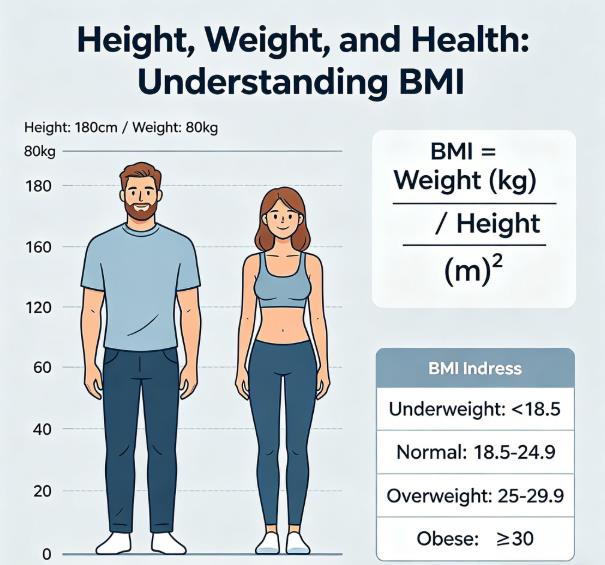
For adults aged 18 to 65, the CDC and WHO define four core BMI categories based on height and weight:
Underweight: BMI below 18.5
Healthy weight: BMI 18.5 to 24.9
Overweight: BMI 25.0 to 29.9
Obese: BMI 30.0 and above
These ranges are gender-neutral for general screening, but they never tell the full story of individual health. A 5'10" man weighing 175 pounds has a BMI of 25.1—barely into the overweight category. If he's a construction worker with significant muscle mass, that "overweight" label may be misleading. If he's sedentary with low muscle mass and high visceral fat, the classification may be accurate. Same height, same weight, completely different health profiles.
This is why the CDC and WHO both recommend pairing BMI with waist circumference and, when possible, body fat percentage. A body fat calculator that uses circumference measurements provides a more nuanced view of what your weight is actually made of—muscle versus fat.
Healthy weight ranges for different heights: a quick reference
Here's a simple reference for how healthy weight ranges shift with height, based on the standard BMI range of 18.5 to 24.9. For a visual grid, see our height and weight BMI chart.
| Height | Healthy Weight Range (lbs) | Healthy Weight Range (kg) |
|---|---|---|
| 5'0" (60 inches) | 95 – 127 lbs | 43 – 58 kg |
| 5'3" (63 inches) | 104 – 141 lbs | 47 – 64 kg |
| 5'6" (66 inches) | 115 – 154 lbs | 52 – 70 kg |
| 5'9" (69 inches) | 125 – 169 lbs | 57 – 77 kg |
| 6'0" (72 inches) | 136 – 184 lbs | 62 – 83 kg |
| 6'3" (75 inches) | 148 – 200 lbs | 67 – 91 kg |
These numbers are a starting point, not a rigid rulebook. Someone at the upper end of the range with higher muscle mass may still be metabolically healthy. Someone at the lower end with low muscle mass could be carrying excess body fat despite a "healthy" weight.
When height and weight alone don't tell the full story
Muscle vs. fat: why composition matters more than weight
Two people can share the same height and weight while having completely different health trajectories. Muscle is denser than fat. It occupies less space in your body, yet it weighs more for the same volume. A person who strength trains consistently may have a BMI in the overweight range but a body fat percentage in the athletic zone. A person who never exercises may have a normal BMI but carry dangerous visceral fat around their internal organs.
Research suggests a significant portion of adults with a "normal" BMI may still harbor metabolic risks like insulin resistance or elevated blood pressure — a condition often referred to as normal-weight obesity. For a more complete picture, check your body fat percentage alongside your weight on the scale.
A normal BMI does not guarantee metabolic health. This is one of the most common misconceptions in health assessment — people see a high BMI and panic, without realizing they've built a foundation of muscle. That's why waist size matters more than the scale for catching hidden metabolic issues early.
Special considerations for height and weight assessment
Seniors (65+)
For older adults, the healthy BMI range shifts. Research suggests a BMI between 23 and 28 may be protective against frailty, malnutrition, and falls. Unintentional weight loss in seniors is a red flag — it often signals muscle loss (sarcopenia) rather than fat loss. A senior BMI calculator with age-adjusted ranges provides more realistic targets for this age group.
Asian populations
The WHO recommends lower BMI thresholds for Asian populations because metabolic disease risk increases at significantly lower BMI values. The healthy range for East, South, and Southeast Asian adults is 18.5 to 22.9, with overweight starting at 23 and obesity at 25. An Asian BMI calculator that accounts for these adjustments catches risks that the standard chart would miss.
Athletes and highly active individuals
For people who regularly lift weights, play sports, or do physically demanding work, BMI is a poor standalone metric. High lean body mass pushes BMI into the overweight or obese range even at low body fat percentages. For this group, body fat percentage and waist circumference are far more meaningful. An athlete BMI calculator provides helpful context for interpreting height-weight numbers in active populations.
Children and teens
BMI-for-age percentiles are used instead of fixed BMI categories for anyone under 20. A pediatric BMI calculator compares a child's result to peers of the same age and gender, which is far more accurate than adult reference charts for growing bodies.
What to do if your height-weight balance isn't where you want it
If your BMI or body composition lands outside the healthy range, or you simply don't feel your best at your current weight, slow, steady adjustments work far better than crash diets. Here's a practical approach:
If you're underweight: Focus on nutrient-dense foods to support healthy weight gain — whole grains, lean proteins, healthy fats, and fruits and vegetables. Avoid empty calories from processed snacks. A calorie calculator can help you estimate your daily needs for gradual, healthy weight gain.
If you're in the healthy range: Maintain balanced nutrition, stay active with at least 150 minutes of moderate exercise per week, and get 7 to 9 hours of sleep. Regular check-ins with your BMI and waist circumference can help you catch shifts before they become trends.
If you're overweight or obese: Small swaps make the biggest long-term difference. Add a 10-minute walk after meals, replace one sugary drink with water each day, and focus on whole foods. Gradual weight loss of 0.5 to 1 pound per week is both safe and sustainable.
Your Healthy Height-Weight Starter Plan
This week: Calculate your BMI and measure your waist circumference at the navel. Write both numbers down. No judgment — just a baseline.
This month: If your waist is above 35 inches (women) or 40 inches (men), add one extra walking session per week and reduce one processed food item from your regular rotation.
This quarter: Re-measure both numbers. Look for trends, not perfection. Small movements in the right direction are the foundation of lasting change.
Common myths about height and weight
Myth: There's one ideal weight for every height. Fact: The healthy weight range for a given height spans 30 to 50 pounds depending on muscle mass, bone structure, and body composition. Two people of the same height can both be healthy at weights 40 pounds apart.
Myth: If your BMI is normal, you don't need to worry about your height-weight balance. Fact: Research suggests a significant portion of adults with a "normal" BMI may still harbor metabolic risks. Waist circumference and body fat percentage often reveal risks that BMI alone misses.
Myth: Height-weight charts work the same for everyone. Fact: Age, ethnicity, activity level, and muscle mass all change how height and weight numbers should be interpreted. One-size-fits-all charts are a rough guide, not a rulebook.
A normal BMI doesn't rule out risk. If your waistline is expanding, that's a signal to act — not a reason to relax.
Individuals with diabetes, metabolic syndrome, or chronic kidney disease should follow personalized weight guidelines from their healthcare provider rather than applying general population ranges.
Frequently Asked Questions
How do I know if my weight is healthy for my height?
The most common starting point is calculating your BMI using your height and weight. A BMI between 18.5 and 24.9 is considered a healthy weight for most adults. But BMI doesn't account for muscle mass, body composition, or age, so pairing it with waist circumference and body fat percentage gives a more complete picture.
Can I be healthy at an overweight BMI if I'm active?
Yes, particularly if your higher BMI is due to muscle rather than fat. Athletes and people who strength train regularly often have BMIs in the overweight range with excellent metabolic health. Waist circumference and body fat percentage are better tiebreakers in these cases.
Does healthy weight change with age?
Yes, particularly after 65. Research suggests a slightly higher BMI is associated with lower mortality risk in older adults. The focus shifts from a single number to preserving muscle mass, maintaining functional ability, and preventing unintentional weight loss.
What is normal-weight obesity?
It describes people with a BMI in the healthy range (18.5–24.9) who still carry excess visceral fat. A significant portion of U.S. adults with a normal BMI fall into this category. Waist circumference and body fat testing can reveal what BMI misses.
How much does height affect healthy weight range?
Substantially. The healthy weight range for 5'2" is roughly 101–136 lbs; for 6'0", it's 136–184 lbs. A 10-inch height difference shifts the healthy corridor by roughly 35–50 lbs.
Should seniors use the same BMI range as younger adults?
No. Research links a BMI of 23–28 with the lowest mortality in adults 65 and older. A slightly higher BMI in this age group is often protective against frailty and bone loss. A senior-specific calculator applies these adjusted thresholds.
Sources
This content is provided for educational and informational purposes only. It does not replace professional medical advice, diagnosis, or treatment. BMI and body composition measures are screening tools, not diagnostic instruments. Always consult a qualified healthcare provider regarding your weight, body composition, or health goals. Individual results vary. The BMI Calculator Blog Team maintains editorial independence and does not sell health products.