BMI does not measure muscle. The formula reads only weight and height, so a 200 lb lifter and a 200 lb desk worker can post identical numbers with completely different bodies. Muscle moves the score only by adding weight. Here is where that leaves trained adults — and what to check instead.
Back in 1830s Brussels, Quetelet built this equation to describe populations. Gym-goers were not on his radar. The math predates the modern weight room by roughly a century.
What the BMI Formula Counts
Weight divided by height squared. Metric: kg ÷ m². Imperial: pounds × 703 ÷ inches². And that is, honestly, all there is to it — no muscle field, no body-fat field, no waist measurement. CDC adult screening categories still run on this same equation.
Muscle enters sideways. It has weight. More muscle means more weight at the same height, which pushes the number up. A lean athlete can land in the "overweight" band with body fat under 12%.
Why Muscular People Skew High
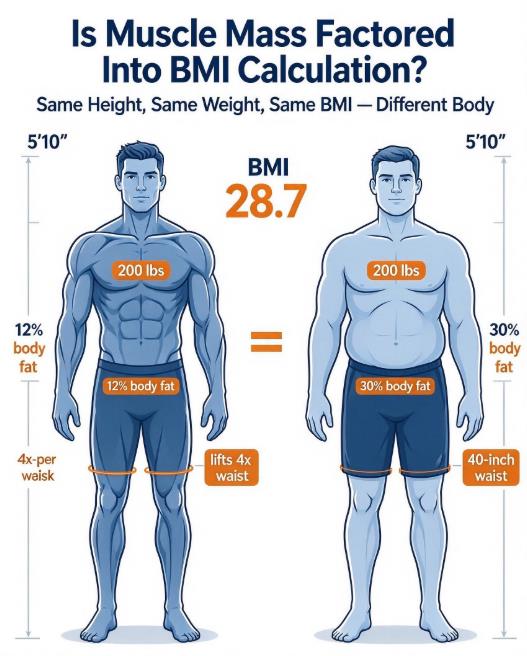
Fat occupies more volume per pound. Muscle packs tighter, so two people at 5'10" and 200 lbs both read BMI 28.7 while carrying wildly different tissue. One sits at 12% body fat with visible abs. The other carries 30% body fat and a 40-inch waist. Same quotient. Different body entirely.
Strength athletes: BMI 28–32 is routine, body fat often 8–15%.
Football linemen: size and power drive the number, not fat storage.
Bodybuilders hit the same wall from a different angle. An off-season bulk can slide BMI into obesity territory while the waist tape still reads 33 or 34 inches.
Our inbox tells this story better than any chart. Three readers wrote in last winter, all asking why their BMI jumped after a bulk — same height, same person, different label. That thread is what pushed us to build an athlete-mode toggle on the calculator side.
What to Measure Alongside BMI
Waist circumference is the fastest context check. Federal guidance draws the risk line at 35 inches for women and 40 inches for men, regardless of what the BMI quotient says. Body fat percentage answers the tissue question. An athlete bmi calculator adjusts the standard bands for training status, and a body fat calculator adds the detail the formula cannot see.
One reader — 34, deadlifting twice her bodyweight — sat at BMI 29 with a 31-inch waist and 22% body fat. Her number looked alarming. Her tape and training log said otherwise. Pull out a tape measure before you rerun the body mass index calculator.
Frequently Asked Questions
Does BMI account for muscle mass?
No. The formula reads only weight and height. Muscle is not a variable. A muscular person can score high because muscle adds weight, not because BMI detects muscle.
Can you have a high BMI and low body fat?
Yes. A 6'0" 220 lb athlete sits at BMI 29.8 — one tick below obesity. At 10% body fat, that number reflects lean mass, not fat storage.
Is BMI accurate for athletes?
Not for classification. CDC adult categories were built for the general population, and collegiate strength cohorts have long been flagged as poorly served by them. Rerun the number if you want, but read the tape first.
What should athletes use instead of BMI?
For trained adults, BMI alone misses too much. Track these screening markers:
Waist circumference: under 35 inches for women, under 40 inches for men.
Body fat percentage: commonly cited healthy ranges are 14–17% for men and 21–24% for women.
Waist-to-height ratio: keep your waist under half your height.
Performance and recovery trends across training blocks.
How does muscle affect BMI indirectly?
Muscle adds body weight. Since BMI is weight divided by height squared, more muscle pushes the number up. The math does not separate a pound of muscle from a pound of fat.
Sources
This article is for informational and educational purposes only. It does not constitute medical advice, diagnosis, or treatment. Always consult a qualified healthcare provider regarding your individual health and fitness goals. Individual results will vary. The BMI Calculator Blog Team maintains editorial independence and does not sell health products.