BMI (body mass index) is a screening tool — not a diagnosis. It uses only your height and weight to estimate body fatness, which means it cannot tell the difference between muscle and fat, it cannot show where your body stores fat, and it was never designed to account for differences in age, sex, or ethnicity. A person can have a "healthy" BMI and still carry dangerous levels of visceral fat around their organs. Another person can be labeled "obese" by BMI while being metabolically healthy with low body fat. Understanding these limitations is not about dismissing BMI — it is about using it correctly as a starting point, then pairing it with other measurements that fill in the gaps.
Key Takeaways
BMI can't distinguish muscle from fat. Active people are often misclassified as overweight despite low body fat.
BMI ignores where fat is stored. Visceral fat around organs is the real danger — waist circumference catches what BMI misses.
BMI fails seniors. After 65, muscle loss makes BMI unreliable; strength and protein matter more than the number.
BMI misses ethnic differences. Asian adults need lower cutoffs (23 for overweight, not 25).
BMI doesn't reflect sex differences. Women naturally carry more body fat than men at the same BMI — interpretation needs adjustment.
Quick Reference: What BMI Cannot Do
❌ Cannot distinguish between muscle, fat, and bone mass (CDC)
❌ Cannot measure body fat distribution — especially dangerous visceral fat around organs (CDC/NHLBI)
❌ Cannot account for age-related muscle loss (sarcopenia) in adults 65+ (Johns Hopkins)
❌ Cannot adapt to ethnic differences in body composition and disease risk (WHO 2004)
❌ Cannot reflect physiological differences between men and women (American Council on Exercise)
✅ Best used as: a population screening tool, combined with waist circumference, body fat %, and metabolic labs
BMI in 30 Seconds
Formula: weight (kg) ÷ height (m)²
Origin: Developed for white European populations (CDC/NIH)
Biggest blind spots: Cannot measure fat vs. muscle, fat location, or ethnic risk differences (WHO 2004)
Smart use: Always pair BMI with waist circumference + body fat % for real health insight
| Population Group | Healthy BMI Range | Overweight Threshold | Obese Threshold |
|---|---|---|---|
| Standard Adults (18–64) | 18.5 – 24.9 | 25.0 | 30.0 |
| Asian Adults | 18.5 – 22.9 | 23.0 | 27.5 |
| Adults 65+ | 23.0 – 28.0 | 28.0 | 30.0 |
Note: These ranges are screening references only. Individual health depends on waist circumference, body fat %, and metabolic labs.
Limitation #1: BMI Cannot Distinguish Muscle From Fat
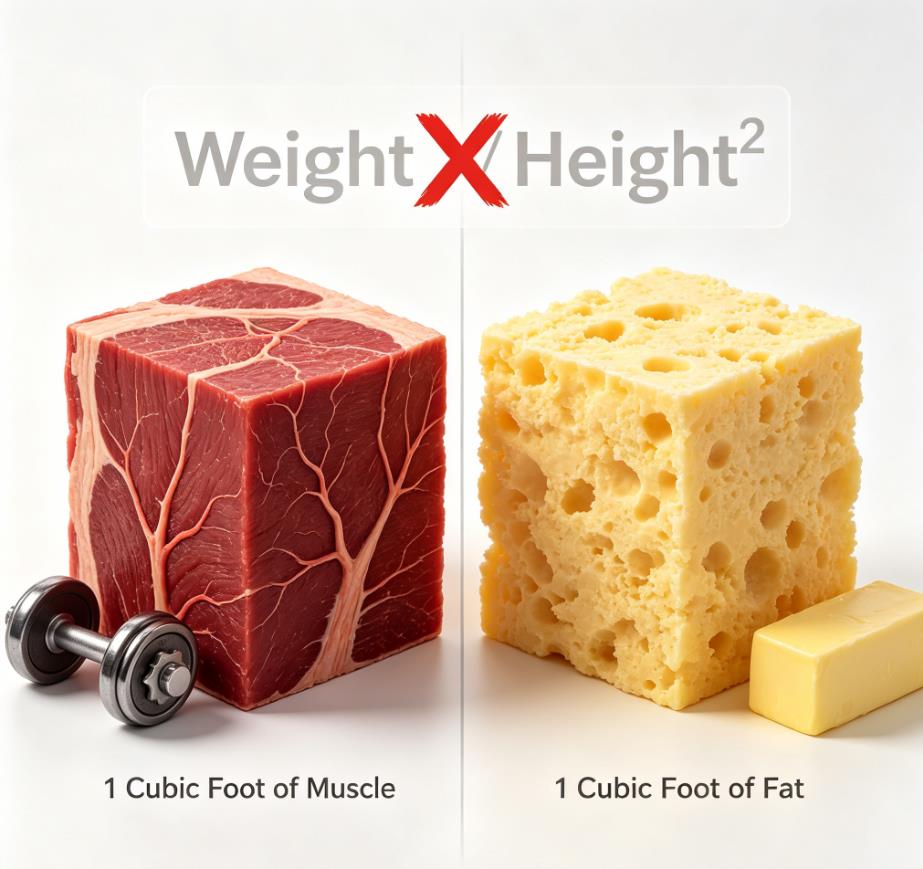
Core takeaway: Muscle is 15–20% denser than fat, so active people are often misclassified as overweight or obese despite being metabolically healthy.
This is the most well-known flaw, and for good reason. BMI is calculated using only two numbers: weight and height. It treats all weight equally — whether that weight comes from lean muscle, dense bone, or excess body fat.
The CDC acknowledges this directly: "BMI does not distinguish between fat, muscle, and bone mass. These all influence a person's weight." The result? Athletes, bodybuilders, and anyone with above-average muscle mass frequently land in the "overweight" or "obese" BMI categories despite having low body fat and excellent metabolic health.
A professional football running back who is 5'11" (180 cm) and weighs 220 lbs (100 kg) has a BMI of 30.7 — technically "obese" by CDC standards. But that weight comes from muscle that powers his performance, not excess body fat. The opposite problem exists too: a sedentary person with a "normal" BMI of 22 might carry so little muscle and so much body fat that they are metabolically obese. This condition — called normal weight obesity — affects between 29% and 46% of adults with a BMI in the healthy range, depending on the population studied.
In a 2024 community screening in suburban Chicago, three male participants in their 30s had BMIs above 30. Two were firefighters with body fat under 15%. The third was a desk worker with body fat near 32%. Same BMI. Opposite health stories.
This muscle-fat confusion isn't just a problem for professional athletes. It affects anyone who lifts weights regularly, works a physically demanding job, or just has a naturally muscular build. If you fall into any of these categories, pairing your BMI with a body fat assessment is the only way to know what the number actually means for you.
Limitation #2: BMI Ignores Where Your Body Stores Fat
Core takeaway: Waist circumference measures visceral fat, the dangerous kind packed around your organs, which BMI completely misses.
Not all body fat is equal. The fat stored just beneath your skin (subcutaneous fat) is far less dangerous than the fat packed deep inside your abdomen around your liver, pancreas, and intestines. That deep abdominal fat — called visceral fat — is metabolically active. It pumps out inflammatory compounds, disrupts insulin function, and drives up your risk of heart disease, type 2 diabetes, and stroke. BMI cannot measure any of this.
Research from the National Heart, Lung, and Blood Institute found that women who were considered normal weight by BMI but had a high waist circumference were 31% more likely to die within the two-decade observation period compared to normal-weight women with healthy waist measurements. Two people with the exact same BMI can have dramatically different health risks based solely on where they carry their fat. The NHLBI puts it plainly: a waist circumference of more than 35 inches (88 cm) for women or more than 40 inches (102 cm) for men increases your risk of heart disease and type 2 diabetes, regardless of what your BMI says.
I recently reviewed the health profile of a 55-year-old woman with a BMI of 24 — right in the middle of "healthy." Her waist measured 38 inches. Within three years, she had developed elevated fasting glucose and hypertension. Her BMI never flagged a problem. Her waist circumference told the real story.
Measuring your waist takes 10 seconds. Stand up, wrap a flexible tape measure around your bare abdomen just above your hipbones, and measure after a normal breath out. The CDC notes that increased waist circumference can also be a marker for increased risk even in persons of normal weight. This single measurement reveals more about your metabolic risk than BMI ever could alone. To find the weight range that aligns with your height and the standard BMI normal range, a healthy BMI range guide helps turn population data into your personal target — just remember to pair it with that waist measurement.
Limitation #3: BMI Cannot Account for Age-Related Body Composition Changes
Core takeaway: After 65, muscle loss (sarcopenia) makes BMI less accurate; focus on strength and protein, not the scale.
After about age 30, skeletal muscle mass begins to shrink — a process called sarcopenia. By the time a person reaches their 70s, they may have only half the muscle weight they had in their 20s. Meanwhile, body fat percentage tends to increase with age. The number on the scale — and therefore the BMI — can stay exactly the same while body composition deteriorates silently.
Johns Hopkins geriatrician Colleen Christmas, M.D., explains the problem directly: "A person with a 'healthy' BMI who has lost muscle mass and replaced it with fat may not be as healthy as the BMI would indicate." She also notes that BMI was "established for adults of European ancestry, and the numbers don't always indicate health risk among people of other ethnicities very accurately."
I saw this play out with a 72-year-old retired teacher. His BMI was 24 — "healthy" — but he struggled to climb stairs and had lost 8 pounds of muscle over five years. It was a classic case of 'skinny fat' hiding in plain sight. What he needed wasn't weight loss; it was two strength sessions a week and more protein at breakfast.
Compounding this, about 60% of older adults have a BMI that falls into the overweight or obesity range — but for many, this extra weight may actually be protective, providing a nutritional cushion against illness and falls. The key for older adults is not chasing a lower BMI. It is preserving muscle through strength exercises two to three times per week and eating enough protein — at least 1.0 to 1.2 grams per kilogram of body weight daily.
Limitation #4: BMI Does Not Adapt to Ethnic Differences in Health Risk
Core takeaway: Asian populations develop diabetes and heart disease at lower BMIs than white Europeans; WHO recommends adjusted cutoffs. Black and Hispanic adults also need context beyond BMI.
Standard BMI cutoffs were developed primarily using data from white European and North American populations. They do not reflect how different ethnic groups carry fat or develop disease at different BMI levels.
The World Health Organization recognized this gap as early as 2004, formally recommending lower BMI cut points for Asian populations. Under these guidelines, a BMI of 23 to 27.5 is considered overweight for Asian adults, and 27.5 or higher is obese — substantially lower than the standard 25 and 30 cutoffs. The WHO reaffirmed these thresholds in 2024. Research has shown that South Asian, Filipino, Vietnamese, Korean, and Japanese adults all have higher diabetes prevalence at lower BMI levels than white Europeans.
Last month, I saw a 48-year-old Indian man with a BMI of 22 who was diagnosed with type 2 diabetes. His waist circumference was 36 inches — well above the Asian threshold — which his standard BMI completely missed. While the WHO formally adopted these lower thresholds for Asian populations in 2004 (reaffirmed in 2024), the CDC has not yet updated its national standard BMI categories. However, the agency's 2025 clinical guidelines explicitly recommend that providers consider these ethnic differences during patient assessments.
Note for Black and Hispanic adults: Black adults tend to have higher muscle mass and lower body fat percentage at the same BMI compared to white adults, so standard cutoffs may overestimate risk. Hispanic adults often have higher rates of central obesity at moderate BMIs, making waist circumference an even more critical screening tool for this group. Research in the Hispanic Community Health Study/Study of Latinos found that waist-to-hip ratio was particularly useful to identify individuals with normal BMI who were at increased cardiometabolic risk.
I always advise my Asian patients to use the WHO thresholds as a more sensitive screening tool. It's better to catch risks early with a 23 cutoff than wait for a standard BMI of 25 to flag a problem — by then, metabolic changes may already be underway. If you have Asian ancestry and a BMI between 23 and 25 — technically "healthy" by the standard scale — do not assume you are in the clear. A waist measurement and blood glucose check tell a much fuller story. For a deeper dive into how BMI applies differently across demographic groups, read our comprehensive overview of BMI limitations for different ethnic groups.
Limitation #5: BMI Cannot Reflect Sex-Based Body Composition Differences
Core takeaway: Women have more body fat than men at the same BMI, so interpretation needs adjustment — a "healthy" BMI of 24 means something different for each sex.
Men and women are built differently. Women naturally carry more essential body fat — roughly 6 to 11% more than men at the same BMI — for reproductive function, while men typically carry more lean muscle mass. The BMI formula treats both sexes identically, which means it systematically misrepresents health risk for both groups.
Research shows BMI tracks body fat more accurately in women than in men. This means a man and woman with the exact same BMI can have very different body fat percentages — and very different health risks. A woman with a BMI of 24 may have a higher body fat percentage than a man with the same BMI — yet the BMI says they are equally "healthy." In reality, body fat thresholds for health differ by sex: a body fat percentage above 25% for men or above 30% for women is generally considered elevated, even if BMI says everything is fine.
Special Note: BMI and Pregnancy
Core takeaway: BMI should never be used to assess weight status during pregnancy. Only pre-pregnancy BMI matters for setting healthy weight gain targets.
During pregnancy, a woman's weight includes the growing baby, placenta, amniotic fluid, increased blood volume, and normal fluid retention. Calculating a current BMI during pregnancy is meaningless and can cause unnecessary anxiety. Instead, healthcare providers use pre-pregnancy BMI to determine safe weight gain ranges. According to ACOG guidelines:
Underweight pre-pregnancy (BMI < 18.5): gain 28–40 lbs (12.7–18.1 kg)
Normal weight pre-pregnancy (18.5–24.9): gain 25–35 lbs (11.3–15.9 kg)
Overweight pre-pregnancy (25.0–29.9): gain 15–25 lbs (6.8–11.3 kg)
Obese pre-pregnancy (≥30.0): gain 11–20 lbs (5.0–9.1 kg)
Postpartum, aim for a gradual return to your pre-pregnancy weight over 6–12 months. Avoid crash dieting if you are breastfeeding — it can reduce milk supply and nutrient quality. During lactation, the body needs an additional 300–500 calories per day to support milk production, and weight loss should not exceed 1–2 pounds per month while exclusively breastfeeding. For more detailed guidance, see ACOG's Weight Gain During Pregnancy resource.
How to Use BMI Correctly: Pair It, Do Not Rely on It
BMI is not useless — it is incomplete. Here is a practical framework for getting a complete picture of your weight-related health:
Start with BMI. Use it as a screening flag, not a final verdict. A BMI below 18.5 or above 30 warrants attention. A BMI between 25 and 29.9? It depends.
Measure your waist circumference. This takes 10 seconds and reveals visceral fat risk that BMI misses. Cutoff: above 35 inches (88 cm) for women, above 40 inches (102 cm) for men.
Check body fat percentage. Skinfold calipers, bioelectrical impedance scales, and DEXA scans all give you the fat-vs-muscle breakdown BMI cannot. DEXA is considered the clinical gold standard for body composition assessment.
Monitor metabolic labs. Blood pressure, fasting glucose, HbA1c, and a lipid panel tell you what is actually happening inside your body — far more important than any BMI number.
Look at lifestyle. A person with a BMI of 27 who exercises 150 minutes per week, eats well, sleeps adequately, and has normal metabolic labs is likely far healthier than a sedentary person with a BMI of 22 and poor lab results.
One small habit I recommend to all my patients: keep a tape measure in your bathroom drawer next to your scale. Every time you weigh yourself, take 10 seconds to measure your waist too. It takes almost no extra time, but it gives you twice as much information about your health.
Recent clinical nutrition research (2025) proposes updated criteria for defining low muscle mass, emphasizing that BMI alone fails to capture this critical health marker. The Lancet Diabetes & Endocrinology Commission — a group of 58 experts convened from around the world — published a new framework in 2025 that redefines obesity diagnosis beyond BMI alone. The Commission defined clinical obesity as "a condition of illness that directly relates to the impact of excess body fat on the function of organs and tissues" — shifting the diagnostic focus away from BMI as the primary criterion. This emerging consensus among global experts underscores what we have been saying: BMI is a starting line, never the finish line.
I've seen too many people get discouraged by a BMI number that doesn't reflect their actual health. Remember: the goal isn't to hit a specific number on a scale. It's to feel strong, have energy, and reduce your risk of chronic disease. If you're moving your body, eating well, and sleeping enough, you're already doing great — regardless of what your BMI says.
If your BMI is below 18.5 or above 30, speak with a healthcare provider — these ranges are consistently linked to higher health risk across populations (CDC, 2025).
Frequently Asked Questions About BMI Limitations
So BMI is basically useless — should I just ignore it?
Quick answer: No. BMI is still valuable at the extremes (under 18.5 or over 40), but needs additional context in the 25–35 range. At the extremes, BMI is still informative. A BMI below 18.5 almost always signals undernutrition or an underlying health issue. A BMI above 40 almost always indicates excess body fat. The problem is the gray zone in between — BMIs of 25 to 35, where body composition varies enormously from person to person. In that zone, you need additional measurements to make sense of the number.
Why does my BMI say I'm overweight when I'm in good shape?
Quick answer: Muscle weighs more than fat by volume. If you strength-train, your BMI will read higher regardless of your actual body fat. Because muscle is denser than fat. If you strength-train regularly, play sports, or have a naturally muscular build, your weight for a given height will be higher than someone with less muscle — and BMI will call you overweight or obese regardless of your actual body fat percentage. This is the single most common misclassification BMI makes, and it is why athletes and active individuals should never rely on BMI alone.
What is a better measure than BMI — waist size or body fat percentage?
Quick answer: Both. Waist circumference catches visceral fat risk; body fat % gives you the real fat-to-muscle ratio. If you can only add one, choose waist — it's free and takes seconds. Waist circumference tells you whether you carry dangerous visceral fat around your organs — the kind linked to heart disease, diabetes, and metabolic syndrome. Body fat percentage tells you your actual ratio of fat to lean tissue. Together, they fill in the two biggest gaps BMI leaves open: fat distribution and body composition.
I'm Asian and my BMI is 24 — my doctor says that's fine. Is it?
Quick answer: Under WHO Asian-specific guidelines, 24 may already be overweight. Ask for a waist measurement and fasting glucose check. Under standard BMI cutoffs, 24 is "healthy." But the WHO has recommended since 2004 that Asian adults use lower thresholds: 23 to 27.5 for overweight and 27.5 or higher for obesity. Many clinicians — especially those unfamiliar with the 2004 WHO Western Pacific Region guidelines — still use the standard cutoffs. If your BMI is between 23 and 25 and you have Asian ancestry, get a waist measurement and fasting glucose check. These provide evidence your BMI alone cannot.
Is BMI accurate after 65?
Quick answer: No. Age-related muscle loss makes BMI unreliable. Focus on strength exercises and protein intake instead. Age-related muscle loss (sarcopenia) means an older adult can have a "healthy" BMI while carrying high body fat and dangerously low muscle mass. Johns Hopkins experts emphasize that maintaining muscle through strength exercises and good nutrition is far more important than focusing on BMI alone for adults over 65. Some extra weight in later life can even be protective against frailty and falls.
Quick Wins: A 7-Day Plan to Move Beyond BMI
Day 1: Calculate your BMI using a free gender-adjusted BMI calculator. Write down the number and category. This is your screening baseline — nothing more.
Day 2: Measure your waist circumference with a flexible tape. Stand, breathe out, measure just above your hipbones. Compare: above 35 inches (88 cm) for women or 40 inches (102 cm) for men signals elevated risk.
Day 3: If you have access to a body fat scale or gym tool, get a body fat percentage reading. Rough healthy ranges: 10–20% for men, 20–30% for women, though athletic individuals trend lower.
Day 5: Schedule a blood work panel if you have not had one in the past year. Fasting glucose, HbA1c, and lipids tell the metabolic story BMI cannot.
Day 7: Write down one strength-training goal. Muscle mass protects metabolic health at any BMI. Even two bodyweight sessions per week make a difference.
At the end of the day, your BMI is just a number. It doesn't know how far you can walk, how strong you feel, or how well you take care of yourself. Use it as a tool, not a judgment, and always talk to your doctor if you have concerns about your health.
Sources
CDC: About Body Mass Index (BMI) — Limitations as a Screening Measure
NHLBI: Lancet Commission on Definition & Diagnostic Criteria of Clinical Obesity (2025)
Johns Hopkins Medicine: Sarcopenia, Body Mass Index and Adults Age 65-Plus
WHO Expert Consultation. Appropriate body-mass index for Asian populations and its implications for policy and intervention strategies. Lancet. 2004;363(9403):157–163.
Jih J, et al. Using appropriate body mass index cut points for overweight and obesity among Asian Americans. Prev Med. 2014;65:1–6. doi:10.1016/j.ypmed.2014.03.012
Harvard Health Publishing: How Well Does Body Mass Index Correlate With Excess Fat?
Reiter R, et al. How to define low muscle mass: A critical exploration of current definitions supports a reference equation-based approach. Clin Nutr. 2025;55:104–112. doi:10.1016/j.clnu.2025.10.016
ACOG: How Much Weight Should I Gain During Pregnancy? (Reviewed August 2021)
Fernández JR, et al. Comparing measures of overall and central obesity in relation to cardiometabolic risk factors among US Hispanic/Latino adults. Obesity (Silver Spring). 2015;23(9):1920–1928. doi:10.1002/oby.21176
Related Articles
BMI Proper Use: Understand Its Limits and Apply It Correctly for Better Health
BMI Accuracy: Key Limitations, Who Gets Misclassified, and What to Measure Instead
BMI Calculator Blog. This content is provided for educational and informational purposes only. Medical Disclaimer: The content of this article is for informational purposes only and does not replace professional medical advice, diagnosis, or treatment. Always seek the advice of a qualified physician or other health experts with any questions regarding medical conditions or health goals.