At a Glance: BMI limitations for different ethnic groups reveal a critical gap in standard weight screening. The widely used 18.5–24.9 healthy range was developed from predominantly white populations and fails to account for ethnic variations in body composition, fat distribution, and disease risk. For Asian populations, the WHO now recommends lower BMI thresholds—overweight at 23 and obesity at 25—because metabolic risks rise sharply at levels considered "normal" on Western scales. For Black and Hispanic adults, standard BMI can misclassify muscle mass as excess fat or miss central adiposity risks entirely. This article explains the physiological evidence behind these disparities, outlines the adjusted cutoffs, and provides a practical framework for interpreting BMI in ethnic context—pairing it with waist circumference and body fat assessments for a more honest picture of health.
Editorial Review by the BMI Calculator Editorial Review Board. Our multidisciplinary board includes registered dietitians (RD/LD), NSCA-certified exercise physiologists, and Master of Public Health (MPH) analysts with a combined 40+ years of experience in evidence-based health content development. As our review team often reminds clinicians: "BMI is a starting point, but ethnicity writes the next chapter." All content is aligned with WHO 2024 ethnic-specific BMI guidelines, CDC 2025 adult obesity recommendations, and NIH metabolic health standards.
If you've ever calculated your BMI and thought, "Does this number really represent my health as an Asian/Black/Hispanic person?"—your doubt has a scientific basis. A growing body of research shows that the genetic physical traits we inherit profoundly shape the relationship between body weight and health risk. That universal "normal range" may not fit you as well as it claims.
Think of applying standard BMI ranges to all ethnicities like using the same map to navigate different terrains—it works reasonably well on flat plains but misleads you in mountains or along jagged coastlines. Ethnic-adjusted BMI and waist circumference are the customized navigation for your specific physiological "terrain."
What follows is your personal navigation guide. We'll walk through what the terrain looks like for different backgrounds and show you how to combine BMI, waist circumference, and other tools to draw the most accurate health map for yourself.
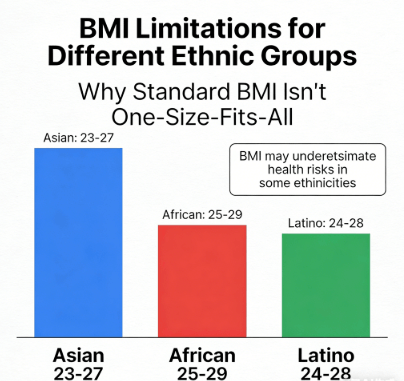
Why Standard BMI Ranges Are Not One‑Size‑Fits‑All
The standard adult BMI classification—underweight below 18.5, normal 18.5–24.9, overweight 25–29.9, obese 30 and above—was derived from epidemiological studies conducted largely on populations of European descent. When applied to individuals from other backgrounds, these cutoffs can mislead in both directions: falsely reassuring some who are at risk, and needlessly alarming others who are metabolically healthy.
The core problem is physiological. Body composition—the proportion of fat to muscle and bone—varies significantly across different groups. Equally important is how fat is distributed. Some populations accumulate visceral fat around organs even at lower total body weights, while others carry more subcutaneous fat or greater lean mass. Standard BMI captures neither of these distinctions. The World Health Organization has increasingly recognized this insufficiency, prompting ethnic-specific cutoffs for several high-risk groups.
BMI Limitations for Asian Populations: The Strongest Evidence for Adjustment
Among all ethnic groups, the case for adjusted BMI thresholds is most robust for populations of East, South, and Southeast Asian descent. In fact, a WHO expert consultation concluded that Asians face elevated risks of type 2 diabetes, hypertension, and cardiovascular disease at lower BMI levels than Caucasians. The physiological driver is a higher percentage of body fat at a given BMI, coupled with a greater propensity to store that fat viscerally—deep within the abdominal cavity, around the liver and pancreas.
That said, many Asian immigrants living in Western countries often get confused when their doctor flags health risks despite a "normal" standard BMI. It's a common and unsettling experience rooted in these very physiological differences.
Li Min's Story: When "Normal" BMI Hid a Warning
A few years ago at our health clinic, a 45-year-old Chinese American software engineer named Li Min came in for her annual physical. Her standard BMI was 23.8—labeled "normal" in her electronic health record. But when she lifted her shirt for a waist measurement, the tape read 34 inches. She mentioned that both her mother and aunt had diabetes. "But I'm healthy," she said, "my BMI is normal." We ordered a hemoglobin A1c test. The result came back at 6.2%—well into the prediabetic range. That "normal" BMI had nearly caused her to miss a golden window for early intervention. Today, she uses an Asian-specific calculator and tracks her waist and blood sugar regularly.
Her experience is far from unique. From real clinical observation, a BMI of 24 in an Asian adult often demands a closer look at metabolic markers, not a pat on the back.
The WHO responded by recommending that for Asian adults, the standard BMI cutoffs be shifted downward:
Overweight: 23.0–24.9 kg/m² (compared to 25.0–29.9 in standard ranges)
Obese: 25.0 kg/m² and above (compared to 30.0 and above)
Using an ethnic-adjusted tool like an Asian BMI calculator provides a more accurate baseline that reflects these different risk thresholds.
Within Asian subgroups, additional nuance exists. South Asians (Indian, Pakistani, Bangladeshi) tend to have even higher body fat percentages and greater insulin resistance at the same BMI compared to East Asians. Many people never notice this key difference: for South Asians, the risk of diabetes begins to climb at BMIs as low as 21–22, well inside the "normal" range. Standard BMI screening without ethnic context systematically underdiagnoses risk in millions of people.
BMI Limitations for Black, Hispanic, and Other Ethnic Populations
For Black adults, particularly those of African descent, standard BMI presents a different kind of problem. On average, Black populations have greater lean muscle mass and higher bone mineral density. This means that at any given BMI, body fat percentage is often lower than in white individuals of the same weight and height. A Black adult with a BMI of 26 might be metabolically healthy with low body fat, while a white adult with the same BMI might carry significantly more adipose tissue. The scale misclassifies the former as overweight despite a healthy body composition.
A quick self-check at home: if your BMI reads high but you can see abdominal definition and your waist is well under 40 inches, muscle—not fat—may be driving the number up. A tape measure costs three dollars and often tells a truer story.
Many athletic Black individuals ask: "My BMI says I'm overweight, but my body fat is low—does this even matter?" The answer is that the BMI number may be reflecting your higher muscle mass and bone density, not excess fat. Here, the tape measure and body fat assessment become essential truth-tellers.
Among Hispanic and Latinx communities, the picture is equally complex. There is a higher prevalence of metabolic syndrome at moderate BMI levels, driven partly by a predisposition to abdominal fat accumulation. Even so, cultural and dietary factors intersect with physiology, making it essential to look beyond BMI alone. For individuals of Middle Eastern, South Pacific, and Indigenous backgrounds, research is ongoing, but early evidence consistently points to the need for ethnic-specific interpretation.
Fat Distribution: What BMI Cannot See Across Different Populations
A central limitation of BMI across all groups is its blindness to fat distribution. Two people with identical BMIs can carry fat in completely different patterns: one storing it subcutaneously under the skin, the other packing it viscerally around internal organs. Visceral fat is metabolically active—it secretes inflammatory substances that drive insulin resistance, high blood pressure, and atherosclerosis.
Research from the NIH consistently shows that Asian populations accumulate visceral fat at lower BMIs than Caucasians. For Hispanic adults, the waist-to-hip ratio often provides critical information that BMI obscures. This is why every major public health agency—the CDC, the WHO, and the NIH—now recommends pairing BMI with waist circumference measurement as a minimum standard for individual screening. The tape measure is not optional; it is a corrective lens for BMI's ethnic blind spots.
How to Use BMI Effectively Across Different Backgrounds
The answer is not to abandon BMI—it remains a useful population-level indicator and a simple conversation starter. But for individual health assessment, particularly for those from non-European backgrounds, BMI must be embedded in a broader context. The CDC's 2025 clinical practice recommendations emphasize a multi-metric approach that includes:
Ethnic-adjusted BMI thresholds where available, especially for Asian populations. Use an Asian BMI calculator to avoid the false reassurance of standard "normal" ranges.
Waist circumference: Standard cutoffs are below 40 inches for men and below 35 inches for non-pregnant women, but for Asian adults, the WHO recommends stricter limits—below 35.5 inches for men and below 31.5 inches for women.
Body fat percentage estimation: A body fat calculator can help distinguish between muscle-dominant and fat-dominant weight patterns, particularly useful for Black adults and athletic individuals.
Family health history and metabolic labs: Blood pressure, fasting glucose, and lipid profiles provide objective data that no anthropometric tool can supply.
A BMI number, taken in isolation, is a silent number. Paired with these tools and interpreted through an ethnic lens, it becomes a more honest health indicator.
Clinical Interpretation: One Number, Different Meanings
Imagine three coworkers of the same height and weight—BMI 24—walking into a clinic. James is of European descent. Priya is South Asian. Marcus is Black and hits the gym four times a week. Their clinical recommendations diverge sharply: James likely gets routine follow-up. Priya receives a blood sugar screening alert. Marcus may get confirmation that his body composition is healthy. Same number. Three completely different health narratives. Healthcare providers who practice population-informed medicine adjust their interpretations accordingly—something a generic online calculator cannot do unless it is built to account for ethnic variation.
Practical Takeaways for Honest Health Monitoring
Recognizing BMI limitations across different populations does not diminish the tool's value. It sharpens it. Use BMI as a starting point—but never the endpoint. If you are from a non-Caucasian background, run your numbers through an ethnic-adjusted calculator and always bring waist circumference into the picture. Track trends over time rather than fixating on a single reading.
As our review board frequently tells patients: "Your BMI number is not your report card. It's the first line of a longer conversation—one that includes your heritage, your body type, and your family history."
Content Integrity Standard: All ethnic-specific BMI thresholds, body composition research, and clinical interpretation guidance in this article are sourced from WHO 2024 expert consultation reports, CDC 2025 adult obesity clinical guidelines, and NIH metabolic health standards. No individual subjective opinions are included. All health claims are verifiable against publicly available government and international health agency publications. BMI is a screening tool only. It cannot diagnose any medical condition. Always interpret BMI results within the full context of your cultural origin, family history, and additional health metrics, and consult a qualified healthcare provider for personalized assessment.
Prepared using WHO ethnic-specific BMI guidelines, CDC adult obesity clinical recommendations, and NIH body composition and metabolic health research.
Sources
Frequently Asked Questions
Why does the WHO recommend lower BMI cutoffs for Asians?
Asian adults tend to have a higher percentage of body fat at a given BMI, with more of that fat stored viscerally around organs. This leads to elevated risks of type 2 diabetes and cardiovascular disease at lower BMI levels. The WHO recommends that overweight for Asian populations begins at 23.0 and obesity at 25.0 to identify at-risk individuals earlier.
Is the standard BMI still useful for Black adults if it overestimates fatness?
BMI can misclassify muscular Black adults as overweight, but it remains a starting point. To get a more accurate picture, combine BMI with waist circumference and body fat percentage. A body fat calculator helps distinguish whether weight is coming from muscle or fat. If your BMI is above 25 but your waist is below 40 inches (for men) and body fat is in the healthy range, the "overweight" label may not apply to you.
Do Hispanic populations have adjusted BMI cutoffs?
No universal adjusted cutoffs have been formally adopted for Hispanic populations by the CDC, but research shows increased risk of metabolic syndrome at lower BMIs compared to non‑Hispanic whites, often due to higher abdominal fat. Pairing BMI with waist circumference is essential. For men, a waist below 40 inches and for women below 35 inches remains the current guidance, though for some individuals of Latin American descent, even slightly lower waist thresholds may be discussed with a doctor.
What if I'm of mixed ethnicity? Which BMI standard should I use?
There is no universal formula for mixed ethnicity. You can start with the stricter ethnic standard first—if you have significant Asian ancestry, for example, use the Asian cutoffs—then adjust based on your doctor's physical exam and lab results. Your physician will consider your family health history, body composition, and metabolic markers such as blood sugar and cholesterol. Clinical judgment is essential.
Can I just use waist circumference instead of BMI?
Waist circumference is a more direct indicator of abdominal fat and metabolic risk, and it works well across ethnicities when interpreted with appropriate cutoffs. However, BMI still provides useful information about overall weight status. The two metrics complement each other. The CDC recommends using both.
Standard Population Guidance
For Asian American adults: Use adjusted BMI thresholds: overweight 23.0–24.9, obesity 25.0+. Waist circumference should be below 35.5 inches (men) and 31.5 inches (women). An ethnic-specific Asian BMI calculator provides the most accurate classification.
For Black or African American adults: Standard BMI cutoffs apply, but interpret with caution if you are physically active with high muscle mass. Supplement BMI with waist circumference and body fat percentage for a more balanced view.
For Hispanic/Latinx adults: Standard BMI ranges apply, but pay close attention to waist circumference and metabolic health markers due to increased central obesity risk.
For South Asian adults: Risk may begin at BMIs as low as 21–22. Tight waist control (below 35.5 inches for men, 31.5 inches for women) and regular metabolic screening are strongly advised.
For pregnant or lactating individuals: Pre-pregnancy BMI is used for baseline assessment. Ethnic-specific cutoffs apply for pre-pregnancy risk evaluation. Follow your obstetric care provider's guidance during pregnancy.
BMI Calculator Blog. This content is provided for educational and informational purposes only. We encourage sharing with proper attribution to our site. Unauthorized commercial use is prohibited. Medical Disclaimer: The content of this article is for informational purposes only and does not replace professional medical advice, diagnosis, or treatment. Always seek the advice of a qualified physician or other qualified health provider with any questions regarding a medical condition or health goals.