At a Glance: Most BMI calculators stop at a single category label. But the classification tables underneath were never drawn up to read uniformly across every body type. Standard adults (18–64) hold at 18.5–24.9 as the healthy band. For older adults, long-running cohort work—not a CDC-issued table—shows lower mortality signal in slightly higher bands. Asian adults face metabolic risk earlier, with WHO 2004 action points at 23 and 27.5. Children use percentiles instead of fixed cutoffs. Muscle mass distorts the read for strength-trained adults. The sections below step through each adjustment with that context in view.
What BMI Guidelines Are, and Who Sets Them
Most calculators hand you a category and stop there. Yet the tables those labels come from belong to the WHO and CDC as population screening frameworks—quick, inexpensive, and built for groups rather than any one person. Both organizations update their interpretive notes as new epidemiological work comes in, and those notes are what most clinical screeners and calculator interfaces echo.
The detail that still catches readers off guard: these are screens, not close readings of internal body composition. They cannot separate subcutaneous from visceral fat, and they do not register lean mass. That gap explains why age, ethnicity, and training history keep reappearing in guideline notes published across the last twenty years.
Before reading the breakdowns, run your numbers through a standard BMI calculator so the thresholds below have a reference point. Then keep going, because the band your result lands in depends on more than the chart most apps display.
The Standard Adult BMI Guidelines (18–64 Years)
For non-pregnant adults aged 18 through 64 who are not competitive strength athletes, the WHO and CDC share one four-tier system. These categories appear on most lab printouts and consumer health handouts.
Underweight: below 18.5. Population research associates this band with thinner energy reserves and lower bone-density markers over time.
Healthy weight: 18.5–24.9. The band showing the lowest chronic-disease signal across large Western-based samples, though sedentary people inside it can still carry visceral fat the number will not reveal.
Overweight: 25.0–29.9. Average blood-pressure and fasting-insulin readings trend upward across this span in pooled data.
Obese: 30.0 and above, subdivided Class I (30.0–34.9), Class II (35.0–39.9), Class III (40.0+), with risk gradients rising across the classes.
Those four tiers were calibrated mostly on European-descent datasets, which is the practical reason clinicians began building out Asian and senior adjustments rather than treating the global table as final.
BMI Guidelines for Seniors (65+ Years)
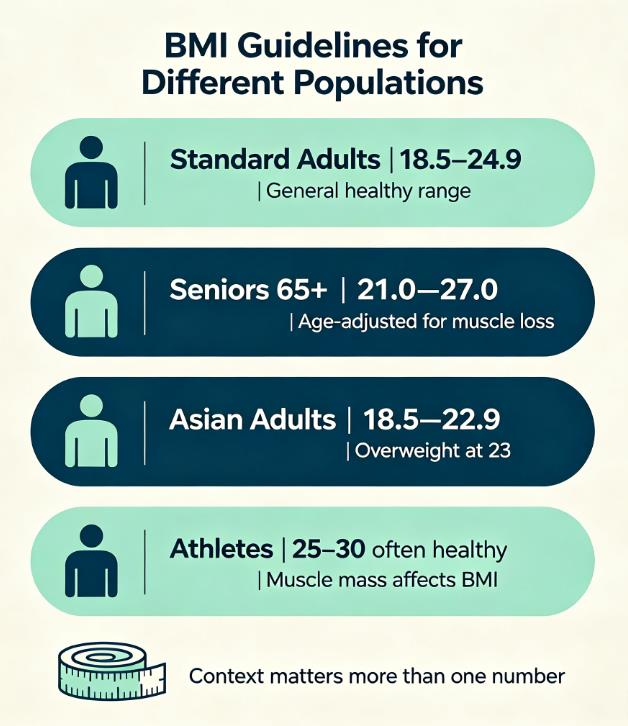
A reader wrote in last spring after seeing a BMI of 26 at age 71 and wondering whether her doctor's label still applied. Reasonable question. Straight answer: the CDC applies its standard adult categories to everyone 20 and older and has not issued a separate senior cutoff. What does circulate in geriatric literature is a major 2014 meta-analysis of older-adult cohorts showing lowest mortality in the low-to-mid 20s past age 65, driven partly by sarcopenia and small age-related height loss changing what the raw figure represents.
So a 25 that prints "overweight" on a younger adult's form is not automatically the same signal at 72. The nutritional cushion implied can offset frailty risk during illness. We have watched long-time users ease off unnecessary restriction once that distinction clicks—without anyone claiming a hard-coded senior range exists in print.
BMI Guidelines for Children and Teens (2–19 Years)
Fixed numbers do not work for kids. The CDC plots BMI on age- and sex-specific growth charts, expressed as percentiles against same-age, same-sex peers. Roughly, the 5th to 84th percentile tracks with expected growth; below 5th raises growth-concern flags; 85th to 94th is the overweight mark; 95th percentile and above is flagged obesity on clinical forms. Puberty timing bends everything, so clinicians read the percentile slope across two or three visits rather than one snapshot.
BMI Guidelines for Athletes and Muscular Individuals
Strength-trained readers know this frustration firsthand. NSCA literature makes plain that BMI cannot separate lean tissue from adipose, since muscle tissue runs roughly 15–20% denser than fat. We see this constantly in our own calculator logs—trained users second-guessing a label that a later composition scan usually contradicts. Running the same BMI entry again will not clear up that mismatch. A waist measurement paired with a body-composition assessment covers ground the two-variable formula leaves open.
BMI Guidelines for Asian Populations
East, South, and Southeast Asian adults develop visceral-fat and glucose-metabolism signals at lower BMI levels than Western cohorts. The WHO expert consultation published in 2004 placed continuum action points at 23.0, 27.5, 32.5, and 37.5 kg/m² rather than the global 25-and-30 pair. In plain terms the healthy reference band is 18.5–22.9, the overweight action point sits at 23.0, and the obesity action point lands at 27.5. South Asian subgroups trend earliest of all, which explains why many visitors rerun the same calculator twice with and without the ethnicity adjustment engaged.
A Note on When the Screen Misleads
One pattern repeats across reader mail: trained adults whose BMI sits in the high 20s while waist and composition readings stay quiet. That mismatch is not a calculator error. It is the built-in ceiling of a formula written long before body-composition imaging existed. The number still earns its place as a front-door screen; it was simply never meant to close the assessment.
Common Misconceptions About BMI Guidelines
That BMI reads health directly lingers because the formula feels definitive, yet it was calibrated as a group-level statistical screen and was never engineered to register organ fat, bone density, or inherited risk, so two people with matching digits can present very different metabolic pictures. That one chart covers every adult identically ignores the age-linked muscle changes, ethnicity-adjusted action points, and training-driven lean mass discussed earlier, all of which bend interpretation without rewriting the underlying math. That an out-of-band figure demands immediate action mistakes a screening prompt for a final read, when the reasonable step after an unexpected label is a broader conversation with a clinician rather than firm conclusions drawn from the number alone.
Practical Tips for Using BMI Guidelines
Track direction, not the decimal. Same calculator, same morning routine, every 3–6 months. The slope across visits matters more than any single quarter's exact read.
Pair the number with waist size. NHLBI thresholds place elevated metabolic signal above 40 inches for men and above 35 inches for women even when BMI looks unremarkable. One operational wrinkle we have learned the hard way: measure twice, because tape tension and angle can shift a reading nearly an inch on the same morning.
Add a second screen when the label feels off. A body fat estimate tool separates lean mass from fat mass in a way the BMI formula cannot.
Habit framing beats digit fixation. Regular movement, steady intake patterns, and consistent sleep do more for long-arc health than chasing one specific BMI figure.
When you want height-adjusted targets without overreading them, the healthy weight range calculator factors height and sex into the window while keeping the output framed as a screen rather than a fixed read. Our editorial review, coordinated by Dr. Sarah K. Johnson, cross-checks every threshold note in this section against current WHO, CDC, and NIH references before publication.
Frequently Asked Questions
What are the standard BMI categories for adults 18–64?
The shared WHO and CDC classification that forms the baseline for every adjusted guideline reads as follows:
Underweight: below 18.5
Healthy weight: 18.5–24.9
Overweight: 25.0–29.9
Obese: 30.0 and above, with Class I (30.0–34.9), Class II (35.0–39.9), Class III (40.0+)
Does the CDC publish a separate BMI range for adults over 65?
No separate CDC cutoff table exists—the agency applies the same adult categories from age 20 upward. The higher-band interpretation that circulates in geriatric literature comes from independent long-term cohort research, not from an official CDC guidance document.
Why do Asian BMI action points sit lower than the global cutoffs?
Visceral-fat accumulation and glucose-metabolism risk rise earlier on the BMI scale for Asian populations. The 2004 WHO consultation set adjusted continuum points that differ from the standard pair:
18.5–22.9: healthy reference band
23.0: overweight action point
27.5: obesity action point, not 25.0
32.5 and 37.5: higher-tier stratification points used in clinical settings
Why does BMI misclassify strength-trained adults?
The formula has no tissue-density input. Lean muscle registers denser than adipose, so a consistent lifter can land in the overweight or obese column with body-fat levels well below population averages. Waist measurement and composition testing fill the gap the single number leaves open.
Sources
WHO Expert Consultation. Lancet 2004;363:157–63 — Appropriate BMI cutoffs for Asian populations
NHLBI: Overweight and Obesity — Waist Circumference Thresholds
NIH National Institute on Aging: Maintaining a Healthy Weight
NSCA: Sport Performance and Body Composition — BMI Limitations for Athletes
BMI Calculator Blog. Content is provided for educational purposes only and does not constitute medical advice or a professional health assessment. Always consult a qualified healthcare provider with any questions regarding weight, nutrition, or fitness.
Related Articles
Last updated: October 19, 2026.