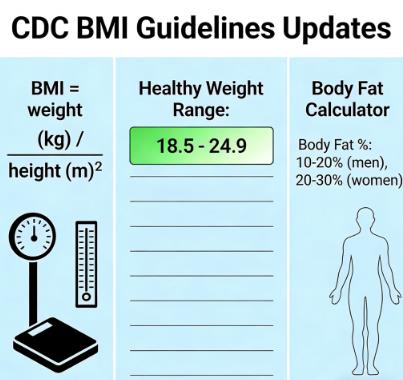
Quick Summary: CDC has not rewritten the adult BMI formula or its published categories — underweight below 18.5, healthy 18.5–24.9, overweight 25.0–29.9, obesity 30.0+. What has moved is the interpretation context: for adults 65+, research places the lowest-mortality band higher than the standard row; waist circumference now sits alongside the BMI number as a routine check; and lower action points for Asian adults come from WHO guidance rather than the CDC table itself.
Why the Interpretation Layer Matters More Than the Formula
The Centers for Disease Control and Prevention (CDC) still publishes the same adult BMI bands used across U.S. health settings. The quotient itself is unchanged. What shifted is the caution around reading it: a single number cannot describe body composition. A muscular athlete can print in the "overweight" row with little fat, while a sedentary adult in the "healthy" row may carry visceral fat the formula never sees.
Normal-weight obesity is one reason the number misleads. A body-composition review from the mid-2000s flagged this gap in how well a quotient tracks actual fatness. We've seen this mismatch thousands of times in our calculator logs: a user with a "normal" BMI will enter a waist reading above the risk threshold. That pattern is exactly why current guidance pairs the two measures.
BMI still earns its place as a first-pass screen. The quotient cannot carry age or waist context on its own. Ethnicity and muscle mass are the other two layers it misses.
What Stayed the Same in CDC Adult BMI Categories
Underweight: below 18.5
Healthy weight: 18.5–24.9
Overweight: 25.0–29.9
Obesity: 30.0+ (Class 1: 30–34.9, Class 2: 35–39.9, Class 3: 40+)
These rows are not redrawn for age or ethnicity inside the CDC table. The movement is in how health professionals and everyday users read the output once it appears.
What Changed in How CDC Guidance Is Applied
1. Age-specific reading for adults 65+
A 2014 meta-analysis pooling older-adult cohorts placed the lowest all-cause mortality around BMI 23–27 for people past 65. CDC's own table still lists 18.5–24.9 as healthy — so the higher band is a research-informed reading adjustment, not an official rewrite. That does not mean someone in their 70s should chase 27; steady weight and healthy waist matter more than the category label. An age-adjusted senior BMI checker reads results against older-adult context instead of the young-adult row.
2. Waist circumference as a routine companion
CDC and NHLBI both treat waist size as an independent marker. Added-risk lines: men above 40 in (102 cm), women above 35 in (88 cm). For Asian adults the lower lines apply — roughly 35.4 in (90 cm) men, 31.5 in (80 cm) women. One operational detail we keep relearning: tape tension alone can shift a reading nearly an inch on the same morning. Two passes beat one.
3. Ethnicity action points trace to WHO, not the CDC table
The CDC adult table stays at 25 / 30 for everyone. The lower action points — overweight at 23.0, higher risk at 27.5 — come from the WHO 2004 consultation for Asian populations. Many screening protocols reference them; CDC materials acknowledge the evidence without relabeling its own categories. An ethnicity-adjusted BMI reference shows both scales together.
Children and Teens: Percentiles, Not Fixed Rows
For ages 2–19, CDC uses sex-specific BMI-for-age percentiles: underweight below 5th, healthy 5th–84th, overweight 85th–94th, obesity at or above 95th. Fixed adult cutoffs do not apply. A child BMI percentile tool places any result against same-age peers. Parents should not use adult BMI ranges to judge a child's weight status.
How to Apply the Updated Reading to Your Own Result
Pull up your baseline reading with a BMI screening calculator, jot down the category, and don't stop there. If you are 65+, read against age context. Measure waist at navel level after a normal exhale. For the fat-versus-muscle split, a body-fat estimator fills what the quotient leaves out.
All screening guidance in this write-up stays consistent with the editorial review process led by Dr. Sarah K. Johnson, PhD, RD, so nothing here conflicts with current CDC and WHO publications.
Clearing Up Common Misreadings
CDC did not abolish BMI screening
Some readers hear "updated guidance" and assume the metric was dropped. The official 18.5–24.9 row is still published. The shift is interpretation, not removal.
A 26 after 65 isn't the same as a 26 at 35
A BMI of 26 reads "overweight" on the young-adult scale. Past 65 with stable weight and a healthy waist, that same figure sits inside the lower-mortality research band — so weight loss is not automatically the aim.
Lower Asian cutoffs sit outside the CDC table
Those 23 / 27.5 points are WHO recommendations health professionals and screening tools may apply separately; they do not replace the uniform CDC categories printed on the standard chart.
Frequently Asked Questions About CDC BMI Guidelines Updates
Did CDC change the BMI formula or categories?
No. The formula and adult categories (18.5–24.9 healthy, 25+ overweight) are unchanged. What shifted is interpretation guidance covering age, waist circumference, and ethnicity context.
Is BMI still useful for individual screening?
Yes. It remains a population screening step and a quick first pass. CDC frames it as a starting point paired with:
Waist circumference to surface hidden visceral fat
Body-composition context to separate muscle from fat
Age context for adults over 65
It never serves as a stand-alone assessment.
Why is BMI 23–27 discussed for seniors?
Older-adult cohort evidence places lowest mortality around that span. CDC's published table still uses 18.5–24.9; the higher reading is an interpretation adjustment for age, not a revision of the official categories.
Do Asian BMI cutoffs replace CDC categories?
No. The 23 / 27.5 action points are WHO guidance. CDC adult categories stay uniform, with lower thresholds applied only as supplementary screening markers.
How do I measure waist correctly?
Stand upright, tape at navel level, exhale normally, snug without pinching skin. Above 40 in men or 35 in women signals added risk regardless of the printed BMI.
References & Sources
NHLBI: Aim for a Healthy Weight — BMI and waist circumference
American Heart Association: BMI in Adults — limitations and complementary metrics
Winter JE, MacInnis RJ, Nowson CA. BMI and all-cause mortality in older adults: a meta-analysis. Am J Clin Nutr. 2014;99(4):875–890.
Related Articles
This article is for informational and educational purposes only. It does not constitute medical advice or replace professional health assessment. Always consult a qualified healthcare provider regarding your individual health and weight-related goals.
Last updated: October 19, 2026.