At a Glance: An overweight 10 year old has a CDC BMI-for-age at the 85th–94th percentile for exact age and sex. Adult BMI 25 does not apply. Confirm with height, weight, trend, and a pediatric growth chart.
At 140 cm and 45 kg, a 10-year-old boy's BMI is about 23.0 — but that raw number means nothing alone. At age 10, the same BMI can mean different things because height and puberty change fast.
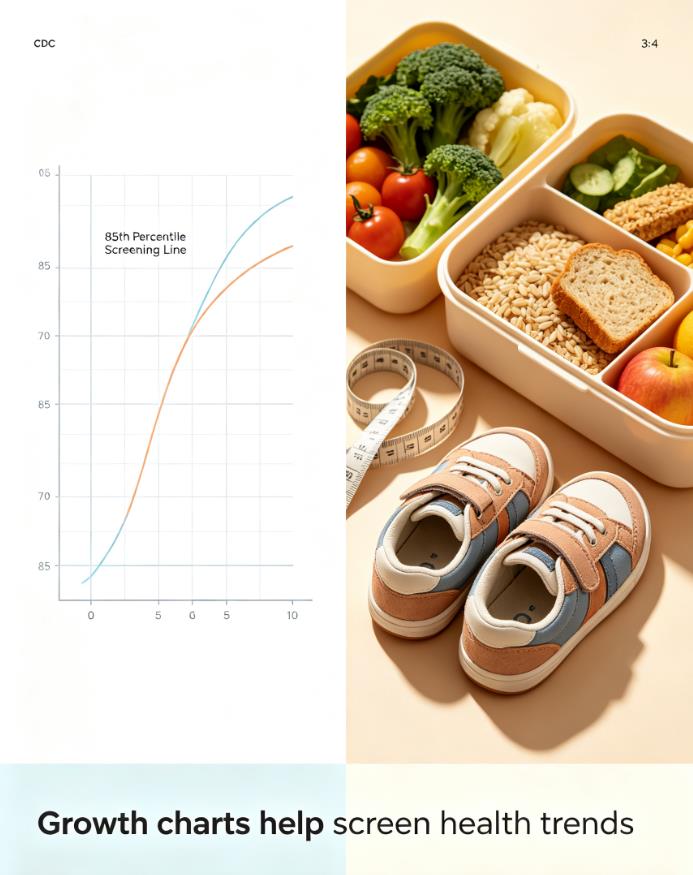
How "Overweight" Is Defined at Age 10
The CDC screens children 2–19 by percentile, not fixed adult cutoffs:
Underweight: below the 5th percentile
Healthy weight: 5th–84th percentile
Overweight: 85th–94th percentile
Obesity: 95th percentile or higher (Severe obesity is defined as ≥120% of the 95th percentile or BMI ≥35 kg/m².)
Most families only weigh kids at doctor visits and miss slow upward percentile drift. One parent tracked their son's numbers over six months; his raw BMI held steady at 22.4, yet his percentile climbed from 72nd to 88th once his height growth slowed. She noticed his clothes fit differently even though the scale hadn't moved much.
Three Growth Patterns That Change What This Screening Result Means
Steady percentile: A 10-year-old staying in the 86th–90th percentile for multiple years falls within the overweight screening range, yet grows along his own curve.
Crossing upward: Moving from 60th to 90th within 6–12 months often signals more calories, less activity, or poor sleep.
Muscular build: A young athlete can land in the 85th–94th from muscle. Use our child bmi calculator to plot CDC percentiles and pair with activity history.
Question: How Do I Check a 10 Year Old Quickly?
Answer: weigh in light clothing, measure height against a flat wall, calculate BMI, then plot BMI-for-age by sex on CDC charts. If the result is 85th–94th percentile, classify it as overweight screening and review the 6–12 month trend. Adult BMI categories should not be used.
Data Points Parents Often Miss
Recheck every 6 months if already 85th–94th; yearly is enough for stable healthy ranges.
Add waist check only as screening. CDC notes abdominal fat raises risk, but percentile remains the first filter.
Sleep matters. Children 6–12 years need 9–12 hours per night; short sleep tracks with weight gain risk.
Sugar drinks add empty calories. Replacing one daily soda with water can remove 150–200 calories.
Small measurement mistakes add up fast over repeated checks. Many parents mistakenly compare their 10-year-old's BMI to adult standards, which creates unnecessary worry. For adult comparison, our Gender Adjusted BMI Calculator uses separate adult ranges. Do not mix those with a 10 year old.
When Extra Assessment Helps
BMI can over-flag muscular kids and under-flag high body fat in "normal" weights. If a 10 year old has rapid percentile crossing, family history of type 2 diabetes, snoring, or waist gain, a qualified healthcare provider can add body-composition screening. Individual growth varies by ethnicity, puberty stage, and muscle.
Frequently Asked Questions
What BMI is overweight for a 10 year old?
There is no fixed cut. CDC uses sex- and age-specific percentiles; 85th–94th is overweight screening. A BMI of 22 may be healthy for one 10 year old and overweight for another.
Is BMI 22 overweight for a 10 year old boy?
Maybe. At 140 cm and 45 kg, BMI 23.0; at 138 cm and 40 kg, BMI 21.0. The same "22" shifts by height, sex, and exact age. Always plot BMI-for-age.
Can a muscular 10 year old be "overweight" by BMI only?
Yes. Muscle raises BMI. Review sports activity, waist size, and body composition before assuming excess fat.
How often should a 10 year old's BMI be checked?
Every 6 months if already 85th–94th or if percentile is rising; yearly for stable healthy ranges.
How much weight should an overweight 10 year old lose?
No universal target. Many children do better with weight maintenance while height catches up. Calorie restriction or rapid loss is not advised without a qualified provider.
What habits lower overweight risk?
Aim for 60 minutes of daily activity, 9–12 hours of sleep, water instead of sugar drinks, and family meals with vegetables, protein, and whole grains. One family swapped evening screen time for a 20-minute walk after dinner — no calorie counting. Their son's percentile stayed flat while his height caught up. Results vary by child.
Sources
This article is for educational and informational purposes only. It does not provide medical advice, diagnosis, or treatment. Growth charts are screening tools, not pass-or-fail scores. Always discuss your child's growth with a qualified pediatrician or healthcare provider. Individual results will vary. The BMI Calculator Blog Team maintains editorial independence and does not sell health products.