At a Glance: BMI for adults is a widely used screening tool that calculates weight in relation to height to estimate weight-related health risks. Most regular people first hear about BMI during annual doctor checkups, not academic research—and that's exactly how it was intended. Developed in the 19th century, it's still just a starting point—not a diagnosis—for conversations about metabolic health. This guide explains the WHO and CDC standard BMI ranges, provides step-by-step calculation methods for both metric and imperial units, and clarifies the tool's strengths and limitations. Because BMI alone cannot distinguish muscle from fat or account for fat distribution, we also show how to combine it with waist circumference and body composition tools for a clearer picture. If you've ever wondered whether your BMI number truly reflects your health—or felt a knot in your stomach after seeing "overweight" on a screen—the evidence-based insights below will help you interpret it with confidence.
Editorial Review by the BMI Calculator Editorial Review Board. Our multidisciplinary board includes registered dietitians (RD/LD), NSCA-certified exercise physiologists, and Master of Public Health (MPH) analysts with a combined 40+ years of experience in evidence-based health content development. As our reviewing dietitians often remind us: "BMI opens the door to a conversation, but it doesn't close it." All content is aligned with CDC 2025 adult weight management guidelines, WHO 2024 BMI classification standards, and NIH 2024 metabolic health recommendations.
What Exactly Is BMI for Adults, and Why Does It Matter?
You've just used a calculator, or done the math yourself. The number stares back at you: 26.3. "Overweight." Your mind races—does this mean I'm unhealthy? Before that thought spirals, take a breath. In clinical practice, this conversation has played out thousands of times. That number is a starting point for a dialogue with yourself and your doctor, not a final grade on your health. Let's break down what it really means.
BMI—short for Body Mass Index—is a single number derived from your weight and height. For adults aged 20 and older, it serves as a population-level screening tool to flag potential weight-related health risks. Unlike direct body composition scans such as DEXA or bioelectrical impedance, BMI doesn't require a clinic visit, specialized equipment, or anything invasive. Its strength is simplicity: a scale, a tape measure, and a basic calculator are all you need to generate a number that falls into a standardized classification system.
The concept originated with Belgian mathematician Adolphe Quetelet back in the 1830s, but its modern public health use was solidified by the World Health Organization (WHO) and the Centers for Disease Control and Prevention (CDC) as a practical way to track population-level obesity trends. The underlying physiology isn't complicated: in general, as weight increases relative to height, body fat tends to rise, which in turn elevates the risk for conditions like type 2 diabetes, high blood pressure, and heart disease. The relationship isn't perfect, but it's consistent enough across large populations to make BMI a useful first filter.
Here's what BMI doesn't tell you. It doesn't directly measure body fat percentage, lean muscle mass, or where your fat is distributed. Two people with identical BMIs can have completely different body compositions. That's why the CDC and NIH both emphasize that BMI should be interpreted as a screening indicator—like a check-engine light—rather than a diagnostic verdict. When the number falls outside the normal range, it simply signals that a closer look may be worth your time.
For a deeper dive into how BMI compares with other body composition tools, you might combine your results with a body fat calculator. But for most adults, BMI remains the recommended entry point for self-assessment.
A Tale of Two 28s: Why BMI Alone Can Mislead
Consider two 40-year-old men, both 5'10" and 200 lbs. Their BMI is identical: 28.7, squarely in the "overweight" category. But the similarities end there.
Alex is a software engineer with a sedentary lifestyle. His body fat percentage is 30%, and his waist circumference measures 40 inches. Per CDC guidelines, that waist measurement places him at elevated metabolic risk, regardless of what the scale says.
Ben is a firefighter who strength trains four times a week. His body fat percentage is 15%, and his waist circumference is 34 inches—well within the healthy range. His elevated BMI reflects lean muscle mass, not excess fat.
The number is the same. The health risk profiles are worlds apart. Context is everything. A single BMI value, stripped of accompanying information about lifestyle, body composition, and fat distribution, can mislead as easily as it can inform.
How to Calculate BMI for Adults: A Step-by-Step Guide
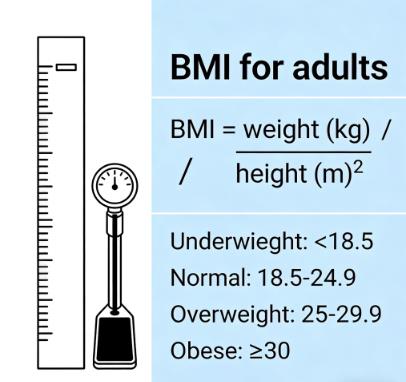
The BMI formula is universal—weight divided by height squared—with only a unit conversion factor separating metric from imperial. Below are the methods with worked examples, so you can calculate manually or understand what an online tool does behind the scenes.
Metric Calculation (Kilograms and Meters)
Weigh yourself in kilograms (kg). Example: 70 kg.
Measure your height in meters (m). If you measure in centimeters, divide by 100. Example: 175 cm = 1.75 m.
Square your height: 1.75 × 1.75 = 3.0625 m².
Divide weight by height squared: 70 ÷ 3.0625 ≈ 22.86 kg/m².
Imperial Calculation (Pounds and Inches)
Weigh yourself in pounds (lbs). Example: 154 lbs.
Measure your height in inches. Example: 5 feet 8 inches = 68 inches.
Square your height: 68 × 68 = 4,624 in².
Divide weight by height squared, then multiply by 703 (the imperial conversion factor derived from the relationship between pounds and kilograms, and inches and meters): (154 ÷ 4,624) × 703 ≈ 23.1.
If manual math isn't your thing, a BMI Calculator handles both unit systems instantly and eliminates arithmetic errors. A practical tip: weigh yourself first thing in the morning, after using the bathroom and before eating, for the most consistent reading. Small fluctuations from water retention or a heavy meal can shift your daily number by a pound or two—completely normal, and not a reason to recalculate your BMI every single day.
Understanding BMI Ranges for Adults: What Your Number Means
The WHO has established international BMI classification standards that the CDC and NIH also adopt for non-Asian adult populations. These ranges are based on epidemiological data linking BMI levels to disease risk—not on aesthetics or arbitrary cutoffs.
Below 18.5: Underweight. This range may indicate insufficient energy intake, nutrient deficiencies, or underlying medical conditions that affect nutrient absorption. Per the NIH, being underweight is associated with a higher risk of osteoporosis, anemia, and weakened immune function.
18.5 to 24.9: Normal weight. For most adults, this range correlates with the lowest risk of weight-related chronic diseases. However, as the CDC notes, individuals in this range can still carry excess visceral fat if they are sedentary—a condition known as normal-weight obesity—which is why waist circumference is a valuable companion metric. Readers often ask: "My BMI is normal, so I'm definitely healthy, right?" Not necessarily. A normal BMI with a high waist circumference still warrants attention.
25.0 to 29.9: Overweight. This range is linked to an elevated risk of high blood pressure, cholesterol problems, and insulin resistance. The CDC emphasizes that weight management at this stage, through modest calorie reduction and increased physical activity, can significantly lower the trajectory toward more serious conditions.
30.0 and above: Obese. Obesity is subdivided into Class I (30.0–34.9), Class II (35.0–39.9), and Class III (40.0 and above). Higher classes are associated with progressively greater risks for type 2 diabetes, heart disease, sleep apnea, and certain cancers. Clinical interventions, including structured lifestyle programs and medical supervision, are often recommended.
These categories are general guidelines. They don't replace individual clinical evaluation. To see where your number falls within a personalized range based on age and gender, you can consult a healthy weight range tool.
Beyond the Number: What Else Matters for Adult Health
BMI's most significant limitation is its inability to tell the difference between fat mass and lean mass. A strength athlete with substantial muscle development may have a BMI in the overweight or even obese range while carrying low body fat. Conversely, an older adult with age-related muscle loss—what clinicians call sarcopenia—may have a normal BMI yet harbor dangerously low muscle mass and high body fat. That's where additional metrics earn their place.
Waist circumference is a direct indicator of abdominal fat. The CDC recommends that men keep their waist below 40 inches (102 cm) and non-pregnant women below 35 inches (88 cm). For Asian populations, the WHO recommends lower thresholds: below 35.5 inches (90 cm) for men and below 31.5 inches (80 cm) for women, due to higher risks for blood sugar and heart health issues at lower BMIs. Pairing waist measurement with BMI gives you a much sharper screening picture.
For those with a naturally athletic build, an athlete BMI calculator can provide a more relevant interpretation. For older adults, a senior BMI calculator accounts for the slightly higher optimal range (often 23–27) that supports muscle retention and reduces fall risk. And for individuals of Asian descent, an Asian BMI calculator uses adjusted cutoffs that reflect heightened metabolic risk at lower numbers.
Lifestyle factors matter independent of BMI. A person in the normal weight range who smokes, leads a sedentary life, and eats a diet heavy in processed foods may face higher cardiovascular risk than someone in the overweight range who stays active and follows a Mediterranean-style diet. It's also worth remembering: even with combined waist and BMI tracking, these tools still can't fully capture sleep quality, mental stress, and daily activity intensity—all of which shape long-term health. BMI is one piece of a larger puzzle that includes blood pressure, cholesterol numbers, blood sugar levels, and personal health history.
Common Misconceptions That Skew How People View BMI
Misconception: A normal BMI guarantees good health. Normal-weight obesity is a recognized phenomenon where body fat percentage is elevated despite a BMI below 25. This usually goes hand-in-hand with low muscle mass and extra fat around the middle. Waist circumference measurement catches this hidden risk.
Misconception: BMI is useless for muscular people. While BMI overestimates fatness in highly muscular individuals, that group represents a small slice of the general adult population. For most people, BMI remains a reasonably accurate screening tool—especially when paired with a tape measure.
Misconception: The 703 factor in the imperial formula is made up. It's a mathematical constant that reconciles imperial units with the metric formula. Specifically, 703 = 0.453592 / (0.0254²), derived from the exact kilogram-to-pound and meter-to-inch conversions. The formula is consistent and validated, not a random adjustment.
Putting BMI to Use: A Practical Monitoring Routine
Clinical guidelines from the NIH recommend that adults calculate their BMI at least once a year as part of routine health monitoring—similar to checking blood pressure. If you're actively working on weight management, a monthly check-in helps track trends without encouraging daily fixation. A real-world example: a 52-year-old office worker tracked his BMI monthly for six months while following a strength program. His BMI stayed steady at 27.5, yet his waist size shrank by two inches—proof he was losing fat while keeping muscle. The number alone would have missed the whole story.
Many health-conscious folks also track sleep hours alongside these numbers—poor sleep can quietly undermine both body composition and overall wellness, so it's a smart add-on to your routine.
Step 1: Measure your height accurately. Once is sufficient unless you're over 50—then annual height checks are wise due to potential spinal compression over time.
Step 2: Weigh yourself under standardized conditions: morning, post-void, minimal clothing, on a hard surface. Stick with the same scale each time.
Step 3: Calculate your BMI manually or with a digital tool. Record the number and the date.
Step 4: Measure your waist circumference at the narrowest point above the navel, following CDC protocol. Jot it down alongside your BMI.
Step 5: Review the combined trend every 4–8 weeks. A stable or improving BMI plus a stable or shrinking waist circumference points in a healthy direction. A rising waist with a stable BMI suggests increasing visceral fat and deserves attention to diet and activity.
Think of your health assessment like a car's dashboard. BMI is the check-engine light—it tells you something might need a look. Waist circumference is the fuel gauge—showing where your energy reserves are stored. And a conversation with your doctor is the full diagnostic scan. Don't ignore the light, but don't mistake it for the full diagnosis either. This integrated approach turns BMI from a static number into a dynamic monitoring tool. If your measurements fall outside recommended ranges, the right next step is a conversation with a qualified healthcare provider—not a self-diagnosis based on a single metric.
Content Integrity Standard: All BMI classification ranges, measurement protocols, and health risk associations in this article are sourced from official WHO, CDC, and NIH publications. No individual subjective opinions are included. All health claims are verifiable against publicly available clinical guidelines. BMI and waist circumference are screening tools only. They cannot diagnose any medical condition. If your measurements fall outside the recommended ranges, follow up with a healthcare provider for a full clinical assessment.
Prepared using WHO BMI classification standards, CDC adult obesity guidelines, and NIH metabolic health recommendations.
Sources
CDC: About Adult BMI — How It Is Used and Interpreted (2025)
NIH National Heart, Lung, and Blood Institute: Classification of Overweight and Obesity by BMI
NIH NIDDK: Health Risks of Overweight and Obesity — Clinical Evidence Summary
Frequently Asked Questions
Can I fully trust my BMI number for real health judgment?
BMI is a screening tool, not a diagnostic test. It categorizes weight status accurately for most of the general population but may misclassify individuals with very high muscle mass or older adults with muscle loss. For a more personalized assessment, combine BMI with waist circumference and, when possible, body fat percentage. A single number never tells the whole story.
Why do the BMI ranges differ for Asian populations?
Per WHO 2024 guidelines, Asian adults tend to develop blood sugar issues and heart health problems at lower BMI levels compared to white populations. As a result, the recommended cutoffs shift downward: overweight is defined as 23.0–24.9 and obesity as 25.0 and above. This adjustment helps identify at-risk individuals earlier.
How often should I recalculate my BMI?
The CDC recommends that adults assess their BMI at least once a year as part of a routine health check. If you are actively losing or gaining weight, a monthly check-in can help you track progress, but avoid daily calculations—small fluctuations in water weight can cause unnecessary noise and anxiety.
What does it mean if my BMI is normal but my waist measurement is high?
This pattern suggests normal-weight obesity—a condition in which excess visceral fat accumulates despite a normal BMI. It is associated with increased heart and metabolic risks. The CDC recommends that men with a waist circumference over 40 inches and women over 35 inches discuss further evaluation with their healthcare provider, even if BMI falls in the normal range.
Can I use BMI if I am over 65?
Yes, but interpretation shifts slightly. The NIH notes that a BMI in the range of 23–27 may be associated with better health outcomes in older adults, as it can help preserve muscle mass and bone density. A senior-specific BMI calculator can provide age-adjusted guidance.
Is the imperial formula really the same as the metric one?
Yes. The imperial formula BMI = (weight in pounds / height in inches²) × 703 is mathematically equivalent to the metric formula weight (kg) / height (m)². The factor 703 converts pounds to kilograms (1 lb = 0.453592 kg) and inches to meters (1 in = 0.0254 m) so that the result is expressed in the same unit: kg/m².
Standard Population Guidance
For Asian American adults: Per WHO 2024 ethnic-specific guidelines, overweight is defined as BMI 23.0–24.9 and obesity as BMI 25.0+. Use an Asian BMI calculator for accurate classification.
For adults 65+: Slightly higher BMI values (23–27) may be protective against malnutrition and frailty. Prioritize muscle mass maintenance and functional health. Consult a healthcare provider for personalized targets.
For pregnant or lactating individuals: Pre-pregnancy BMI is used for baseline assessment. BMI-based weight management is not recommended during pregnancy. Follow your obstetric care provider's guidance.
For individuals with a history of eating disorders: Frequent weight monitoring and BMI calculation can trigger harmful behaviors. Work with a mental health professional and a registered dietitian before engaging in any self-assessment routine.
For competitive athletes: Standard BMI cutoffs often overestimate fatness due to high muscle mass. Prioritize direct body composition assessments such as skinfold caliper measurements or DEXA scans, or use an athlete-specific BMI tool that adjusts for lean mass.
BMI Calculator Blog. This content is provided for educational and informational purposes only. We encourage sharing with proper attribution to our site. Unauthorized commercial use is prohibited. Medical Disclaimer: The content of this article is for informational purposes only and does not replace professional medical advice, diagnosis, or treatment. Always seek the advice of a qualified physician or other qualified health provider with any questions regarding a medical condition or health goals.