Quick summary: The key difference between BMI and ideal body weight is that BMI places you in a weight category — underweight, healthy, overweight, or obese — while IBW formulas give a single target number. Per CDC guidelines, a healthy BMI is 18.5 to 24.9. Ideal body weight (IBW) formulas like Devine and Robinson were developed for medical dosing, not for defining health. Research published in 2020 found IBW can differ by up to 14% in males and 19% in females depending on which formula you use. Neither is perfect. This guide breaks down the numbers, the limits, and how to use both tools without getting stuck on any single number. The most reliable health assessment combines: 1) BMI screening, 2) waist circumference measurement, 3) body fat percentage, and 4) regular blood work.
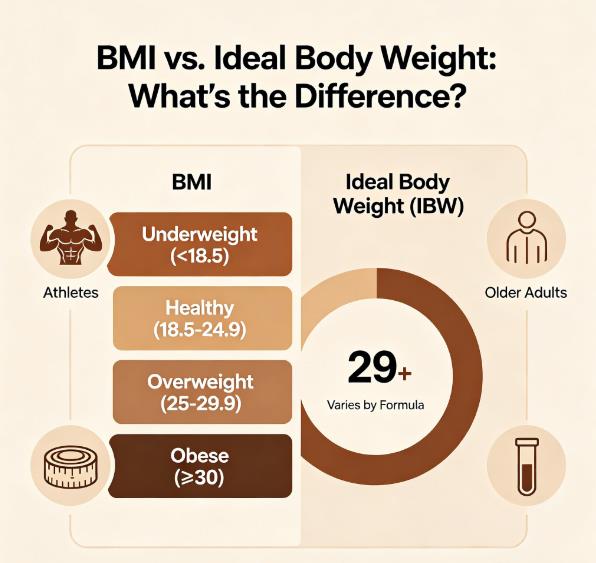
Your BMI and your "ideal body weight" are related but not the same. BMI is a screening tool. It places you in a broad category based on your height and weight. Ideal body weight formulas give you a specific target number. Both can be useful. Both can be misleading.
What BMI tells you:
Underweight: BMI below 18.5
Healthy weight: BMI 18.5 to 24.9
Overweight: BMI 25.0 to 29.9
Obese: BMI 30.0 or higher
BMI is calculated the same way for all adults, regardless of age, sex, or race. The CDC emphasizes that BMI is a screening measure, not a diagnostic tool. It should be considered alongside other factors like blood pressure, cholesterol levels, and physical examination.
What ideal body weight formulas tell you:
Ideal body weight (IBW) formulas give you a single target weight in pounds or kilograms. The most common is the Devine formula, developed in 1974 for drug dosing calculations, not for defining health. All classic IBW formulas were originally developed for medical dosing purposes, not for setting personal health goals. No IBW formula accounts for individual variations in frame size, muscle mass, or ethnic body composition differences.
Devine formula for men: 50 kg + 2.3 kg per inch over 5 feet
Devine formula for women: 45.5 kg + 2.3 kg per inch over 5 feet
Other formulas exist — Robinson, Hamwi, Miller — and they produce different numbers for the same person. Research published in 2020 found that IBW can differ by up to 14% in males and 19% in females depending on which formula you use. That is a big spread. One person can be "ideal" by one formula and not by another.
The key difference in one sentence: BMI gives you a category. IBW gives you a single number. BMI is broader. IBW is more specific — but often less reliable.
Where BMI falls short:
BMI does not distinguish between fat, muscle, and bone mass
A muscular athlete can have a high BMI but very low body fat
An older adult can have a normal BMI but low muscle mass and high fat
BMI does not indicate where fat sits on the body
For Asian adults, the WHO recommends lower BMI thresholds. Overweight begins at BMI 23, not 25. This is because Asian populations tend to develop metabolic risks at lower BMI levels. For adults over 65, a slightly higher BMI between 25 and 27 may be associated with better survival rates, as it indicates preserved muscle mass.
Where IBW formulas fall short:
IBW formulas were not designed for healthy people
The Devine formula was created for drug dosing in hospitalized patients
Different formulas give different answers for the same person
IBW does not account for frame size, muscle mass, or age
The formulas do not account for ethnic differences in body composition
Which one should you use?
Use BMI for a quick screening. It gives you a category and a sense of where you stand relative to population norms. Use IBW as a rough reference point only. Do not treat it as a target you must hit.
For a more complete picture, use a BMI calculator to get your baseline. Then pair it with a healthy weight range tool to see your full BMI-based range. A body fat calculator gives you the tissue-level detail that both BMI and IBW miss.
Track your waist circumference alongside your BMI. Per NIH, a waist over 35 inches for women or over 40 inches for men increases health risk regardless of BMI. That single measurement often tells you more than any formula. Learn more about calculating your personalized healthy weight range in our complete ideal body weight guide.
References & Sources
CDC: About Body Mass Index (BMI) — Screening and Limitations
NIH: Assessing Your Weight and Health Risk — Waist Circumference
Variability in ideal body weight formulae — Journal of Critical Care (2020)
WHO Western Pacific: Obesity and Overweight — BMI Cut-off Points
Frequently Asked Questions About BMI vs Ideal Body Weight
What is the difference between BMI and ideal body weight?
BMI gives you a weight category (underweight, healthy, overweight, obese) based on your height and weight. Ideal body weight formulas give you a specific target weight in pounds or kilograms. BMI is broader. IBW is more specific — but often less reliable.
Which is more accurate, BMI or ideal body weight?
Neither is perfectly accurate. BMI is a screening tool with known limitations. IBW formulas were developed for drug dosing, not health. Both are rough estimates. For a more accurate picture, use waist circumference and body fat percentage alongside BMI.
What is a healthy BMI range?
Per CDC, a healthy BMI for adults 20 and older is 18.5 to 24.9. This range is associated with lower risk of chronic disease at the population level.
What is the Devine formula for ideal body weight?
For men: 50 kg + 2.3 kg per inch over 5 feet. For women: 45.5 kg + 2.3 kg per inch over 5 feet. It was developed for drug dosing, not for defining health.
Why do different ideal body weight formulas give different numbers?
Different formulas were developed from different patient populations and time periods. Research published in 2020 found IBW can differ by up to 14% in males and 19% in females depending on which formula you use.
Is BMI different for Asian adults?
Yes. The WHO recommends lower BMI thresholds for Asian populations. Overweight begins at BMI 23, not 25. This is because Asian populations tend to develop metabolic risks at lower BMI levels.
Should older adults use the same BMI range as younger adults?
For adults over 65, a slightly higher BMI between 25 and 27 may be associated with better survival rates, as it indicates preserved muscle mass. Focus on mobility and strength rather than just the number.
What should I track instead of just BMI or ideal body weight?
Track your waist circumference, body fat percentage, and blood work — fasting glucose, cholesterol, and blood pressure. These give you a clearer picture of your metabolic health than any single number.
Related Articles
What Is My Ideal Body Weight? A Complete Guide to Finding Your Healthy Range
Your Ideal Body Weight: A Realistic Guide to Finding Your Healthy Range
Ideal Body Weight Formula: Real Numbers, Why a Range Beats One Number, and Who Should Ignore It
BMI Calculator Blog. This content is provided for educational and informational purposes only. We encourage sharing with proper attribution to our site. Unauthorized commercial use is prohibited. Medical Disclaimer: This content does not replace professional medical advice, diagnosis, or treatment. Always seek the advice of a qualified physician or other licensed health provider with any questions regarding your body composition, weight status, or health goals.