Quick summary: Average height and weight for 8-year-old children range from 47–54 inches and 44–80 pounds, per CDC growth charts[1]. For boys, average weight runs 46–78 pounds; for girls, 44–80 pounds. These numbers represent broad ranges because children grow at different rates. What matters most is tracking the growth trend over time, not a single measurement. This guide breaks down CDC-based ranges, explains how to read percentiles, shows when to check in with your pediatrician, and helps you use our child BMI calculator to track growth over time.
For an 8-year-old child, height and weight fall into a wide range. All ranges below are based on official CDC growth chart data[1] for children aged 2–20 years. An 8-year-old boy typically stands between 47 and 54 inches tall and weighs between 46 and 78 pounds. An 8-year-old girl is typically between 47 and 54 inches tall and weighs between 44 and 80 pounds. These numbers are averages. Your child could be above or below these ranges and still be developing normally.
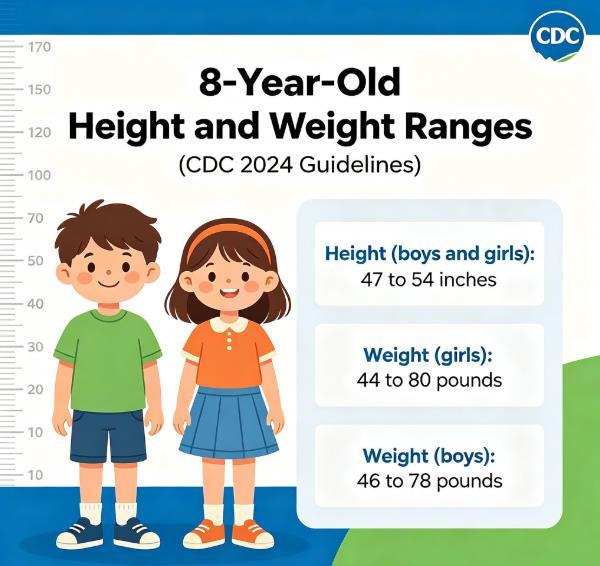
8-Year-Old Height and Weight Ranges (CDC 2024 Guidelines):
-
Height (boys and girls): 47 to 54 inches
-
Weight (girls): 44 to 80 pounds
-
Weight (boys): 46 to 78 pounds
Percentiles explain how a child compares to other children the same age and sex. A child at the 50th percentile is exactly average. A child at the 25th percentile is smaller than 75 out of 100 children. A child at the 75th percentile is larger than 75 out of 100. According to the CDC[2], a BMI-for-age between the 5th and 84th percentile is considered a healthy weight range for children. A BMI at or above the 85th percentile is classified as overweight. A BMI at or above the 95th percentile is classified as obese and associated with increased risk of type 2 diabetes and high blood pressure in children[3]. Note: Muscular children may have a higher BMI percentile without excess body fat; consult a pediatrician for a full body composition assessment. Per the CDC[3], children with obesity are more likely to have numerous health conditions, including high blood pressure and type 2 diabetes. The American Academy of Pediatrics recommends structured lifestyle intervention for children with BMI at or above the 95th percentile to reduce long-term health risks.
Genetics play a major role in height and weight. Tall parents tend to have tall children. Shorter parents tend to have shorter children. Nutrition also matters. A balanced diet supports steady growth. Physical activity helps maintain a healthy weight. Sleep affects growth hormones. According to the American Academy of Pediatrics (AAP)[4], an 8-year-old needs about 9 to 11 hours of sleep per night for optimal growth and development.
Boys and girls grow at similar rates at age 8. The height ranges are identical. Weight ranges are close. Girls may weigh slightly less on average, but the difference is small. Growth patterns start to diverge more during puberty, which typically begins between ages 8 and 13 for girls and 9 and 14 for boys.
Children grow at different rates. Some 8-year-olds have already started their pre-puberty growth spurt. Others have not. Both are normal. A child who is shorter than classmates at age 8 may catch up later. A child who is taller may slow down earlier. On average, children aged 3 to 10 grow about 2 to 2.5 inches per year, though 8-year-olds may experience slower, steadier gains. Weight gain of about 4–5 pounds per year is typical. According to CDC growth data, 7–9 year olds average about 2.5 inches of growth per year. At age 8, children typically gain 4–5 pounds per year; deviations from this rate may warrant a pediatric checkup.
Pediatricians track growth over time, not single measurements. A child who has always been at the 30th percentile for height and suddenly drops to the 10th may need a check. A child who has always been at the 60th percentile and stays there is likely fine. The trend matters more than the number. If your child crosses more than 2 major percentile lines in 6 months or shows signs of delayed growth, schedule an appointment with a pediatrician. Seek immediate medical attention if your child experiences rapid weight loss (≥5% in 6 months), persistent fatigue, or delayed puberty alongside abnormal growth trends.
Use a child BMI calculator to check where your child falls on the growth chart. Enter your child's age, height, and weight to get an accurate BMI percentile and see how they compare to peers. This tool uses CDC growth charts to calculate BMI percentile and category for children 2 to 20 years. Use our child BMI calculator to log measurements every 6 months and generate a personalized growth trend chart to share with your pediatrician. Print your child's growth trend chart from our calculator and bring it to every well-child visit to help your pediatrician identify any potential issues early.
Learn more about normal growth patterns across all ages in our complete height and weight by age guide. For more detailed guidance on tracking growth percentiles, see our complete guide to BMI for children 2-19 years.
At age 8, aim for 60 minutes of daily physical activity and limit added sugars to less than 10% of daily calories to support healthy growth[5]. Prioritize whole grains, lean proteins, and colorful vegetables; limit sugary drinks and processed snacks to support steady growth and maintain a healthy BMI.
References & Sources
-
CDC: About Obesity — Childhood Obesity Causes and Consequences
-
AAP: Screen Time Affecting Sleep — Sleep Recommendations for Children 6–13
-
CDC: Physical Activity Guidelines for Children 6–17 (60 minutes daily)
Frequently Asked Questions About 8-Year-Old Height and Weight
What is the average height for an 8-year-old boy per CDC guidelines?
The average height range for an 8-year-old boy is 47 to 54 inches, according to CDC growth charts[1]. Some boys are taller, some are shorter — both can be normal.
What is the average height for an 8-year-old girl per CDC guidelines?
The average height range for an 8-year-old girl is also 47 to 54 inches. Growth rates are similar for boys and girls at this age.
What is the average weight for an 8-year-old per CDC guidelines?
An 8-year-old girl typically weighs 44 to 80 pounds. An 8-year-old boy typically weighs 46 to 78 pounds. These ranges account for natural differences in body type and development.
Is my 8-year-old overweight per CDC BMI standards?
Weight alone does not tell you if a child is overweight. Pediatricians use BMI-for-age percentiles. Per CDC guidelines[2], a BMI between the 5th and 84th percentile is considered a healthy weight. A BMI at or above the 85th percentile is considered overweight.
Is my 8-year-old underweight per CDC BMI standards?
A child with a BMI below the 5th percentile is considered underweight. If you are concerned, talk to your child's healthcare provider. They can check for any underlying issues.
How much should an 8-year-old grow each year?
On average, children aged 3 to 10 grow about 2 to 2.5 inches per year, though 8-year-olds may experience slower, steadier gains. Weight gain of about 4–5 pounds per year is typical.
Why is my 8-year-old shorter than classmates?
Some children are naturally shorter. Genetics play a big role. Some children grow later than others. If your child is following their own growth curve, that is usually a good sign.
When should I worry about my 8-year-old's growth?
Talk to your child's healthcare provider if your child's growth suddenly slows down or speeds up, or if they fall off their growth curve. Large shifts in percentiles can be a reason to check in.
Related Articles
-
Height and Weight by Age: A Complete Guide to Normal Changes Across the Lifespan
-
Height and Weight Chart for Ages 0–5: A Complete Guide to Percentiles, Trends, and Healthy Growth
-
BMI for Children 2-19 Years: A Complete Guide to Using CDC Growth Charts
BMI Calculator Blog. This content is provided for educational and informational purposes only. We encourage sharing with proper attribution to our site. Unauthorized commercial use is prohibited. Medical Disclaimer: This content does not replace professional medical advice, diagnosis, or treatment. Always seek the advice of a qualified physician or other licensed health provider with any questions regarding your body composition, weight status, or health goals.