Overweight for a 5'2" female means a BMI of 25.0–29.9, which is about 137–163 pounds. But BMI has blind spots. A muscular 5'2" athlete or an active older woman can be "overweight" by the numbers while being perfectly healthy. This article breaks down what the label really means, where it comes from, why it misleads certain groups, and what you should check instead — waist size, lifestyle, and how you feel.
What "Overweight for 5'2 Female" Actually Means
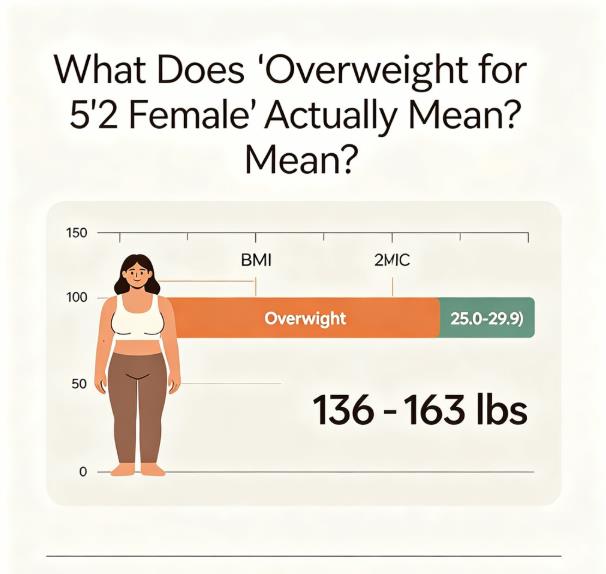
The official definition comes from the World Health Organization and the CDC. Overweight for any adult — including a 5'2" woman — means a body mass index between 25.0 and 29.9. At 62 inches tall, that weight range is roughly 137 to 163 pounds.
Here are the exact weight groups for a 5'2" adult female:
Underweight: below 101 lbs (BMI < 18.5)
Healthy weight: 101–136 lbs (BMI 18.5–24.9)
Overweight: 137–163 lbs (BMI 25.0–29.9)
Obesity: 164 lbs and above (BMI ≥ 30.0)
These numbers come from decades of population research. But here is the catch — BMI cannot tell the difference between a pound of muscle and a pound of fat. That is why a fit, muscular 5'2" woman can fall into the "overweight" category while having very low body fat.
How did researchers pick BMI 25 as the cutoff? In the 1990s, the WHO analyzed large studies linking BMI to disease and death. They found that once BMI passed 25, the risk of type 2 diabetes, heart disease, and certain cancers started climbing noticeably. A 2016 Lancet meta-analysis looked at 10.6 million people and confirmed that for non-Asian adults, the lowest death risk was in the BMI 20–25 range. At BMI 25–29.9, risk increased, but not as sharply as for obesity (BMI 30+).
If you are wondering just how much extra risk overweight brings, that same study found that compared to normal weight (BMI 20–24.9), overweight was linked to a 13% higher risk of death from any cause. For type 2 diabetes, the risk roughly triples for overweight women and jumps seven-fold for obesity.
Here is the part that gets lost in the headlines: those studies average across millions of people. They do not predict what will happen to you, especially if you are active or older.
Where BMI Misleads the Most
Muscle is denser than fat. A 5'2" female who lifts weights regularly might have a BMI of 27 but a body fat percentage of 20% — perfectly healthy. In that case, the "overweight" label is essentially wrong for her. That is when a tool to estimate your body fat percentage gives a truer picture.
Women over 65 are another group BMI routinely misreads. Research published in The American Journal of Clinical Nutrition found that older adults had the lowest mortality risk at a BMI between 23 and 27. So a 5'2" woman aged 68 weighing 148 lbs (BMI ~27) might actually be in a safer zone than a younger woman at the same weight. The standard "overweight" label does not account for that.
Asian women need adjusted thresholds too. The WHO and The Lancet's 2004 expert consensus recommend a lower BMI cutoff for Asian populations — overweight starts at BMI 23 or higher. This adjustment exists because people of Asian descent tend to carry more visceral fat even at a lower body weight. So a 5'2" Asian female at 140 lbs (BMI ~25.6) would already be in a higher risk category under Asian-specific guidelines.
Our editorial team often sees this confusion from active women who hit this BMI bracket during strength training — the scale goes up, the mirror stays the same, and the panic sets in. The number is not lying. It is just answering the wrong question.
What to Check Instead of Fixating on BMI Alone
The NIH and CDC outline a simple assessment, yet many people rush past the most critical first step. Here's what deserves your attention.
Start with your waist. Grab a tape measure and wrap it around your bare belly at the level of your hipbones. For women, a waist over 35 inches signals higher health risk — even if your BMI is normal. The NIH calls waist circumference an "independent risk factor." Many of our readers overlook the technique here: pulling the tape too tight skews the result by a full inch or more. Snug, not stretched.
Then ask yourself two questions. Do you move your body for at least 150 minutes a week — brisk walking counts? Do you feel energetic most days, without joint pain or shortness of breath during normal activities? If yes, your "overweight" label matters less than you think.
Finally, check your other numbers. Blood pressure, fasting glucose, and cholesterol levels tell you more about metabolic health than BMI alone. Many "overweight" people have perfectly normal markers — a state called metabolically healthy overweight.
Doing the BMI math manually is tedious. Most people just want a quick answer. That is why you can use a free BMI calculator — enter your height (5'2") and weight, and it places you in the right category instantly. If you want an even more personalized view, pair BMI with a healthy weight range tool that factors in your frame size or age. A BMI or weight number alone cannot paint your complete health picture.
Frequently Asked Questions
Is 150 pounds overweight for a 5'2" female?
If you stand 5 feet 2 inches tall and weigh 150 pounds, your BMI lands around 27.4. That number falls squarely in the official overweight range (25.0–29.9), because the healthy weight cap for this height is 136 lbs. But if you are muscular or over 65, this label might be less meaningful for your actual health.
Would 140 lbs count as heavy for a 5'2" woman?
By strict BMI standards, yes — 140 pounds puts your BMI at roughly 25.6, just crossing into mild overweight. But "heavy" is a loaded word. Consider these points before letting the label worry you:
Some women at 140 lbs feel great — they run 5Ks, carry groceries up stairs, and have normal blood work.
BMI does not distinguish muscle from fat — a strength trainer at this weight may have optimal body composition.
The label does not override how you feel — energy, mobility, and lab results tell the real story.
What is a realistic weight for a 5'2" woman over 60?
Research from the AJCN suggests that for healthy adults over 65, a BMI of 23–27 is linked to the lowest death risk. For a 5'2" woman, that is roughly 124 to 148 pounds. So being slightly "overweight" by standard charts (up to about 148 lbs) may actually be protective in older age.
I am 5'2" and pregnant — does BMI apply?
No, standard BMI categories do not apply during pregnancy. Pregnancy changes weight distribution, fluid retention, and body composition. Doctors use pregnancy-specific weight gain charts based on pre-pregnancy BMI. If you were overweight before conceiving (BMI 25–29.9), the typical recommended gain is 15–25 lbs total. Always follow your OB-GYN's advice — never try to lose weight or restrict calories while pregnant unless directly instructed by your healthcare provider.
Is 160 pounds considered obese for a 5'2" female?
No. At 160 pounds, a 5'2" woman has a BMI of about 29.3, which is still in the overweight category (25.0–29.9). Obesity starts at 164 pounds for this height (BMI 30.0). So 160 lbs is just four pounds below the obesity line — a small change in weight could move categories.
I am 5'2" and weigh 155 lbs, but I am an athlete. Does "overweight" apply to me?
Probably not in a meaningful way. BMI was never designed for athletic populations. In our screening data, athletes with a BMI of 27–30 consistently show body fat under 22% — well within the healthy range. If you can deadlift, sprint, or climb stairs without getting winded, ignore the BMI label and focus on performance and waist size instead.
Sources
Global BMI Mortality Collaboration. Body-mass index and all-cause mortality: individual-participant-data meta-analysis of 239 prospective studies in four continents. The Lancet. 2016;388(10046):776-786. DOI
Winter JE, MacInnis RJ, Wattanapenpaiboon N, Nowson CA. BMI and all-cause mortality in older adults: a meta-analysis. The American Journal of Clinical Nutrition. 2014;99(4):875-890. DOI
WHO Expert Consultation. Appropriate body-mass index for Asian populations and its implications for policy and intervention strategies. The Lancet. 2004;363(9403):157-163. DOI
This article is for informational and educational purposes only. It does not replace professional medical advice. Consider discussing your results with a qualified healthcare provider. The BMI Calculator Blog Team maintains editorial independence.
Related Articles
What Is Considered Overweight? BMI Limits, Waist Risk, and When the Label Misleads
Overweight Chart: What BMI 25-29.9 Looks Like at Every Height
Overweight People: What It Means for Your Health, BMI Limits, and What the Label Misses
Last updated: October 12, 2026.