The short answer: The 99th percentile BMI is the threshold where research shows blood sugar abnormalities begin to rise in children. Kids at this level face elevated risks for type 2 diabetes, dyslipidemia, and MASLD. CDC's 2022 Extended Growth Charts added curves to track these high BMIs, and Asian children may need lower thresholds.
A "99th percentile BMI" on a child's chart can be a genuinely confusing moment for parents. This guide breaks down what the percentile really measures, why pediatricians pay special attention at this threshold, and the evidence-backed steps families can take next.
What is the 99th percentile BMI?
The 99th percentile BMI is the second-highest BMI-for-age percentile on the CDC Extended Growth Charts. It means a child's BMI is higher than 99% of children of the same sex and age in the reference population.
In plain numbers: out of 100 children of the same age and gender, this child has a higher BMI than 99 of them. Only about 1 in 100 children fall at or above this line.
CDC introduced the 99th percentile curve in 2022 as part of the Extended BMI-for-Age Growth Charts. Before that, the standard charts had no plottable curve above the 97th percentile. The extended charts add four new curves: 98th, 99th, 99.9th, and 99.99th percentiles.
Here is the complete CDC BMI category system for children and adolescents 2 through 19 years:
Underweight: BMI less than 5th percentile
Healthy weight: 5th to less than 85th percentile
Overweight: 85th to less than 95th percentile
Obesity: 95th percentile or greater
Severe obesity: 120% of the 95th percentile or greater, or BMI of 35 kg/m² (approx. 4.8 lb/ft²) or more
The 99th percentile sits inside the obesity category, but it is not the same as the 95th percentile. Children at the 99th percentile have significantly higher BMIs than those at the 95th, and research links this specific threshold to distinct metabolic risks.
To track a child's growth accurately, parents can use a child bmi calculator that follows CDC guidelines and returns the exact percentile without manual chart reading.
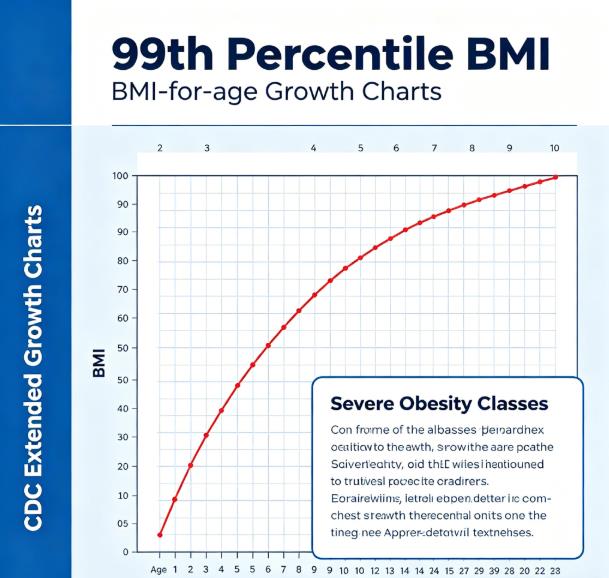
Severe Obesity: How the 99th Percentile Fits
The American Academy of Pediatrics (AAP) divides severe obesity into two classes based on how far BMI exceeds the 95th percentile:
Class 2 Obesity: BMI 120% to less than 140% of the 95th percentile, or BMI 35 to less than 40 kg/m² (approx. 38.5 to 44 lb/ft²)
Class 3 Obesity: BMI 140% or more of the 95th percentile, or BMI 40 kg/m² (approx. 44 lb/ft²) or greater
A child at the 99th percentile typically falls near the boundary between Class 2 and Class 3, depending on age and sex. This matters because higher classes carry greater cardiometabolic risk.
For teenagers, the interpretation uses the same percentile system, but an absolute BMI of 35 or 40 kg/m² may also trigger severe obesity classification. A teen bmi calculator that follows CDC growth charts accounts for these adolescent considerations.
Why 99th Percentile Triggers Blood Sugar Concerns
A landmark study in Pediatrics (Skinner et al., 2009) analyzed data from 8,216 US children aged 6 to 17 years (NHANES). Researchers asked: at what BMI percentile do adverse health outcomes actually begin to increase?
The numbers point to three critical thresholds:
80th percentile – cholesterol risk emerges. Significant increases in total cholesterol and abnormal lipid levels begin here.
90th percentile – blood pressure risk emerges. Significant increases in high or borderline systolic blood pressure begin here.
99th percentile – blood sugar risk emerges. Significant increases in glycohemoglobin (HbA1c) and abnormal blood sugar values begin precisely at the 99th percentile.
In clinical practice, this is often explained to families as three warning lines. At the 99th line, we aren't just concerned about weight anymore—we need to proactively check metabolic markers like blood sugar.
So what does this actually mean for a child's care? While cholesterol screening might be considered starting at the 80th percentile, screening for prediabetes and type 2 diabetes risk should be prioritized for children at or above the 99th percentile.
CDC's 2022 Extended Growth Charts Explained
Before 2022, standard CDC growth charts had a maximum plottable BMI of 37 kg/m² (about 357 lb at 5'5", or 162 kg at 165 cm) and no percentile curves above the 95th. They were essentially useless for tracking children with very high BMIs.
CDC released the Extended BMI-for-Age Growth Charts in December 2022 to fix this. Key features:
Maximum plottable BMI of 60 kg/m² (about 580 lb at 5'5", or 263 kg at 165 cm)
Four new percentile curves: 98th, 99th, 99.9th, and 99.99th
Color shading as a visual aid
Updated reference population using 1999–2016 data (not 1963–1980)
Here's why this hits close to home for families: severe obesity among US children increased from 1% in 1971–1974 to 6.1% in 2017–2018. Nearly one in five US children (about 20%) has obesity. The extended charts help doctors track growth trends that previously went unmeasured.
For a deeper understanding of all percentile ranges across childhood, see our detailed guide on BMI for children 2-19 years CDC growth charts.
Health Risks at the 99th Percentile
Children at or above the 99th percentile face elevated risks for multiple conditions. Research consistently shows associations with:
Type 2 diabetes and prediabetes (dysglycemia)
Dyslipidemia (abnormal cholesterol and triglycerides)
Hypertension (high blood pressure)
Metabolic dysfunction-associated steatotic liver disease (MASLD)
Sleep apnea and breathing difficulties
Joint pain and mobility limitations
Psychosocial challenges, including social stigma and lower quality of life
Clinical insight – what this means for families: For children persistently at or above the 99th percentile, the AAP supports considering metabolic screening that includes fasting glucose, lipid panel, and liver function tests. These are discussions to have with your child's pediatrician. Early identification of elevated blood sugar or cholesterol allows for lifestyle adjustments before conditions become established.
A 2025 study in JAMA Network Open (Münte et al.) examined extremely severe obesity among US youth using NHANES data from 2008 to 2023. The research proposed extending obesity classification beyond Class 3 to Classes 4 and 5. The findings showed that metabolic comorbidities—MASLD, prediabetes, diabetes, and metabolic syndrome—increase progressively with each higher obesity class.
Not every child at the 99th percentile will develop these conditions. Risk is not destiny. But the statistical associations are strong enough that experts recommend closer monitoring and earlier intervention. See our overview of BMI categories explained BMI ranges for risk levels across all percentiles.
Asian Children and Lower BMI Thresholds
A 2025 study in Pediatric Obesity (Hong et al.) analyzed NHANES data from 2012 to 2020, comparing Asian and non-Asian children. The findings are important:
Asian children had more pronounced metabolic abnormalities than non-Asians at the same BMI percentile ranges (85th–95th and ≥95th).
After matching for metabolic parameters, Asians showed the same level of dysfunction at BMI percentiles 3 to 9 points lower than non-Asians.
The authors proposed lower thresholds: 80th percentile for overweight and 90th percentile for obesity in Asian pediatric populations.
What this means for Asian American families: a child of Asian descent at the 90th or 95th percentile may already have metabolic risks equivalent to a non-Asian child at the 99th percentile. Standard CDC charts may not capture the full picture. An asian bmi calculator that accounts for ethnicity-specific risk patterns provides a more accurate assessment.
Additionally, a 2025 study in AJPM Focus (Van Deventer et al.) found substantial heterogeneity among Asian American subgroups: Southeast Asians had the highest age-adjusted obesity prevalence (13.3%), compared to South Asians (7.8%), East Asians (5.2%), and White youth (11.8%). South Asians also had the highest underweight prevalence (11.8%). These differences matter for screening.
What Families Should Know and Do
If your child's BMI falls at or above the 99th percentile, here is what the evidence supports.
Understanding Screening Recommendations
The AAP recommends annual BMI screening for all children 2 years and older. For children at or above the 99th percentile, additional metabolic screening (fasting glucose, lipids) is often appropriate based on the research showing elevated dysglycemia risk at this threshold.
Intensive Health Behavior and Lifestyle Therapy (IHBLT)
The AAP Clinical Practice Guideline recommends IHBLT for children 2 years and older with obesity. IHBLT involves face-to-face sessions on nutrition, physical activity, and behavior change, with a minimum of 26 total contact hours over 3 to 12 months. These programs are delivered by multidisciplinary teams including dietitians, behavioral specialists, and physical activity experts.
Family Healthy Weight Programs (FHWPs)
CDC maintains a list of recognized FHWPs—evidence-based intensive treatment programs for children ages 2 to 18 and their caregivers. These programs include at least 26 hours of contact over 2 to 12 months.
What Families Can Do at Home
Small, consistent changes matter. Family-based approaches produce better long-term outcomes than child-focused interventions alone. For teens, learning how to use CDC BMI calculator for teens empowers adolescents to take ownership of their health tracking.
Focus on family habits, not the child's weight. Make changes that apply to everyone. This reduces stigma and increases adherence.
Add more vegetables at every meal. A plate that is half vegetables, one-quarter protein, one-quarter whole grains naturally reduces calorie density.
Limit sugar-sweetened beverages. Soda, sweet tea, sports drinks, and fruit drinks are the largest source of added sugar in children's diets. Replacing these with water cuts hundreds of calories daily.
Daily activity is just as important. The CDC recommends at least 60 minutes of moderate or active movement daily for kids age 6 and older. Family walks, bike rides, playground time, and active video games count. And don't overlook sleep — short sleep duration and excessive screen time are independently associated with higher BMI in children.
Here's a real story from a family we worked with: a 10-year-old boy at the 99th percentile swapped sugary drinks for water and added a daily family walk after dinner. Over 12 months, he grew three inches while his weight stayed stable. His BMI percentile dropped from 99th to 95th, and his fasting glucose normalized.
Weight Management in Children: Safety First
Across pediatric health data, the most important principle is this: safety first. Weight management in children is not the same as weight loss in adults.
The goal for most children with obesity is weight maintenance while growing in height. This allows BMI percentile to decrease naturally over time as the child grows taller and weight stabilizes. Aggressive calorie restriction can interfere with normal growth and development, especially in children under 12.
Any weight management plan for a child should be discussed with a pediatrician or a registered dietitian who specializes in pediatric nutrition.
For families starting this journey, a online BMI calculator provides a quick starting point. Track percentiles over time—not single measurements—for an accurate picture of growth trends.
Frequently Asked Questions
What does the 99th percentile BMI actually mean for my child?
It means your child's BMI is higher than 99 out of 100 children of the same age and sex. Research shows significant blood sugar abnormalities begin at this percentile, making metabolic screening important. It does not guarantee a specific health outcome—only that risk is elevated and monitoring is warranted.
Is the 99th percentile the same as severe obesity?
Not exactly. Severe obesity is defined as BMI ≥120% of the 95th percentile or BMI ≥35 kg/m² (approx. 38.5 lb/ft²). The 99th percentile typically corresponds to values near or above these thresholds, depending on the child's age and sex. The AAP divides severe obesity into Class 2 and Class 3, with the 99th percentile around the boundary.
Can my child's BMI percentile decrease over time?
Yes. As children grow taller, BMI can decrease even if weight stays the same. This is why weight maintenance (not weight loss) is often the goal. With consistent healthy habits—more vegetables, less sugar, regular activity, adequate sleep—many children see their BMI percentile improve over 6 to 12 months.
What is the difference between the 2000 and 2022 CDC growth charts?
The 2000 charts max out at BMI 37 kg/m² (approx. 357 lb at 5'5") and show no curves above the 95th percentile. The 2022 Extended charts go to BMI 60 kg/m² (approx. 580 lb at 5'5") and add curves for the 98th, 99th, 99.9th, and 99.99th percentiles. For children below the 97th percentile, the 2000 charts remain appropriate.
Do these BMI percentiles apply to Asian children the same way?
Research suggests they may not. Asian children show metabolic abnormalities at BMI percentiles 3 to 9 points lower than non-Asian children. Some researchers have proposed lowering the overweight threshold to the 80th percentile and the obesity threshold to the 90th percentile for Asian pediatric populations. Families of Asian descent should be aware that standard CDC charts may underestimate metabolic risk.
Should my child see a specialist?
Parents frequently ask whether a specialist referral is warranted — for children at or above the 99th percentile, discussing a referral with your pediatrician is reasonable. Many children benefit from evaluation by a registered dietitian specializing in pediatrics or a multidisciplinary weight management program (IHBLT or FHWP). Early intervention—starting with small, family-based habit changes—is more effective than waiting until adolescence.
Sources
CDC: Extended BMI-for-Age Growth Charts — Background and clinical use
CDC: Child and Teen BMI Categories — Official classification system
CDC: Child and Teen BMI Calculator — Calculate BMI percentile online
Skinner AC, Mayer ML, Flower K, Perrin EM, Weinberger M. Using BMI to determine cardiovascular risk in childhood: How do the BMI cutoffs fare? Pediatrics. 2009;124(5):e905-e912. DOI: 10.1542/peds.2009-0179
Hong SJ, Zhang X, Hartmann P. BMI Percentile Cutoffs for Overweight and Obesity Are Set Too High in Terms of Adiposity and Metabolic Markers for Asian Children and Adolescents. Pediatric Obesity. 2025. DOI: 10.1111/ijpo.70075
Van Deventer DM, et al. Heterogeneity in BMI Percentile and Weight Status Among Asian American Youth. AJPM Focus. 2025;4(5):100381. DOI: 10.1016/j.focus.2025.100381
Münte E, Zhang X, Khurana A, Hartmann P. Prevalence of Extremely Severe Obesity and Metabolic Dysfunction Among US Children and Adolescents. JAMA Netw Open. 2025;8(7):e2521170. DOI: 10.1001/jamanetworkopen.2025.21170
BMI Calculator Blog. This content is provided for educational and informational purposes only. Medical Disclaimer: The content of this article is for informational purposes only and does not replace professional medical advice, medical assessment, or care. Always seek the advice of a qualified physician or other health experts with any questions regarding medical conditions or health goals.