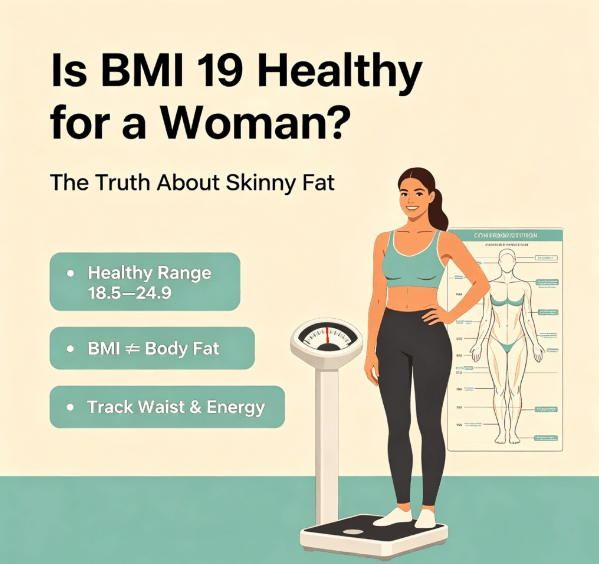
Quick summary: A BMI of 19 for a woman falls squarely in the CDC's healthy weight range (18.5–24.9). But here is what most guides won't tell you: BMI is just a screening tool—it does not measure body fat directly. Research shows BMI misclassifies over half of individuals with excess body fat as having normal weight (Romero-Corral et al., Int J Obes 2008), a condition called normal-weight obesity (NWO). Women are two to six times more likely than men to develop NWO (Beyond BMI: Womens Health 2026)[4]. So while a BMI of 19 is generally associated with lower risks for chronic conditions, it is not an automatic "all-clear" signal. This guide breaks down what BMI 19 actually means, where it falls short, and what to track alongside it.
What a BMI of 19 means for your health
Being in the healthy weight range generally means your weight is not a major contributor to chronic disease risk. People with BMIs in this range have a lower risk of developing type 2 diabetes, heart disease, and other health problems compared to those in higher weight categories.
But there is an important nuance. BMI does not measure body fat directly. It cannot tell the difference between muscle, bone, and fat. A woman with a BMI of 19 might have a lean, athletic build with low body fat. Or she might have a "normal" weight but a higher percentage of body fat—a condition known as normal-weight obesity (NWO).
Research shows BMI misclassifies over half of individuals with excess body fat as having normal weight[1]. NWO is a real and underrecognized condition that can elevate a woman's risk for metabolic, hormonal, and musculoskeletal issues. Women are at a two- to six-fold higher risk of developing NWO compared to men.
The lower end of normal: is BMI 19 too low?
While 19 is within the healthy range, it sits on the lower end. Research published in the Journal of Nutrition, Health & Aging found that underweight women with BMIs less than 19 had higher mortality rates than women with BMIs of 19 or higher[3]. The study followed 5,398 women over 15 years and found that women with BMIs below 19 had a nearly 80% higher risk of death (age-adjusted odds ratio: 1.80, 95% CI: 1.16–2.76). This is an observational study finding and does not prove causation; results may be influenced by confounding factors like smoking status and pre-existing health conditions.
A BMI under 18.5 is classified as underweight, a category that can be associated with malnutrition, anemia, nutrient deficiencies, heart irregularities, and loss of menstrual periods. If your BMI is 19, you are not underweight. But staying at the lower end of the scale requires the same attention to nutrition and overall health as any other weight category.
BMI 19 weight examples by height
Here is what a BMI of 19 looks like in pounds for different heights:
| Height (ft/in) | Height (cm) | Approx. Weight (lbs) | Approx. Weight (kg) |
|---|---|---|---|
| 5'0" | 152 cm | ~97 lbs | ~44 kg |
| 5'2" | 157 cm | ~104 lbs | ~47 kg |
| 5'4" | 163 cm | ~111 lbs | ~50 kg |
| 5'6" | 168 cm | ~118 lbs | ~54 kg |
| 5'8" | 173 cm | ~125 lbs | ~57 kg |
| 5'10" | 178 cm | ~132 lbs | ~60 kg |
Use an Adult BMI Calculator to check your number.
What to track alongside your BMI
Your BMI is a screening tool, not a diagnosis. To get a complete picture of your health, consider these additional measures:
Waist circumference: Per NIH guidelines, a waist measurement of more than 35 inches (88 cm) for women increases health risk, regardless of BMI. To measure correctly: place a soft tape measure at the top of the iliac crest (hip bone), after a normal exhale, snug but not squeezing the skin.
Body fat percentage: This tells you how much of your weight is fat versus muscle. Healthy body fat ranges for women are age-dependent: generally 21–33% for women aged 20–60. A body fat percentage above 30% in women with a normal BMI may indicate NWO. Use a body fat calculator to estimate yours.
Blood work: Fasting glucose, cholesterol, and blood pressure provide direct information about your metabolic health. These numbers matter more than any single BMI reading.
How you feel: Energy levels, sleep quality, and overall well-being are honest indicators of health that no number can capture.
Pair your BMI with a healthy weight range tool to see where you fall.
Special considerations
BMI 19 may mean different things for different people:
Asian women: The WHO recommends lower BMI thresholds for Asian populations. Overweight begins at BMI 23 for Asian adults. A BMI of 19 is still within the healthy range but may carry different implications depending on body composition and fat distribution.
African American women: African American women typically have higher lean muscle mass and lower visceral fat at the same BMI compared to white women, so BMI may slightly overestimate health risk for this group.
Adults 65 and older: For women over 65, BMI 19 is on the lower end. NIH and ACSM clinical consensus suggests a slightly higher BMI (21–27) may be protective for older adults, providing nutritional reserves that reduce risk of falls and osteoporosis. Older women with BMI 19 should focus on maintaining muscle mass and bone density through protein intake and resistance training.
Pregnant women: Standard BMI categories do not apply during pregnancy. Weight gain is expected and necessary for fetal development. Follow your healthcare provider's guidance.
Athletes and muscular women: BMI may underestimate or overestimate body composition. Muscle is denser than fat, so an athletic woman with a BMI of 19 may have very low body fat and excellent metabolic health.
Women with endocrine conditions: Women with PCOS, thyroid disorders, or other endocrine conditions may have body composition patterns that do not match BMI. Body fat percentage and blood work provide more accurate insights.
Women with a history of eating disorders: Focusing on a specific BMI number can be triggering. Work with a healthcare professional to establish a healthy relationship with food and body image.
When to talk to a healthcare provider
If your BMI is 19 but you experience any of the following, consider checking in with a healthcare provider:
Irregular or absent menstrual periods
Persistent fatigue or low energy
Fasting blood glucose above 100 mg/dL
Unexplained weight loss or difficulty maintaining weight
Hair thinning or brittle nails
References & Sources
Wyshak G. Underweight, smoking, exercise and mortality in women. J Nutr Health Aging. 2007
NIH/NIDDK: Am I at a Healthy Weight? — BMI and Waist Circumference
Frequently Asked Questions About BMI 19 for Women
Is a BMI of 19 healthy for a woman?
Yes. Per CDC guidelines, a BMI of 19 falls within the healthy weight range (18.5–24.9). It is generally associated with lower risk for chronic diseases like type 2 diabetes and heart disease.
Is a BMI of 19 considered underweight?
No. Underweight is defined as a BMI below 18.5. A BMI of 19 is above that threshold and falls within the normal weight category.
Can a woman with a BMI of 19 have too much body fat?
Yes. BMI does not measure body fat directly. A woman with a BMI of 19 can still have a high body fat percentage—a condition called normal-weight obesity—which carries its own health risks.
Is BMI 19 still healthy for Asian women?
Yes, BMI 19 is within the healthy range even under WHO's ethnic-specific thresholds (healthy 18.5–22.9 for Asian adults). But since metabolic risk begins climbing at lower BMIs in this population, pair BMI with waist circumference (<31.5" for Asian women) and body fat percentage.
What is the ideal weight for a woman with a BMI of 19?
The actual weight depends on height. For a 5'5" woman, a BMI of 19 is about 114 pounds. For a 5'7" woman, it is about 121 pounds. See the table above for specific heights.
Should I gain weight if my BMI is 19?
Not necessarily. If you feel healthy, have good energy, eat well, and stay active, there's no reason to gain weight just to increase your BMI number. Focus on health, not the scale.
What are the risks of having a BMI on the lower end of healthy?
While BMI 19 is not underweight, it's on the lower end of the normal range. Research suggests that women with BMIs below 19 may have higher mortality rates compared to those with BMIs of 19 or higher. Maintaining adequate nutrition is important at any weight.
What is a healthy BMI for a 30-year-old woman?
The same CDC guidelines apply: 18.5–24.9. For a 30-year-old woman, BMI 19 falls within the healthy range. However, age and activity level influence body composition, so pairing BMI with body fat percentage provides a more accurate picture.
What else should I track besides my BMI?
Track your waist circumference, body fat percentage, blood work (glucose, cholesterol, blood pressure), and how you feel day to day. These give you a more complete picture of your health than BMI alone.
Related Articles
Normal BMI, Hidden Risks: Signs Your "Healthy" Weight Could Be Normal-Weight Obesity
BMI Healthy Range: What It Really Is for Every Age, Body Type, and Background
What Is a Healthy BMI for Women? Age-Specific Ranges, How to Calculate, and Limits
BMI Calculator Blog. This content is provided for educational and informational purposes only. We encourage sharing with proper attribution to our site. Unauthorized commercial use is prohibited. Medical Disclaimer: This content does not replace professional medical advice, diagnosis, or treatment. Always seek the advice of a qualified physician or other licensed health provider with any questions regarding your body composition, weight status, or health goals.