At a Glance: Most adult women need 1,600–2,400 calories daily. The USDA baseline for moderately active women is 2,000. But your actual number depends on body size, muscle mass, age, and activity — factors a single chart cannot capture. This guide breaks down the real numbers, why 1,200 calories backfires for most women, and how to find your personal range without guesswork.
A calorie is a unit of energy. Your body burns it for everything — breathing, circulating blood, digesting food, and moving through your day. Eat roughly the same number your body uses, and your weight stays stable. That is the whole equation. The tricky part is figuring out your personal number.
What the Guidelines Actually Say
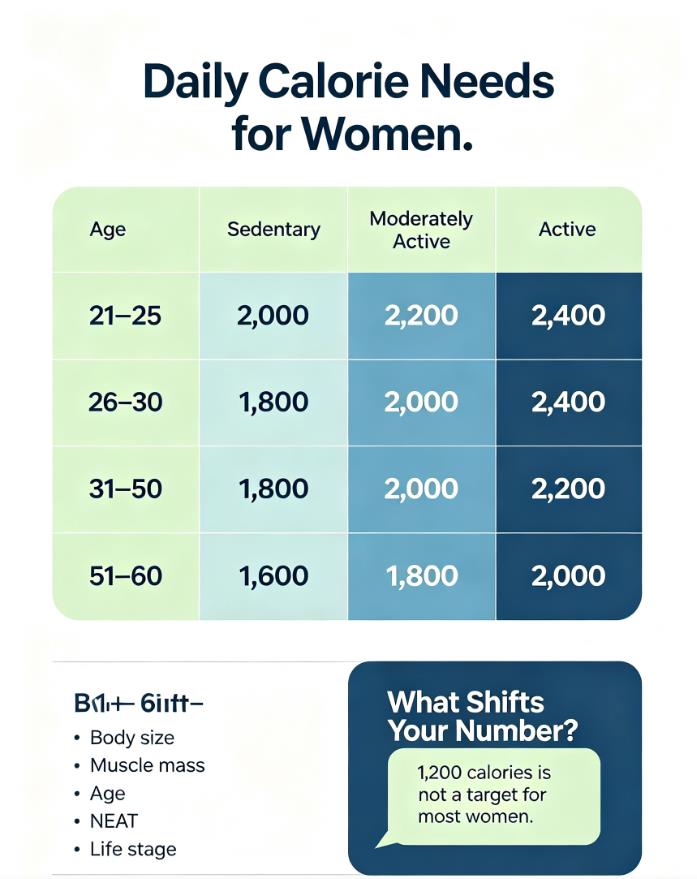
The USDA publishes calorie recommendations for women by age and activity level. These are maintenance estimates for women at a healthy weight:
| Age | Sedentary | Moderately Active | Active |
|---|---|---|---|
| 21–25 | 2,000 | 2,200 | 2,400 |
| 26–30 | 1,800 | 2,000 | 2,400 |
| 31–50 | 1,800 | 2,000 | 2,200 |
| 51–60 | 1,600 | 1,800 | 2,200 |
| 61+ | 1,600 | 1,800 | 2,000 |
Source: Dietary Guidelines for Americans 2020–2025. "Sedentary" means only light physical activity from typical daily living. "Moderately active" includes 1.5–3 miles of walking per day plus other daily activity. "Active" means more than 3 miles per day.
The NHS puts the average woman’s maintenance needs at around 2,000 calories daily, with the caveat that age, weight, height, and exercise level all shift the number.
Here is what those ranges look like in practice. A 35-year-old woman who works a desk job and walks 30 minutes most days lands around 1,800–2,000 calories. A 28-year-old who runs four times a week and lifts twice may need 2,200–2,400. Same gender, different lives, different fuel needs.
Why 1,200 Calories Is Not a Target
You have probably seen the 1,200-calorie diet promoted as a weight-loss shortcut. It is one of the most persistent myths in women‘s health.
For most adult women, 1,200 calories is well below maintenance. A woman whose body needs 1,900 calories to function normally would be running a 700-calorie deficit on that plan — a gap that forces the body to cut costs somewhere. That somewhere is often muscle tissue, not fat.
Muscle loss slows metabolism. When metabolism drops, the same 1,200 calories that once caused weight loss now maintain it. The plateau hits. The frustration builds. And the cycle tightens.
Research on female athletes shows a harsh trade-off: women consuming 1,300–1,400 calories while exercising often lose muscle instead of fat. The scale might drop, but their metabolic rate tanks. One woman in our community logs described it as “feeling like I was starving my muscles to feed my workouts.” That’s the opposite of a sustainable goal.
Question: Is 1200 calories safe for active women?
Answer: For most active women, 1200 calories falls too low to sustain muscle mass and daily energy. It should only be considered with guidance from a qualified nutrition professional.
Signs that you may be eating too little: persistent fatigue, hair thinning, irregular periods, feeling cold when others are comfortable, and thinking about food constantly. If any of those sound familiar, it is worth talking to a healthcare provider before cutting further.
Your Number Is Not the Chart’s Number
A taller woman, or one carrying more weight, burns more calories at rest than a smaller peer doing the exact same activities. That gap can reach 200 calories daily. Muscle mass then layers on top of that. We‘ve seen user logs where women of the same weight differ by nearly 200 calories daily simply because one lifted regularly and the other didn’t.
Age also shifts the baseline. Metabolic rate drops gradually after 20, and the USDA table reflects this — a 55-year-old woman needs roughly 200 fewer daily calories than she did at 25. Activity level adds another layer: a 45-minute run burns roughly 400–500 calories for an average-weight woman (Harvard Health Publishing). That is a significant chunk of the daily total.
Do not overlook NEAT — Non-Exercise Activity Thermogenesis. This is the energy burned from fidgeting, walking to the printer, or even just standing instead of sitting. For some women, NEAT can add 300–400 calories to their daily burn without a single “workout.” Many of our site visitors underestimate how quickly metabolism shifts with age, and NEAT is one reason why two women of the same weight can have very different daily needs. It is why a desk job can silently lower your calorie needs.
Life stage matters too. Pregnancy adds roughly 340–450 calories in the second and third trimesters. Breastfeeding adds 330–400 calories daily, per CDC guidance.
To estimate your personal maintenance number, start with your weight in pounds and multiply by 13–15. That range accounts for basic metabolic function plus light daily activity. Adjust up for higher activity levels. A calorie calculator can give you a more precise starting estimate based on your height, weight, age, and activity.
What to Do With This Information
Calories are not the whole story. The source matters. A 2,000-calorie day built on whole grains, lean proteins, vegetables, and healthy fats supports energy and health differently than 2,000 calories of ultra-processed food.
Here’s how to put this into practice:
Find your baseline. Use the USDA table or a calculator to estimate maintenance.
Track for two weeks. Log what you eat without changing anything. Compare intake to your estimated need.
Adjust by 200–300 calories at a time. For weight loss, a modest deficit is more sustainable than a steep one. For weight gain, add the same amount.
Recheck every 4–6 weeks. Your needs shift with activity, muscle mass, and life changes.
These simple steps avoid extreme cuts that many people rush into.
If tracking every meal feels obsessive, focus on protein, vegetables, and consistent meal timing instead. The structure often solves the calorie question without the math. You can also pair calorie tracking with our Free BMI Calculator to evaluate your weight category alongside energy intake.
Some women we’ve tracked see their hunger spike sharply after 2–3 weeks of very low calorie intake. That is not a willpower problem — it is biology. The body pushes back against sustained restriction by increasing appetite signals. A moderate deficit avoids that pushback.
Frequently Asked Questions
How many calories should a woman eat to lose weight?
A common starting point is 500 calories below maintenance, which supports roughly 1 pound of loss per week. For a woman maintaining on 2,000 calories, that means 1,500 daily. But context matters. One reader shared that she felt exhausted at 1,500 but found 1,700 calories — with a focus on protein and strength training — allowed her to lose fat without the constant hunger. She tracked her intake for three weeks. Her energy stabilized. Then she slowly reduced to 1,600 as her body adapted. This kind of metabolic flexibility is common, and it’s why rigid calculators often fail real women. Most women should not go below 1,200 without medical supervision. Individual needs vary — a healthcare provider can help set a safe target.
Is 1,800 calories a day enough for a woman?
For many women, yes. The USDA sets 1,800 as the maintenance need for sedentary women aged 26–50. If you are moderately active, 2,000–2,200 may be more appropriate. The right number depends on your activity level and body size.
Do women need fewer calories than men?
Generally, yes. Men typically need 2,200–3,000 calories daily, compared with 1,600–2,400 for women. The difference comes largely from body size and muscle mass, which affect resting energy expenditure. Individual needs vary based on activity and composition.
How many calories does a woman need after 50?
The USDA recommends 1,600 calories for sedentary women aged 51+, 1,800 for moderately active, and 2,200 for active. Muscle loss accelerates after 50, so resistance training and adequate protein become more important for maintaining metabolic rate.
Does breastfeeding change calorie needs?
Yes. Breastfeeding mothers generally need an additional 330–400 calories daily compared with pre-pregnancy intake, per CDC guidance. Individual needs vary — a healthcare provider can help adjust your intake based on your milk supply and activity level.
Sources
This article is for educational and informational purposes only. It does not provide medical advice, diagnosis, or treatment. Calorie needs are estimates, not prescriptions. Discuss your individual nutrition plan with a qualified healthcare provider or registered dietitian. Individual results will vary. The BMI Calculator Blog Team maintains editorial independence and does not sell health products.