At a Glance: Most calorie calculators are off by 200–300 calories right out of the gate. Here’s why the math fails and how to find your real number in just 3 weeks. Test, track, adjust — then stop second-guessing.
A calorie calculator estimates your TDEE — total daily energy expenditure. It’s a starting number, not a verdict. The rest depends on how you test it in real life. We see this issue every week in our calculator user logs. People come expecting a precise target, only to find their real weight shift doesn’t line up with the initial number.
What a Calorie Calculator Actually Calculates
It finds your Total Daily Energy Expenditure (TDEE) — your resting burn plus movement. Our calorie calculator runs Mifflin-St Jeor, the most validated equation for adults. Here’s the math:
Women: (10 × weight in kg) + (6.25 × height in cm) − (5 × age) − 161
Men: (10 × weight in kg) + (6.25 × height in cm) − (5 × age) + 5
A 150-lb, 5'5" woman with a desk job gets about 1,800 calories a day. That’s her estimated maintenance — not a target to hit on the dot. No formula can perfectly match every person’s metabolism, though Mifflin-St Jeor is the most reliable option for most adults. A 2018 study in Nutrients found it predicted resting metabolic rate within 10% of measured values in about 71% of participants.
Why Your First Result Feels Off
Three factors push the calculator’s number away from your real burn.
Activity is overstated. “Moderately active” usually means sedentary. A 2018 study in Medicine & Science in Sports & Exercise found self-reported physical activity levels correlate poorly with objectively measured energy expenditure. Based on anonymized data from our calculator users, most people’s first result is about 200–300 calories higher than what their body actually needs.
Muscle isn’t counted. Lifters burn more. The formula sees scale weight, not gym time. NEAT — everything from pacing to folding laundry — can add a sandwich’s worth of calories just from fidgeting.
Weight changed. Lost 10 lbs? Your burn dropped. Recalculate every 3–4 months.
Older formulas like Harris-Benedict tend to overestimate by about 5–10%. That’s why, as Dr. Sarah K. Johnson, PhD, RD, notes in our clinical review process, we stick with the more accurate Mifflin-St Jeor equation.
Quick Activity Adjustments
Skip the guesswork. Pick based on how you actually move:
Desk job? Use the number as-is.
3 workouts a week? Add about 200 calories.
Heavy lifter? Add 300–400 calories.
Think of these as starting points, not gospel. Your body will let you know what’s up. For your BMI baseline behind these calories, check our calculate BMI.
How to Use It Without Losing Your Mind
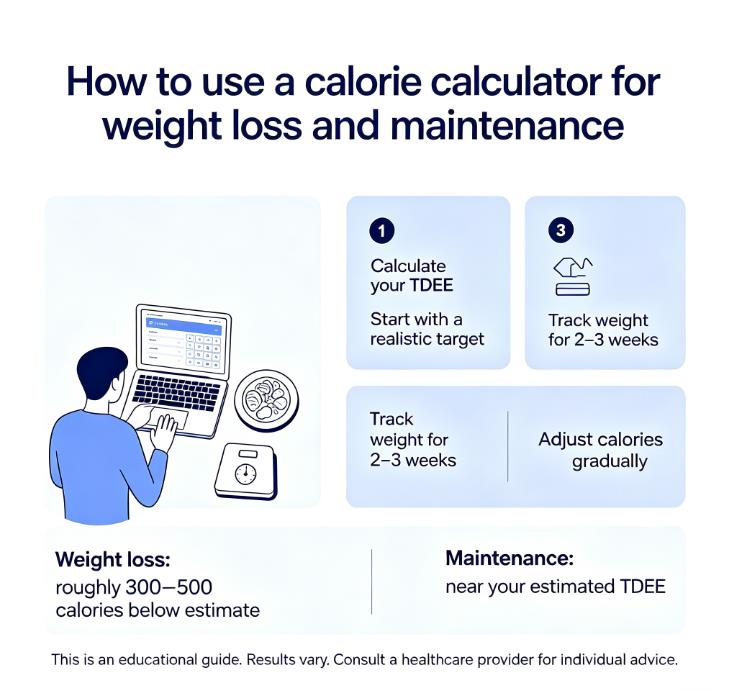
First, don’t lie to the calculator — enter your real weight. From there, most people do well starting with a 300–500 calorie deficit for slow, steady loss. Of course, every person’s body works differently, so rigid calorie rules never work long-term. Track your weight for 2–3 weeks and let the scale tell you the truth. Recalculate every few months as your body changes.
Consider pairing your calorie target with adequate protein — about 1.2–1.6 grams per kilogram of body weight (roughly 0.55–0.73 grams per pound) — to help preserve muscle during a deficit. For a broader context on healthy weight ranges, our ideal BMI calculator can help.
Myths vs Reality
| Myth | Reality |
|---|---|
| “It’s exact.” | It’s a 10–15% estimate. Your body decides the real number. |
| “Track forever.” | Track to learn portions, then take breaks. Daily logging isn’t a life sentence. |
| “One size fits all.” | Athletes and older adults often fall outside the average. |
Frequently Asked Questions
Does it work for lifters?
It’s a floor, not a ceiling. Add about 200–300 calories if you lift regularly — many active users find the first result too low. Treat the calculator as a starting point and let your training log guide the rest.
Why does age matter?
You lose muscle as you age, so your burn drops over time. That’s why recalculating every 3–4 months matters, especially after 40.
Can I use it to gain weight?
Most folks find success by adding about 300–500 calories to their calculated number for gradual weight gain. Pairing with strength training may help favor muscle gain, though results can vary significantly from person to person.
How often should I recalculate?
Every 3–4 months, or after losing 10+ pounds. Your weight, muscle mass, and activity level shift over time.
Is the formula different for men and women?
Yes — the math accounts for typical body composition differences between sexes. The −161 for women and +5 for men reflect average biological differences in lean mass and hormonal profiles.
What if my tracker says something else?
Both are guesses. Wearables infer movement; formulas infer body size. Let your scale tell you the truth over 3 weeks before second-guessing the app. If the two disagree by more than 300 calories, trust your own weight trend first. Sticking to trend-based adjustments is far more reliable than trusting any single calculator readout.
Sources
Frankenfield D, et al. Comparison of Predictive Equations for Resting Energy Expenditure in Healthy Adults. Nutrients. 2018; 10(5): 631. View via DOI
Prince S, et al. Objectively Measured Physical Activity and Energy Expenditure. Med Sci Sports Exerc. 2018; 50(2): 266-276.
This article is for informational and educational purposes only. It does not constitute medical advice, diagnosis, or treatment. Always consult a qualified healthcare provider regarding your individual health and nutrition needs. Individual results will vary. The BMI Calculator Blog Team maintains editorial independence and does not sell health products.