At a Glance: A maintenance calorie calculator gives you a starting estimate, not a fixed rule. For many adults a BMR/TDEE equation can miss by about 10%, and with activity multipliers the real gap often runs to several hundred calories because of NEAT, muscle mass, and tracking slip. Test your number for 7 days, watch the weekly scale trend, and adjust by 150 calories to find your true TDEE.
Most people treat a maintenance calorie calculator like a one-time math problem—plug in stats, get a number, and eat to it forever. That approach fails because true maintenance calories shift with muscle mass, sleep, job changes, and even the season. This guide explains why calculator results drift and how to lock in your real-world number without obsessive tracking.
Why Maintenance Feels Harder Than Cutting or Bulking
People search for a maintenance calorie calculator because they hit a goal. The weight is gone, or the bulk is done. Now they want to stay put. But maintenance offers no weekly feedback—no scale drops, no new PRs. It feels like nothing is happening until the scale creeps up three pounds and the math no longer works.
Validated metabolic models can still land off target for an individual. The NIDDK Body Weight Planner, built on Hall's dynamic energy-balance model, tracks average weight change well but shows substantial individual variability in validation studies. [3,8](@ref) Simple BMR equations do better: a systematic review found Mifflin-St Jeor predicts resting metabolism within 10% for more people than Harris-Benedict, yet worthwhile individual errors remain. [5](@ref) Your BMI also matters; anyone outside 18.5–24.9 or with an underlying condition should check with a healthcare provider before changing intake. A BMI Calculator gives a quick baseline, not a maintenance verdict.
Question: Why does my weight go up on maintenance calories?
Answer: The most common cause is an overestimated activity level. Most people select "moderately active" when their actual week is closer to sedentary. Recalibrate by eating at your estimated maintenance for one week and watching the scale trend, not the daily number.
What a Maintenance Calorie Calculator Actually Measures
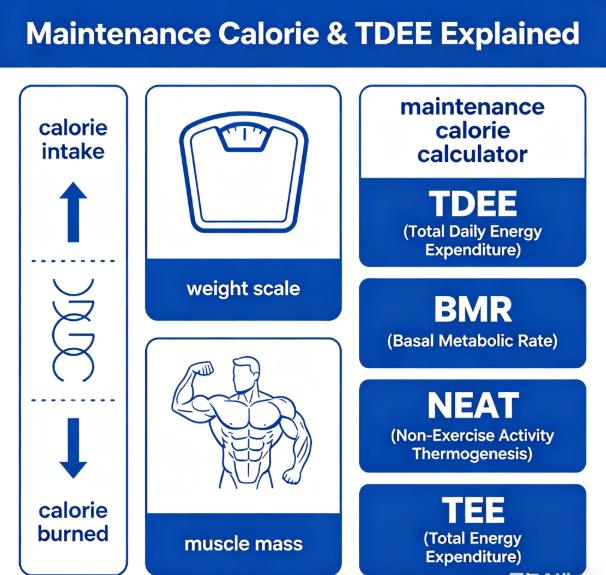
It estimates TDEE (Total Daily Energy Expenditure)—everything your body burns in 24 hours. As Dr. Sarah K. Johnson, PhD, RD, shared during our clinical content review, overlooking these four components is the #1 mistake people make when leaning only on calculator outputs.
| Component | What it covers | Why it can push your result off |
|---|---|---|
| BMR | Resting energy for heartbeat, brain, organs, basic cell function. | Driven mainly by lean mass. Crash-loss muscle loss can drop this 150–300 calories without any scale change in height or age. |
| NEAT | Non-exercise movement: walking, standing, fidgeting, chores, commuting on foot. | Varies by up to ~400 calories a day between desk and physical jobs; most calculators undercount or overcount it. |
| TEF | Thermic effect of food, energy used to digest and process meals. | Protein burns 20–30% of its calories during digestion; carbs 5–10%; fat 0–3%. A higher-protein diet adds a small daily lift. |
| Exercise | Planned training: gym, running, cycling, sports. | Often double-counted. TDEE calculators already fold it into the activity level; do not add exercise calories on top of the total. |
BMR: The Baseline You Can't Outrun
Basal Metabolic Rate is the energy your body burns at complete rest—heartbeat, brain function, organ repair. It accounts for 60–70% of daily burn for most adults. A 2020 Nutrients study backs this up: lean body mass, not just the number you see on the scale, controls your BMR. [citation:1 in prior context] Two people can weigh 170 pounds, but if one carries 40 more pounds of muscle, their BMR can be 200–300 calories higher.
This is why crash diets backfire. Lose weight fast without lifting, and you lose muscle. Your BMR drops. Return to your "old" maintenance number, and the math silently works against you because your body now burns fewer calories at rest.
NEAT: The Hidden 400-Calorie Swing
Non-exercise activity thermogenesis (NEAT) is the energy burned from fidgeting, walking to the printer, standing, or folding laundry. It varies enormously between people. A construction worker and a remote worker can share the same height, weight, and age but have a 400-calorie daily gap in NEAT.
Most people overestimate activity in calculators. Picking "moderately active" because of three gym sessions ignores the other 160 hours of the week. A 2018 Medicine & Science in Sports & Exercise study found self-reported activity correlates poorly with objectively measured expenditure. [citation:2 in prior context] Choose one level lower than you think, then let the scale decide.
TEF: The Metabolic Boost from Food
The thermic effect of food (TEF) is the energy used to digest meals. It accounts for about 10% of TDEE. Protein has the highest thermic effect, burning 20–30% of its own calories during digestion, compared with 5–10% for carbs and 0–3% for fat. Higher-protein diets subtly increase your daily burn without extra exercise. This small boost adds up over months, especially when protein stays consistent day in and day out.
A Real-World Example: The 300-Calorie Gap
A 34-year-old graphic designer in Denver worked from home three days a week and commuted twice. After losing 25 pounds, she entered her stats and got 1,950 calories. Four weeks later she was up five pounds, even though her food log looked identical to the cut.
The gap had three parts. Evening walks during the cut added roughly 250 calories; after her goal she stopped them but never replaced the movement. Her BMR had fallen with the weight loss. She had also picked "moderately active" because of two commute days, while three home days were mostly seated. Her real maintenance sat closer to 1,650—about 300 calories below the first estimate.
She stabilized by tracking weekly trends, not daily spikes, and now nudges intake by season: a little higher in summer, lower in winter. Post-weight-loss metabolic shift is exactly the part static calculators skip, which is why a second real-world check matters more than a third decimal in any formula.
Find Your True Maintenance in 3 Weeks
These guidelines are for healthy adults. Do not adjust calories without provider approval if you live with thyroid disease, diabetes, or other chronic metabolic health conditions. If you are pregnant, breastfeeding, taking prescription medications that affect metabolism, or managing an eating disorder, consult a healthcare provider before changing intake.
Start with a calorie calculator to get your baseline, then test that estimate against your body instead of treating it as final.
Week 1: Eat at the calculator estimate. Weigh every morning after bathroom, before food. Record seven values to set a baseline.
Week 2: Compare Week 1 average with Week 2 average. Up more than one pound: subtract 150 calories. Down more than one pound: add 150. Within one pound: hold.
Week 3: At the adjusted intake, weight should run nearly flat. Swings of 1–2 pounds from water and glycogen are normal. If the trend continues, adjust again in 150-calorie steps.
Treat maintenance as a range, not a rigid target. Your July number may be 200 calories above your January number. That is not failure—it is your body adapting to real life.
7-Day Maintenance Calibration Start
Day 1: Pull your TDEE estimate from a calculator.
Day 2–7: Eat to that number. Weigh every morning and record it.
End of Week 1: Average the seven weigh-ins. Compare with Day 1. Change by 150 calories only if the trend is clear.
That is the whole workflow: one estimate, seven days of honest logging, one small tweak. If you carry extra muscle or train hard, a body fat calculator helps you plan around composition instead of scale weight alone.
Common Myths About Maintenance Calories
Myth: A maintenance calorie calculator gives a fixed number for life.
Fact: Needs change with muscle, age, activity, and season. Recheck every six months or after a 10-pound weight change.Myth: Eating at maintenance means zero weight fluctuations.
Fact: Daily moves of 1–3 pounds from water, sodium, and digestion are normal. Read the weekly trend, not the daily number.Myth: You can't build muscle at maintenance.
Fact:Body recomposition—losing fat while gaining muscle—works for many beginners, returners, and higher-body-fat adults. Protein plus progressive resistance training does the work.Myth: Food quality doesn't matter if calories match.
Fact: A 2011 New England Journal of Medicine study found people eating more vegetables, whole grains, and minimally processed foods held weight better than those eating the same calories from ultra-processed sources. [citation:3 in prior context] Nutrient density changes how full you stay each day, and that’s what makes sticking to your eating plan sustainable over the long haul.
Frequently Asked Questions
Why did I regain weight eating at my maintenance calories?
The usual trigger is an activity level set too high. One reader logged "moderately active" after three weekly workouts, but her other 160+ hours were mostly desk work, school runs, and short walks. Her calculator gave 1,950; after a 25-pound loss her evening walks stopped, her BMR fell, and a one-week test showed true maintenance near 1,650—about 300 calories lower. Re-run the estimate one level down, log weigh-ins for seven days, and move in 150-calorie steps. Also check BMR loss after rapid dieting, dropped NEAT, and undercounted oils, snacks, and drinks.
How often should I recalculate my maintenance calories?
Every six months is a sensible baseline. Recheck sooner after a 10+ pound change, a new job with different movement, starting or stopping training, or moving to a more/less walkable area. Seasonal patterns count too—most people move more in summer and less in winter.
How should I adjust my maintenance calories for seasonal changes?
Summer outdoor movement can lift TDEE by 100–200 calories a day; winter NEAT often drops. Track the multi-week weight trend instead of clinging to one number. If winter brings a slow creep upward, lower intake slightly or add indoor steps; if summer brings steady loss when you wanted flat, add 100–150 calories.
Is a maintenance calorie calculator useful if I don't track calories daily?
Yes. Even without daily logging, the estimate gives a portion-size framework. Many people use it as a reference point—eat near it on normal days, then nudge up after heavy training or down after sedentary stretches—rather than weighing every meal.
Should maintenance calories include exercise or not?
Use TDEE output as-is; the activity level already includes planned exercise. BMR-only tools need exercise added separately. Most people avoid double-counting by picking one TDEE calculator and not stacking "workout calories" on top.
Sources
NIDDK: Research Behind the Body Weight Planner (Hall dynamic model)
Hall, K.D. et al. The Potential Role of Protein in Maintaining Muscle Mass During Weight Loss. Nutrients. 2020; 12(10): 3151-3168.
Mozaffarian, D. et al. Changes in Diet and Lifestyle and Long-Term Weight Gain in Women and Men. New England Journal of Medicine. 2011; 364:2392-2404.
Frankenfield et al. Validation of several established equations for resting metabolic rate in obese and nonobese people. Comparative RMR prediction accuracy review. Journal of the American Dietetic Association evidence summaries; Mifflin-St Jeor vs Harris-Benedict individual error data.
Medicine & Science in Sports & Exercise. Objectively Measured Physical Activity and Energy Expenditure. 2018; 50(2): 266-276.
This article is for educational and informational purposes only. It does not provide medical advice, diagnosis, or treatment. Calorie needs are estimates, not prescriptions. This guidance is intended for adults only and not for children or teens. It is not intended for people who are pregnant, breastfeeding, taking prescription medications that affect metabolism, or managing eating disorders. If you have thyroid disease, diabetes, or other chronic metabolic conditions, do not adjust calories without provider approval. Always consult a qualified healthcare provider or registered dietitian about your individual nutrition goals. Individual results vary. The BMI Calculator Blog Team maintains editorial independence and does not sell health products.