At a Glance: The standard BMI normal range is 18.5–24.9, but this "healthy" window shifts based on your biology. Asian adults face higher risks above 22.9, while seniors (65+) are often protected at 23–28. This guide breaks down the evidence-based ranges for every age, ethnicity, and life stage — and explains why waist size matters more than the number on the scale.
Most adults assume a "normal" BMI means they are safe. However, up to 20% of people within the 18.5–24.9 range carry excess body fat and metabolic risk despite a "healthy" number. Your Body Mass Index is a screening tool, not a diagnostic one. It provides a starting point, but it cannot see what is happening inside your body. For a precise calculation based on your height and weight, use our calculate BMI to find your category instantly.
What Is the Standard BMI Normal Range for Adults?
The standard classification for adults aged 18–64 who are not athletes and not of Asian descent is divided into four categories. These ranges are derived from large-scale epidemiological studies by the CDC and WHO linking weight to chronic disease risk.
Underweight: Below 18.5
Normal weight: 18.5–24.9
Overweight: 25.0–29.9
Obesity: 30.0 and above
The formula is identical for everyone: Metric (kg/m²) or Imperial (lb/in² × 703). However, biological sex influences body composition. Women naturally carry more essential fat than men, meaning a BMI of 24 might look different physiologically between genders. The key is to treat the number as a risk marker, not a moral judgment.
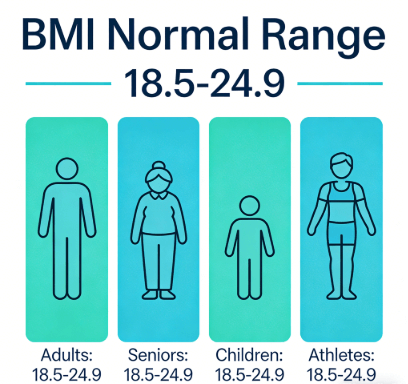
Why the "Normal" Range Isn't One-Size-Fits-All
Population health data reveals that the standard 18.5–24.9 range fails specific groups. Age, ethnicity, and muscle mass change how your body stores fat and how that fat impacts your organs. Here is how the thresholds shift for different populations.
Asian Adults: The Narrower 18.5–22.9 Range
East, South, and Southeast Asian populations develop type 2 diabetes and heart disease at lower BMIs than Caucasians. The WHO recommends an adjusted normal range of 18.5–22.9 for these groups. At a BMI of 23, an Asian adult has a similar metabolic risk as a Caucasian adult at BMI 27. South Asians (Indian, Pakistani, Bangladeshi) face even higher risks; some clinicians suggest screening for diabetes starting at a BMI of 22. Many South Asian adults never expect prediabetes risk at seemingly low BMI numbers, which makes routine screening especially important. If you fall into this group, our Asian BMI calculator provides the most accurate risk assessment.
Seniors (65+): The Protective 23–28 Range
For older adults, a slightly higher BMI is associated with better survival rates. Research from the National Institute on Aging shows that a BMI of 23–28 acts as a nutritional buffer against frailty, falls, and illness. Muscle loss (sarcopenia) is a bigger threat than weight at this age. A senior with a BMI of 26 has more reserves to recover from surgery or infection than one at 20. Use our senior BMI calculator to see your age-specific healthy zone.
Children and Teens: Percentiles, Not Fixed Numbers
Children are growing, so a fixed number is meaningless. The CDC uses BMI percentiles (5th–84th) based on age and sex. A BMI of 16 might be healthy for a 5-year-old but underweight for a 15-year-old. Pediatricians track the trend of these percentiles over time to spot growth issues.
Athletes: When Muscle Skews the Math
BMI cannot differentiate between muscle and fat. Muscle is denser, so strength athletes (powerlifters, football players) often have a BMI in the 25–30 "overweight" range while maintaining single-digit body fat. For these individuals, body fat percentage and waist circumference are far better indicators of health than BMI alone.
Pregnancy: Pre-Pregnancy Baseline
During pregnancy, weight gain includes the fetus, placenta, and fluid. Therefore, we only use your pre-pregnancy BMI to set weight gain goals. The CDC recommends gaining 25–35 lbs for those starting in the normal range. Current pregnancy weight should not be plugged into a standard BMI calculator.
Global BMI Normal Ranges at a Glance
| Population Group | Normal BMI Range | Key Clinical Note |
|---|---|---|
| General Adults (18–64) | 18.5–24.9 | CDC/WHO baseline standard |
| Asian Adults | 18.5–22.9 | Higher visceral fat risk at lower BMIs; South Asians may use stricter cutoff 18.5–22 |
| Seniors (65+) | 23.0–28.0 | Protects against frailty and mortality |
| Children (2–19) | 5th–84th Percentile | CDC growth chart dependent |
| Strength Athletes | 25.0–30.0 (Contextual) | Requires body fat assessment |
Beyond BMI: What the Number Misses
Looking only at your BMI number tells you very little about what's happening inside your body, just as a vehicle's paint condition does not reveal engine health. It misses three critical health factors:
Normal-Weight Obesity: Up to 20% of people with a "normal" BMI have high body fat percentages and metabolic issues. This is often called "skinny fat."
Visceral Fat Location: BMI doesn't know if fat is stored under the skin (subcutaneous) or around your organs (visceral). Visceral fat is far more dangerous.
Muscle Mass: It cannot detect sarcopenia (muscle loss) in seniors, which is a primary predictor of falls and fractures.
To get a true picture of your health, pair your BMI with your waist circumference. The NIH identifies high risk at >40 inches for men and >35 inches for women. If your waist is large, your health risks are high, regardless of your BMI.
Question: What is a healthy waist circumference?
Answer: For men, below 40 inches (102 cm); for women, below 35 inches (88 cm). A shrinking waist while weight stays flat often means you're losing visceral fat and gaining muscle — exactly what you want.
One woman we heard from, 38, had a BMI of 22.5 — squarely "normal." But her waist measured 36 inches, above the 35-inch risk threshold. Her fasting glucose was 102 mg/dL, in the prediabetic range. She started walking 30 minutes daily and swapped refined carbs for whole grains. Six months later, her waist was 33 inches and her glucose dropped to 91. Her BMI never changed. This example is illustrative and not personalized medical advice.
Your 7-Day Action Plan
Simply knowing which BMI bracket you fall into won’t improve your health on its own. Below are actionable steps tailored to your age, ethnicity, and body composition.
For those with a normal BMI who don’t exercise: Add 150 minutes of moderate walking weekly. Activity protects your metabolism even if your weight stays the same.
If you are Asian with a BMI of 23–24.9: Don't panic. Instead, get a fasting glucose test. This range signals the need for early metabolic screening.
If you are a senior with a BMI under 23: Focus on strength training twice a week. Preserving muscle is more important than losing fat at this age.
If you are an athlete with a high BMI: Measure your body fat. If it's low, your BMI is just reflecting your muscle mass.
Day 1: Calculate your BMI and write it down.
Day 3: Measure your waist at the navel. Compare it to the 40"/35" thresholds.
Day 7: Swap one processed snack for a piece of fruit or a handful of nuts.
If you need to adjust your calorie intake to move toward your ideal range, use our calorie calculator to find your personalized target. For a more complete picture of your body composition, a body fat calculator can distinguish between fat loss and muscle gain.
Frequently Asked Questions
Can I be healthy with a BMI outside the normal range?
Yes. A muscular athlete with a BMI of 26 may have better blood work than a sedentary person with a BMI of 22. Health markers like blood pressure, cholesterol, and insulin levels are more important than the BMI number alone.
Why do South Asians have a lower BMI threshold?
South Asians accumulate visceral fat at lower BMIs. A BMI of 22 in an Indian or Pakistani adult carries the same diabetes risk as a BMI of 27 in a Caucasian adult. This is because visceral fat — the fat around your organs — drives insulin resistance more aggressively in this population. Even at a "normal" weight, South Asian adults often have a higher proportion of visceral fat relative to total body fat. That’s why the WHO recommends stricter cutoffs and why screening for diabetes starting at BMI 22 is clinically urgent.
Do men and women have different normal BMI ranges?
The numerical BMI cutoffs are identical for adult men and women. The difference lies in body composition: women naturally hold more essential body fat, while men often carry more lean muscle mass at the same BMI value. A woman at BMI 24 may carry a higher, yet still healthy, body fat percentage compared to a man at the same BMI.
Is a BMI of 24.9 "better" than 22?
Not necessarily. Both are within the normal range. However, for a 70-year-old woman, a BMI of 24.9 is protective against frailty — the extra reserve helps during illness. For a 25-year-old, a BMI of 22 often reflects excellent fitness. The "best" BMI depends entirely on your age and body composition.
What is the biggest mistake people make with BMI?
Assuming it is a diagnostic tool. BMI is a screening tool. It tells you where to look closer, but it cannot diagnose obesity, diabetes, or heart disease. Only a doctor can do that using blood tests and physical exams.
How does menopause affect my BMI normal range?
Menopause often shifts fat storage to the abdomen, increasing visceral fat even if your weight stays the same. This means your "normal" BMI might hide increased metabolic risk. Post-menopausal women should prioritize waist measurement over BMI.
Sources
CDC: Adult BMI Categories — Healthy Weight 18.5–24.9 and Full Range Chart
WHO: Obesity and Overweight Fact Sheet — Normal-Weight Obesity and Metabolic Risk
WHO Western Pacific Region. The Asia-Pacific Perspective: Redefining Obesity and Its Treatment (2004).
NIH NIDDK: Health Risks of Overweight & Obesity — Waist Circumference and Metabolic Risk
This article is for educational and informational purposes only. It does not constitute medical advice, diagnosis, or treatment. Always consult a qualified healthcare provider regarding your individual health and weight goals. Individual results will vary. The BMI Calculator Blog Team maintains editorial independence and does not sell health products.
Related Articles
BMI Healthy Range: Adjusted Charts for Age, Asians & Athletes
CDC BMI Guidelines: Adult BMI Categories 18.5–24.9 & Senior Adjustments
Why Asian BMI Cutoffs Are Lower Than Western: The Visceral Fat Difference
Last updated: October 20, 2026.