Quick Summary: Asian BMI cutoffs start at 23, not 25, because many Asian adults carry more body fat and visceral fat at the same weight. Diabetes and heart risks appear earlier, so WHO uses 23 and 27.5 instead of 25 and 30 for public health guidance.
Standard BMI math is the same for everyone, but risk isn’t. The classic 18.5–24.9 “healthy” range comes mostly from European and North American data. It works as a baseline, yet misses important patterns in Asian body composition.
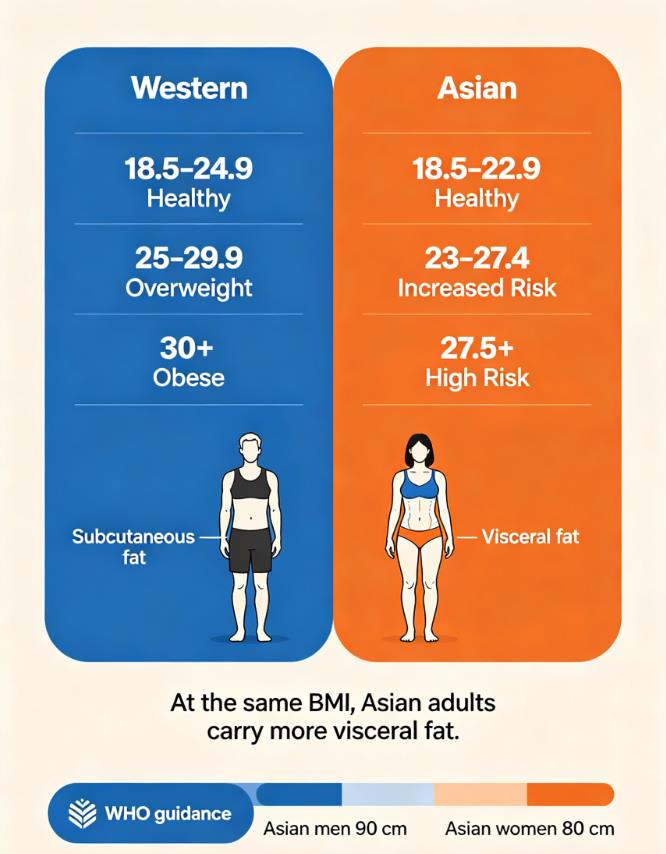
Why Asian Cutoffs Sit Lower
A 2004 WHO Expert Consultation published in The Lancet reviewed population data across Asia. Researchers found that, at the same BMI, many Asian adults have 3–5% more body fat than white European adults. They also store more fat around organs—visceral fat—rather than under the skin.
These numbers are not arbitrary. They come from decades of tracking metabolic disease across ethnic groups. At a BMI of 24, an Asian adult may look “normal” on a standard chart while already carrying the visceral fat and insulin resistance that raise diabetes risk. The standard number doesn’t capture that ethnic difference.
Asian vs Western Ranges
Instead of memorizing lists, use this side-by-side view. It shows exactly where the lines shift.
| Metric | Standard (Western) | Asian (WHO) |
|---|---|---|
| Healthy BMI | 18.5–24.9 | 18.5–22.9 |
| Increased Risk | 25–29.9 | 23–27.4 |
| High Risk / Obesity | 30+ | 27.5+ |
| Waist (Men) | 40 in / 102 cm | 35.4 in / 90 cm |
| Waist (Women) | 35 in / 88 cm | 31.5 in / 80 cm |
Notice the waist thresholds. They drop significantly for Asian adults because abdominal fat drives risk long before total weight climbs.
What This Looks Like in Real Life
Consider a common pattern: an Asian adult with a BMI of 24 checks a generic chart, sees “healthy,” and moves on. But their waist is 34 inches, and their fasting glucose is creeping upward. The standard number didn’t capture what was happening underneath. That’s why using ethnic-specific cutoffs matters for early awareness.
To get a clearer picture, plug your numbers into an asian bmi calculator. For a broader view of your target zone, a healthy weight range tool helps map your height to these adjusted categories. You can always cross-check with a standard Adult BMI Calculator to see the baseline difference.
Simple Action Steps
Use ethnic settings. Don’t rely solely on the generic 18.5–24.9 window.
Measure your waist. Do it at navel level after a normal exhale every few months.
Watch the trend. Stable BMI with a rising waist often signals muscle loss and visceral gain.
Pair numbers with labs. Blood pressure, glucose, and lipids fill in the risk picture.
Frequently Asked Questions
Why is BMI 23 overweight for Asians but normal for Western adults?
At BMI 23, many Asian adults already have body-fat levels that raise diabetes risk. Standard European-based charts wait until 25 to flag risk, so ethnic charts act earlier to prevent disease.
Do all Asian subgroups use 23 and 27.5?
No. WHO provides public-health benchmarks. South Asians may see risk rise from BMI 22, while some East Asian guidelines use 23–24.9 as the first action point. Local guidance can differ.
Is 22.9 or 23 the Asian healthy limit?
WHO defines Asian healthy BMI as 18.5–22.9. BMI 23 starts the “increased risk” category. Some national charts label 23–24.9 as overweight, others call it a pre-action range.
Should I ignore standard BMI if I am Asian?
No—use both. Standard BMI gives a baseline. Then check your number against the Asian cutoffs (23 and 27.5) and measure your waist. Blood work fills in the rest. No single number defines risk.
Why are Asian waist limits lower?
Visceral fat builds at smaller waists in many Asian adults. Lower thresholds catch cardiometabolic risk before general limits would.
Can muscle make Asian BMI look overweight?
Yes. If your waist stays within Asian limits and body-composition testing shows low fat, a high BMI may reflect muscle. A qualified professional can help interpret individual results.
Sources
This article is for informational and educational purposes only. It does not constitute medical advice, diagnosis, or treatment. Always consult a qualified healthcare provider regarding your individual health and weight goals. Individual results will vary. The BMI Calculator Blog Team maintains editorial independence and does not sell health products.