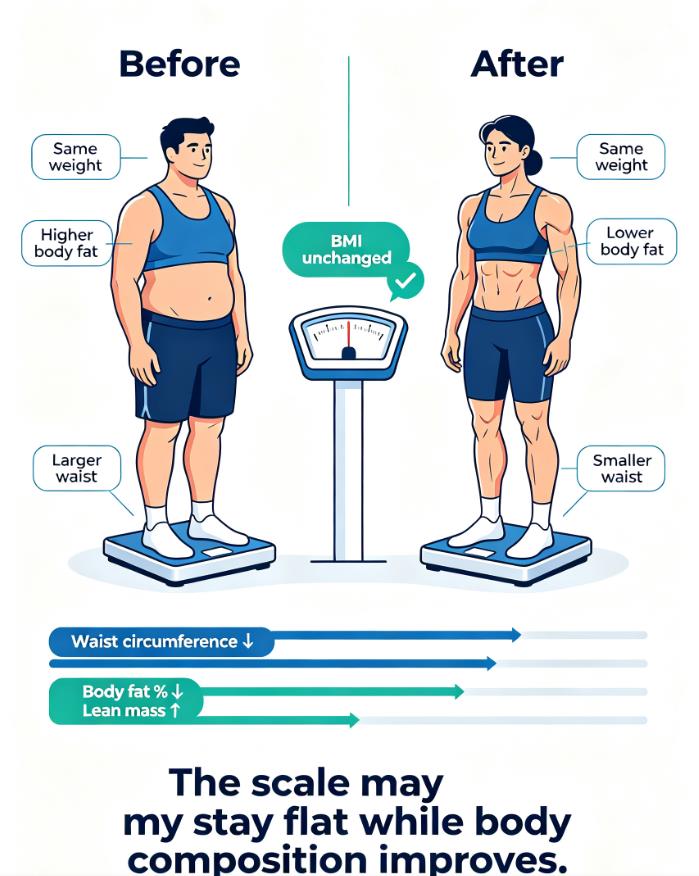
Quick summary: Resistance training can lower your BMI without weight loss, but the drop is usually small and tied to specific conditions. BMI only tracks height and total weight, not tissue type. A lower number at the same weight typically means you have lost more fat than you gained in muscle. For most people, the real win is a smaller waist and healthier body-fat percentage while the scale barely moves.
What "lower BMI without losing weight" actually means
BMI = weight(kg) ÷ height(m)². The formula never sees muscle, fat, bone, or water. If you lose 5 kg of fat and gain 5 kg of muscle, the scale can stay identical and BMI stays identical too.
So “resistance training lowers BMI without weight loss” is true only in specific situations: partial fat loss with partial muscle gain, fluid shifts, or measurement timing. More often, the win is better body composition at the same BMI.
Three outcomes you can realistically expect
| Starting point | What resistance training changes | BMI vs. better markers |
|---|---|---|
| Overweight, untrained | Fat ↓, lean ↑ or steady | BMI may drop 0.5–1.5 over 8–16 weeks; waist/body fat improve more |
| Normal BMI, high body fat | Recomposition, weight stable | BMI often unchanged; body-fat % and waist are the real progress |
| Muscular/athletic | Lean gain dominates | BMI may stay high or rise; use body-fat % and performance, not BMI alone |
A systematic review of 114 trials found resistance training alone increased lean mass by about 0.8 kg compared to no training and reduced body-fat percentage. When combined with aerobic exercise and a controlled diet, fat-mass reductions were even larger. That makes progressive strength work a top choice for body recomposition.
Why muscle changes the health picture before the scale moves
Muscle is denser than fat and metabolically active. The scale often stays flat for 6–8 weeks, then waist drops 1–2 inches and clothes fit looser. That’s recomposition, not stalled progress.
Skeletal muscle improves glucose uptake and insulin sensitivity. A DXA-based study tracked 304 adults during calorie restriction. Resistance training was the only approach that preserved or even built fat-free mass. Aerobic and no-exercise groups lost lean tissue instead. For most healthy adults, that makes strength training the core of a recomposition plan.
Minimum effective training plan
Frequency: 2–3 full-body sessions weekly; beginners start with 2.
Movements: squat, hinge, push, pull, carry, core—cover legs, hips, back, chest, shoulders, arms.
Load: 1–3 sets of 8–15 reps at controlled effort; add weight or reps over time.
Protein: most healthy adults doing recomposition do well on 1.6–2.2 g/kg/day, spread across meals.
Energy: maintenance or a modest 250–500 kcal/day deficit; steeper cuts raise muscle-loss risk.
The CDC advises adults to target 150 minutes of moderate aerobic activity weekly plus muscle-strengthening work on at least 2 days, covering all major muscle groups. A online BMI calculator gives a baseline, but pair it with waist and body-fat tracking.
Track these instead of scale weight
Waist circumference beats scale weight during recomposition. CDC risk cutoffs are 40 inches/102 cm for men and 35 inches/88 cm for women; a shrinking waist at stable weight usually means less abdominal fat. Add a body fat calculator reading every 4–6 weeks using the same method each time.
For a fuller comparison of the two metrics, see BMI vs body fat percentage. When BMI looks “healthy” but waist is high, body-fat data often explains the hidden risk.
Common mistakes that keep BMI flat for the wrong reasons
Many people misapply standard BMI benchmarks to athletes. A muscular trainee can show “overweight” or “obese” BMI with excellent body-fat and lab markers. In that case, the number is a measurement limit, not a health verdict.
Another mistake is doing endless cardio with no progressive resistance. That favors calorie burn but not lean-mass gain. Eating too little protein during a deficit favors fat loss but also lean loss. Weighing at different times of day, after heavy sodium meals, or only once weekly adds noise that looks like “no progress.”
Frequently Asked Questions
Can BMI go down if my weight does not change?
Yes, but usually only with small net fat loss and muscle gain, hydration changes, or retesting after consistent training. Expect modest shifts; waist and body-fat changes matter more.
How long until resistance training changes body composition?
Strength gains often appear in 3–6 weeks. Measurable fat-loss and waist changes commonly show by 8–12 weeks with progressive training, adequate protein, and consistent measurement.
Is strength training better than cardio for lowering BMI without weight loss?
For preserving or building muscle, strength training is the preferred modality. For total weight and waist reduction, combined strength plus aerobic usually works best. Choose based on your goal: recomposition favors strength first.
Why is my BMI still “overweight” when I look lean?
BMI cannot separate muscle from fat. If waist is below risk cutoff and body-fat percentage is in your sport/age range, a high BMI may reflect muscle rather than excess fat. Confirm with body-composition testing.
What body-fat range should I target instead of BMI?
General adult fitness ranges vary by lab and sex; many references use roughly 14–17% for men and 21–24% for women as fitness, with athletes lower. Individual goals should account for age, sex, and activity—review with a qualified provider if unsure.
Do seniors need a different rule for resistance training and BMI?
Often yes. Adults over 65 may benefit from preserving muscle even if BMI stays in the mid-20s. Train 2 days weekly, prioritize protein and balance, and judge progress by strength, waist, and function rather than scale weight alone.
Sources
This article is for informational and educational purposes only. It does not constitute medical advice, diagnosis, or treatment. Always consult a qualified healthcare provider regarding your individual health and fitness goals. Individual results will vary. The BMI Calculator Blog Team maintains editorial independence and does not sell health products.