Quick summary: BMI sorts total weight by height; body fat percentage measures actual fat tissue. For personal health, BMI alone often misleads because it cannot tell muscle from fat. Pair both with waist circumference — that combination catches risks a single number misses.
BMI is best for fast screening and population data, not for judging muscle-heavy individuals.
Body fat percentage shows fat vs lean mass, but home methods carry a 3–5 point error versus DEXA.
Waist circumference adds fat-distribution risk: above 35 in/88 cm (women) or 40 in/102 cm (men) needs attention even with a normal BMI.
Use them together — start with BMI, add body fat, confirm with waist and, when indicated, metabolic labs.
Why These Two Numbers Disagree
BMI = weight(kg) ÷ height(m)². It returns one category from two inputs and treats a pound of muscle the same as a pound of fat. Body fat percentage splits your weight into fat mass and lean mass, so it answers a question BMI never asks: how much of you is actually fat.
Two men at the same height and weight illustrate the gap — both 5'10" (178 cm), 210 lbs (95 kg), BMI 30.1. One trains seriously, carries 13% body fat, and has normal blood pressure and glucose. The other is sedentary, carries 32% body fat, and shows elevated cardiometabolic markers. Identical BMIs, opposite health pictures. That example is why one metric is never enough for an individual.
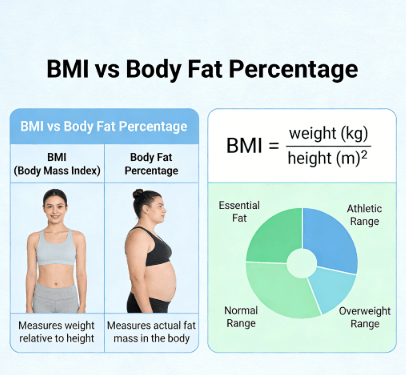
What Each Metric Actually Answers
| Question you care about | BMI result | Body fat % result |
|---|---|---|
| Am I in a weight category? | Fast yes/no by population cutoffs. | Indirect — must be read against age/sex ranges. |
| Is fat or muscle changing? | Cannot separate them. | Directly tracks fat vs lean over time. |
| Where is the fat stored? | Not addressed. | Combine with waist; high visceral fat shows up indirectly. |
| Does it fit athletes? | Often over-flags muscle as "overweight". | More realistic when method error is understood. |
| Effort to measure | Height + weight, under 1 minute. | Navy method: height, weight, waist, neck, about 5 minutes. |
A free BMI calculator gives the population view in seconds. A body fat calculator adds the tissue-level view that BMI lacks.
Body Fat Ranges by Sex and Goal
The American Council on Exercise publishes adult ranges most clinics and trainers use as a benchmark. Home methods carry a 3–5 point error versus DEXA, so treat the number as a trend, not a verdict.
| Category | Men | Women |
|---|---|---|
| Essential fat | 2–5% | 10–13% |
| Athletic | 6–13% | 14–20% |
| Healthy (fitness) | 14–17% | 21–24% |
| Overweight | 18–24% | 25–31% |
| Obese | 25%+ | 32%+ |
Women need more essential fat — roughly 10–13% versus 2–5% for men — because of reproductive hormone function. A 15% reading is "athletic" for a woman and "healthy fitness" for a man, so sex-specific ranges always apply.
Normal-Weight Obesity: The Quiet Mismatch
A BMI in the 18.5–24.9 band does not prove a healthy body composition. Suppose a 34-year-old office worker has a BMI of 22, a waist of 37 inches (94 cm), and a body fat reading of 34%. She does no structured training and eats most meals away from home. Her BMI looks ideal; her body-fat result explains the real risk.
Research estimates roughly 1 in 5 U.S. adults with a normal BMI carry high body fat — "normal-weight obesity." Romero-Corral et al. (Eur Heart J, 2010;31(6):737–746, DOI 10.1093/eurheartj/ehp487) linked that pattern to higher blood pressure, fasting glucose, and unfavorable lipid profiles versus people who were normal on both metrics. Waist cutoffs — above 35 inches/88 cm for women, 40 inches/102 cm for men — catch many of these cases even when BMI stays quiet.
When BMI Still Earns Its Place
BMI works best at scale and at the extremes. Keep in mind this is why population reports and your personal check-up need different tools: one number rarely does both jobs.
Population studies:Across thousands of people, muscle-fat misclassification averages out; BMI predicts chronic-disease trends well.
Extreme values:Below 18.5, especially below 16, signals undernutrition risk; above 40 almost always means substantial excess fat regardless of composition.
Fast triage:No equipment beyond a scale and stadiometer; useful for first-pass screening.
Big weight shifts:For 10%+ loss or gain, BMI direction tracks progress even if body fat gives the "what changed" detail.
Using Both Without Double-Guessing Yourself
Get BMI first.Below 18.5 or above 40 needs professional review regardless of body fat.
In the 25–35 zone, add body fat percentage.This is where muscle and fat overlap most; compare results to the ACE table.
Add waist circumference.Above 35 in/88 cm (women) or 40 in/102 cm (men) signals visceral fat even with a "normal" BMI.
Confirm with labs when indicated.Blood pressure, fasting glucose, HbA1c, and lipids turn a number into a health plan. A qualified provider interprets these with your full history.
Pregnancy changes the rules — only pre-pregnancy BMI guides weight-gain targets, and body fat percentage is not used for status during pregnancy. For adults 65+, a BMI around 23–28 can be protective if muscle is preserved; chasing a lower BMI may cost lean mass. For a tool-by-tool walkthrough, see body fat percentage vs BMI calculator.
Frequently Asked Questions
Which is more accurate — BMI or body fat percentage?
When assessing your personal health, body fat percentage delivers a clearer view, measuring your actual fat tissue instead of only total body weight. BMI works best for large population research, where individual variations in muscle and fat get averaged out.
Can I have a healthy BMI and still be overfat?
Yes. Studies estimate about 20% of adults with a normal BMI carry high body fat. If your waist exceeds 35 in/88 cm (women) or 40 in/102 cm (men), ask about body fat testing and metabolic labs even when BMI looks fine.
Why does my BMI say I'm overweight when I look lean?
Muscle is denser than fat — a pound of muscle takes up less space than a pound of fat. Regular strength trainers often carry extra mass at the same height. If your BMI lands at 26–28 but your body fat sits at 14–17% for men or 21–24% for women, that higher BMI is almost certainly muscle mass rather than excess fat risk.
How often should I check body fat percentage?
Every 4–6 weeks under the same conditions — same time of day, similar hydration, same method. Weekly checks add noise because fat changes slowly and home devices carry a few points of error.
Is BMI useless for athletes?
Not useless, just incomplete. Muscular athletes often read "overweight" or "obese" on BMI with normal body fat and good labs. When BMI and body fat disagree, trust body fat plus waist circumference and performance data.
Sources
CDC: About Body Mass Index — Limitations as a Screening Measure
American Council on Exercise: Body Fat Percentage Guidelines
WHO. Obesity and body composition classification standards, used for population-level screening, reviewed 2026.
Romero-Corral A, et al. Normal weight obesity: a risk factor for cardiometabolic dysregulation and cardiovascular mortality. Eur Heart J. 2010;31(6):737–746 (DOI 10.1093/eurheartj/ehp487).
This content is provided for educational and informational purposes only. It does not replace professional medical advice, diagnosis, or treatment. Always consult a qualified healthcare provider regarding your BMI, body composition, or health goals. Individual results vary.