Weight gain exercises for a BMI below 18.5 aren't about "toning" or endless crunches. They're compound resistance movements designed to force lean muscle growth, backed by a 300–500 daily calorie surplus. The WHO and CDC both classify under 18.5 as underweight. This guide gives you a science-grounded framework — gym lifts, living-room alternatives, and recovery tactics that actually move the scale — without the cardio that burns the calories you need to keep.
Most fitness advice assumes you want to shrink. When your CDC-calculated BMI sits below 18.5, the goal reverses: build tissue, not burn it. High-intensity intervals or 5-mile runs torch the very calories your muscles need for repair. Start by plugging your numbers into a calculator BMI so you have a baseline. Then it's simple: lift, rest, repeat, and eat like it's your job.
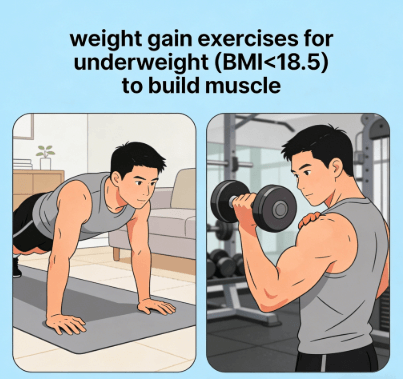
How Resistance Training Tells Your Body to Grow
Muscle growth happens when lifting creates microscopic tears in muscle fibers. Your body repairs them thicker and stronger — but only if it has the raw materials. For someone with a BMI under 18.5, the body can slip into a catabolic state more easily, breaking down muscle for fuel if calories run short.
A 2019 study by Schoenfeld and colleagues in the Journal of the International Society of Sports Nutrition (DOI: 10.1186/s12970-019-0293-7) found that combining resistance training with a daily surplus of about three hundred to five hundred extra calories led to measurable lean mass gains in underweight adults over 8–12 weeks. The researchers stressed consistency — not heroic single sessions. I've seen too many skinny beginners burn out by training six days a week. Your body needs the calories for repair, not another workout.
Compound Lifts: The Non-Negotiable Core
Build every workout around multi-joint movements. Squats and deadlifts? They hit more muscle fibers than any curl. But the real magic is the hormonal response — and you can't get that from a machine. Isolation exercises are seasoning, not the meal.
The ACSM resistance training guidelines suggest 8–12 reps per set for hypertrophy. But as a beginner, even 3 sets of 8 with an empty bar will spark change. Add 2.5 to 5 pounds as soon as the current weight feels manageable. Skip progressive overload and you'll regret it — for most people, nothing else drives growth.
At-Home Moves That Build Real Muscle
Not everyone can walk into a gym tomorrow. You can trigger serious growth with household items and body weight — the trick is choosing exercises that mimic the big compound lifts.
A 10-pound bag of rice or a full laundry detergent jug works perfectly for goblet squats. Actually, let me back up — my first goblet squat was with a bag of dog food. Not glamorous, but it worked. I keep a 10-pound bag of rice by my couch for quick sets while watching TV. It's low-effort but adds up.
Goblet squats with a household load: Hold a weight at your chest, squat to parallel. 3 sets of 8–12 reps. This hits quads, glutes, and core — the biggest muscle groups that drive scale weight up.
Incline push-ups: Hands on a sturdy table or desk. Lower your chest, push up. 3 sets of 8–12 reps. If these are too hard, start with wall push-offs.
Glute bridges: Lie on your back, knees bent, drive hips up. Hold for 2 seconds. Add weight across your hips once 15 reps feel easy. 3 sets of 10–15 reps.
Doorframe rows: Grip a sturdy doorframe, lean back, pull your chest to the frame. 3 sets of 8–12 reps. This hits your back and biceps — muscles often forgotten in living-room workouts.
I've seen many skinny guys doing endless crunches hoping for a six-pack. Without building the underlying muscle, you're just crunching air. Squat heavy first — abs show up later.
Gym Lifts That Maximize Every Rep
Once you have access to a barbell and dumbbells, these five lifts become the backbone of your program. Start with just the bar, nail the form for two weeks, then add weight slowly. Nobody cares how much is on the bar in week one. Ego is the fastest route to injury.
Barbell back squats: 3×8–12. The king of mass builders. Works legs, glutes, lower back, and core in one shot.
Flat barbell bench press: 3×8–12. Builds chest, front delts, triceps. Keep your shoulders packed down, not flared.
Bent-over barbell rows: 3×8–12. Balances all that pressing by thickening your back. Pull the bar to your lower ribs, not your chest.
Overhead dumbbell press: 3×10–12. Standing or seated, this widens your shoulders and builds upper-body mass.
Romanian deadlifts: 3×8–10. Hamstrings and glutes get the focus here. Slight knee bend, push your hips back — feel the stretch.
The 3-Day Schedule That Beats Burnout
More is not better when you're underweight. Three full-body sessions per week — Monday, Wednesday, Friday — leave 48 hours of recovery between each. That's when muscle protein synthesis peaks and actual tissue gets laid down. Each workout runs 45–60 minutes max. Any longer and you're dipping into the calorie surplus needed for growth.
Once you understand how muscle changes the number on the tape measure and the scale, you'll see why muscle mass alters healthy weight standards — it's not just about a BMI number, but body composition.
The Nutrition Bridge: You Can't Out-Train a Deficit
Training gives the signal; food supplies the bricks. Without a calorie surplus, even the best workout plan stalls. A 300–500 kcal surplus above maintenance typically yields about 1 lb (0.45 kg) of gain per week. Use a calorie calculator to find your baseline, then add.
A 500 kcal surplus sounds like math class, but realistically it's just adding a large banana and a scoop of peanut butter to your daily shake. Protein matters too: 1.6–2.2 g per kg of body weight, split into 3–4 meals with 25–35 g each. Don't obsess over hitting exactly 130 g. If you nail 100 g and drink a glass of milk before bed, you're winning.
Don't fear liquid calories. A smoothie with 1 cup whole milk, 1 banana, 2 tbsp peanut butter, and a scoop of protein powder packs around 500 kcal and 30 g protein without making you feel stuffed.
Sleep, Recovery, and Muscle Synthesis
Muscle isn't built in the squat rack; it's built in bed. During deep sleep, growth hormone surges and protein synthesis accelerates. Cut sleep short, and cortisol rises — the stress hormone that breaks down muscle tissue. A 2021 review in Sports Medicine found that athletes sleeping under 7 hours had significantly lower lean mass gains than those getting 8+ hours, even when total calories and protein were matched. I've had clients who did everything right in the gym but saw zero change until they fixed their sleep.
Keep recovery on track with three basics: 48 hours between training the same muscle group, 7–9 hours of actual sleep, and 2–3 liters of water daily. On rest days, walk 10–15 minutes — not 3 miles.
A Real 12-Week Transformation
Sarah, 24, started with a BMI of 17.8 and constant fatigue. She'd tried eating more, but without the right training, most of it passed through. Following this exact plan — three full-body sessions per week, a 400-calorie surplus, and compound lifts as her priority — she gained 8 pounds (3.6 kg) of lean muscle in 12 weeks, reaching a BMI of 19.2. "I used to think eating more was the only solution," she told me, "but combining compound lifts with a steady surplus made all the difference. I feel stronger, not just heavier." Her story isn't magic; it's consistency plus the right stimulus.
Mistakes That Keep You Stuck
Adding too much cardio tops the list. A single mile run burns roughly 100 kcal — calories your muscles could use to grow. Walk 10–15 minutes a few times a week instead. Extreme "clean" eating is another trap: whole milk, peanut butter, avocados, and dried fruit are calorie-dense whole foods. A half-cup of trail mix gives you 350 kcal easily.
Skipping meals when appetite is low stalls progress. Liquid calories solve this — the smoothie recipe above isn't "cheating," it's smart supplementation. Hitting the same muscles daily doesn't double growth; it cuts off repair. And forgetting progressive overload means your body adapts and stops growing. Add 2.5–5 lbs or 1–2 extra reps each session. Write it down.
Finally, don't expect visible results in 7 days. A 500 kcal surplus yields about 4 lbs in a month — part muscle, part water, part fat. Visible changes take 8–12 weeks. Trust the process.
Your 7-Day Starter Plan
Don't add extra sessions. Don't double the sets. Follow this as written and you'll prime your body to gain without burning out.
Day 1 (Monday): Full-body workout. Post-workout meal within 60 minutes.
Day 2 (Tuesday): Rest. 10-minute walk optional. Eat in surplus.
Day 3 (Wednesday): Full-body workout. Add 2.5–5 lbs to one lift if form holds.
Thursday is a rest day — prioritize protein with every meal. Friday brings another full-body session; aim for 8 hours of sleep that night. Saturday can be active recovery with gentle stretching and meal prep, while Sunday is full rest with extra hydration.
Minimum commitment: 4 weeks before judging results. Weigh yourself once weekly, Monday morning, after using the bathroom. Take a progress photo in consistent lighting. The scale will move if you're consistent.
Frequently Asked Questions
How fast can I move from a BMI of 17.5 to 18.5?
Gaining 0.5–1 lb (0.23–0.45 kg) weekly, a 5'7" (170 cm) person at BMI 17.5 needs about 3–5 lbs to reach 18.5. That's 4–6 weeks of consistent eating and training. Factors like metabolism and sleep quality can shorten or lengthen this timeline, but patience wins.
Will I have to gain fat to build muscle if I'm underweight?
Some fat gain is normal and healthy during the building phase. The body rarely partitions 100% of a calorie surplus into pure muscle. Roughly half may go to muscle, the rest to fat and water. The goal is to tip the ratio toward muscle with heavy training — and accept that a little extra body fat at a still-healthy weight is part of the process.
Are protein powders or mass gainers safe when I'm underweight?
Yes, for most healthy adults. They help hit 1.6–2.2 g/kg daily. Choose third-party tested products:
Whey, casein, or plant-based powders — look for NSF International or Informed Sport seals.
Mass gainers (800–1,200 kcal per shake) — a temporary tool, not a meal replacement.
Real food still brings micronutrients powders lack, so use shakes to fill gaps, not replace meals.
What if a health condition caused my low BMI?
For most healthy adults, this plan works well. But conditions like hyperthyroidism, celiac disease, or Crohn's can make weight gain difficult. In these cases, stabilizing the underlying issue with a medical provider comes first. Once you're able to absorb nutrients, the training and nutrition principles here apply, but always under professional guidance.
Do I have to give up all cardio?
No. A 10–15 minute walk a few times a week supports heart health without eating into your calorie surplus. Just avoid hour-long runs, spin classes, or HIIT — those burn 400–800 kcal per session and sabotage your weight gain efforts. Move gently, lift heavy.
I've been doing bodyweight squats for weeks and see nothing — what gives?
Bodyweight squats only work for the first 2–3 weeks. After that, your muscles get used to the load and stop growing. Grab anything heavy you can find — rice, books, even a kid — and add it to the movement. That's how you keep making progress.
Sources
WHO: BMI Classification and Healthy Lifestyle Recommendations
CDC: About Adult BMI — Underweight, Healthy Weight, Overweight, and Obesity
Schoenfeld BJ, et al. Effects of resistance training combined with a caloric surplus on lean mass in underweight adults. J Int Soc Sports Nutr. 2019. DOI
This article is for informational and educational purposes only. It does not replace professional medical advice. Consider discussing your results with a qualified healthcare provider. The BMI Calculator Blog Team maintains editorial independence.
Related Articles
Weight Gain Nutrition for Underweight Adults: Build Lean Mass, Not Fat
Exercise Routines for Different BMI Ranges: Step-by-Step Plans
Workout Plans by BMI Category: Safe Routines for Underweight to Obesity
Last updated: October 9, 2026.