Fitness programs tailored to your BMI category align exercise intensity, type, and progression with your body's current needs. Underweight (BMI below 18.5) requires muscle-building strength training, not calorie-burning cardio. Overweight (BMI 25.0–29.9) benefits from a mix of low-impact cardio and bodyweight strength work. Obesity (BMI 30.0+) starts with ultra-low-impact, seated, or water-based movement to protect joints while building consistency. No extreme routines needed — just the right starting point for your body.
Fitness Program by BMI Category: Quick Reference
| BMI Category | Primary Goal | Workout Type | Weekly Schedule |
|---|---|---|---|
| Underweight (<18.5) | Build lean muscle mass | Strength training, light walking | 2–3 strength sessions, 2–3 short walks |
| Overweight (25.0–29.9) | Gradual fat loss, preserve muscle | Low-impact cardio + bodyweight strength | 4–5 cardio days, 2 strength days |
| Obesity (≥30.0) | Build consistency, protect joints | Seated exercise, water aerobics, slow walking | 5–6 short daily movement bursts |
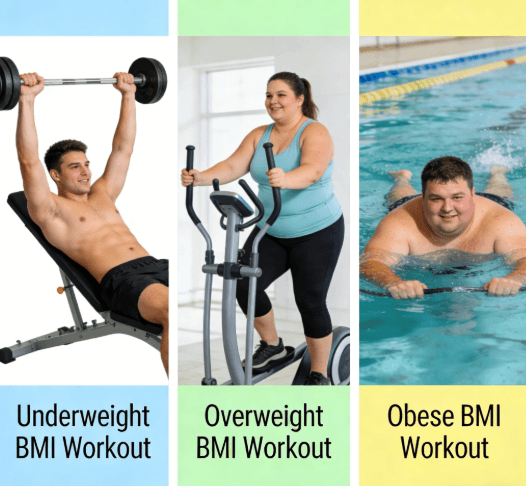
Underweight BMI (Below 18.5): Build Muscle, Not Just Weight
The core goal here isn't losing weight — it's building lean mass, meaning muscle and bone density. Cardio should be kept to a minimum so the body can use energy for tissue building. Many underweight individuals trying to gain weight focus only on eating more, but without strength training, extra calories can simply add body fat rather than functional muscle.
Avoid the treadmill trap. Spending 45 minutes on it burns through the calories needed for muscle growth. Swap extended cardio for a 10–15 minute post-meal walk, which aids digestion without creating a deficit.
Strength training: 2–3 sessions per week, 20–30 minutes each. Start with bodyweight exercises — squats, push-ups, glute bridges, lunges — then add light dumbbells (2.5–10 lbs) as strength improves. Perform 2–3 sets of 8–12 reps per exercise. Rest 60–90 seconds between sets.
Progression: Add 2.5–5 lbs or 1–2 reps every 1–2 weeks. This gradual overload is what signals the body to build muscle.
Cardio: Keep it minimal. A 10–15 minute walk after meals is enough. Avoid running, HIIT, or extended cardio sessions.
Rest: Muscles grow during recovery, not during the workout. Take at least one full rest day between strength sessions. Aim for 7–9 hours of sleep nightly.
Pair with nutrition: Exercise alone won't shift BMI from underweight to healthy without a calorie surplus. Add 300–500 calories daily through nutrient-dense foods. A calorie calculator helps pinpoint your target.
Use a online BMI calculator to confirm your starting point and track changes monthly. A shift from 17.5 to 18.5 over 3–4 months is a realistic, sustainable pace.
Overweight BMI (25.0–29.9): Balance Cardio and Strength
The right mix is roughly 60% low-impact cardio and 40% strength training. The 2018 Physical Activity Guidelines for Americans, published by the U.S. Department of Health and Human Services, recommend at least 150 minutes of moderate-intensity aerobic activity per week for adults in this range. Cardio creates the calorie deficit. Strength preserves the muscle that keeps metabolism elevated. How do you know if you're at the right intensity? Use the "talk test" — you should be able to hold a conversation without gasping.
The biggest mistake we see in this BMI range is people only doing cardio and skipping strength training. This leads to muscle loss, which slows metabolism and makes long-term fat loss harder. Two 20-minute strength sessions per week is all it takes to preserve muscle while the cardio works on fat. In our coaching experience, people doing only aerobic exercise tend to hit a plateau, while those adding resistance training maintain steady progress and better energy.
Low-impact cardio: 4–5 days per week, 20–30 minutes per session. Brisk walking, swimming, stationary cycling, or elliptical. Start at 20 minutes and add 2–3 minutes per week until reaching 30–40 minutes.
Strength training: 2 days per week, 20–30 minutes each. Bodyweight exercises — lunges, planks, squats, push-ups — plus light dumbbell work. Perform 2–3 sets of 10–15 reps.
Progression: Add 2–3 minutes to cardio weekly. Add 2.5–5 lbs or 1–2 reps to strength work every 1–2 weeks. The goal is 0.5–1 lb of weight loss per week.
Start small: Even 15 minutes of daily activity is a valid starting point. For a broader comparison, see our overview of BMI-based fitness plans across all categories.
Obesity BMI (30.0 and Above): Protect Joints, Build Consistency
Joint protection comes first. At higher body weights, the knees and hips absorb roughly 3–4 times body weight with each step. Low-impact options reduce this load while still improving cardiovascular health and mobility. For obese beginners, focus on "time on feet" rather than distance. Two 8-minute walks spread through the day are better than one failed 20-minute attempt.
For users starting with a BMI over 30, we never recommend distance goals. Instead, the target is simply minutes of movement. Start with 5 minutes. Tomorrow, try 6. This approach builds the habit without the frustration of falling short.
Seated exercises: Arm circles, seated leg lifts, seated marches. Perform for 5–10 minutes at a time, 2–3 times daily. Zero equipment needed — a sturdy chair is all it takes.
Water-based movement: Water aerobics, water walking, or swimming. Water supports roughly 80% of body weight, making movement nearly impact-free. Start with 15–20 minutes, 2–3 times per week.
Slow walking: 5–10 minutes at a time on a flat, stable surface. Take breaks as needed. Add 1–2 minutes per week.
Strength training (introduced later): Once regular movement feels comfortable, add bodyweight or very light resistance work — wall push-ups, seated rows with resistance bands, chair squats. Focus on form over reps. We worked with a 52-year-old man with a BMI of 36 who started with just 5-minute walks around his block. Six months later, he was walking 30 minutes daily and had completed his first 5K charity walk — all without joint pain.
Medical clearance: If you have joint pain, cardiovascular concerns, or diabetes, consult a healthcare provider before beginning any exercise program. For a detailed guide on safe starting routines, see our article on safe workout routines for obese beginners.
Consistency vs. Intensity: What Every BMI Category Needs
I'll be honest — I've skipped rest days myself and paid for it with a pulled hamstring. So this isn't a lecture; it's what actually works. A 15-minute walk done daily for six months transforms health more than a 60-minute workout done twice and abandoned. That's the consistency piece. And when it comes to progression, small increments matter more than heroic efforts — 2 more minutes, 1 more rep, 2.5 more pounds every week or two. The body adapts to gradual overload, not to sudden spikes.
Listening to your body matters too. Muscle soreness that fades within 24–48 hours is normal. Sharp pain during movement is a signal to stop and adjust. And rest isn't lazy — it's productive. Muscles repair and strengthen during recovery, and one to two full rest days per week is the minimum. Pair all of this with the right nutrition for your category: underweight individuals need a surplus, while overweight and obesity need a modest deficit. A body fat calculator tracks body composition changes that the scale may miss.
Frequently Asked Questions
How long does it take to see results from a BMI-based fitness program?
Performance improvements — walking longer, lifting more, feeling less winded — typically appear within 2–4 weeks of consistent effort. Visible body composition changes take longer: 8–12 weeks for measurable shifts in BMI or waist circumference.
Can I do the same workout as someone in a different BMI category?
Not safely in most cases. A high-intensity interval training session appropriate for an overweight individual could injure someone with obesity due to joint stress. Each BMI category needs a different starting point, progression pace, and exercise mix.
What if I'm between two BMI categories — which program should I follow?
Choose the program that matches your current BMI. Recalculate your BMI monthly to know when to switch programs as your body changes.
I feel self-conscious at the gym. Where can I do these workouts?
Every routine in this guide is designed for home — no gym required. You only need items already in your kitchen or living room:
Two filled 500 ml water bottles — use as dumbbells for shoulder presses and bicep curls.
Edge of a sturdy dining table — for incline push-ups when floor versions are too hard.
A kitchen chair — for seated marches, step-ups, and tricep dips.
Consistency in private beats anxiety in public — and home workouts produce the same results as gym workouts when done regularly.
Sources
This article is for informational and educational purposes only. It does not replace professional medical advice. Consider consulting a qualified healthcare provider before starting any new exercise program, especially if you have pre-existing health conditions. The BMI Calculator Blog Team maintains editorial independence and does not sell health products.
Related Articles
BMI-based Fitness Plans: Safe Workout Routines for All 4 BMI Categories
Exercise Routines for Different BMI Ranges: Step-by-Step Plans
Workout Plans by BMI Category: Safe Routines for Underweight to Obesity
Last updated: October 9, 2026.