Quick Summary: Your workout should match your BMI range, not a generic template. Under 18.5: lift heavy, eat more, keep cardio short. 18.5–24.9: mix strength, cardio, and mobility. 25.0–29.9: low-impact cardio plus two strength days. At 30 and above, start with 10-minute walks. Add no more than 10% a week.
Four ranges, four different jobs. Under 18.5 builds mass. 18.5–24.9 holds steady. 25.0–29.9 loses fat while keeping muscle. 30.0 and above builds tolerance for movement.
Cardio gets capped below 18.5, not maximized. Every extra mile burns the calorie surplus your muscles need for repair.
Joint protection outranks intensity at 25.0 and above. Water walking, cycling, and chair-based strength come long before running does.
Add no more than 10% a week. Lungs and legs adapt in days. Tendons and connective tissue take weeks.
Your waist breaks every tie. Two adults can both sit at BMI 27.0 and need opposite plans — waist size and body fat say which.
What Are BMI-based Fitness Plans?
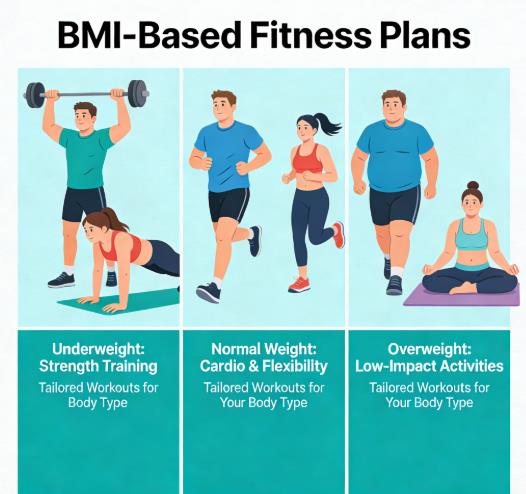
BMI-based fitness plans are workout routines shaped by your Body Mass Index range rather than one generic template. The index sorts adults into four buckets — underweight (below 18.5), normal weight (18.5–24.9), overweight (25.0–29.9), and obese (30.0 and above) — and each bucket gets a different job: build mass, hold steady, shed fat while keeping muscle, or build the basic capacity to move.
The CDC describes BMI as a screening measure, not a direct read on body fat. It does not tell muscle from bone, and it says nothing about where you carry weight. Two adults can both land at 27.0 and need opposite programs.
Three numbers sit underneath every plan below, and they outrank whichever bucket you are in: 150 minutes of moderate activity a week, 2 days of muscle-strengthening work, and a 10% ceiling on weekly increases. Nail those and the category matters less than you think.
How Do I Pick the Right BMI-based Fitness Plan?
Start with the number, then check it against your waist. Run your height and weight through a free BMI calculator, then wrap a tape measure just above your hipbones and breathe out before you read it.
Train with weights regularly? Take a body fat calculator reading before you commit to a bucket. A 5'10" man at 200 lbs reads BMI 28.7 on paper, but at 14% body fat he belongs on the maintenance plan — not the fat-loss one.
| Your BMI | Weekly structure | What usually derails it |
|---|---|---|
| Below 18.5 | 3–4 strength days, cardio capped at 15 minutes | Running the surplus off, then wondering why nothing grows |
| 18.5–24.9 | 2–3 strength, 2 cardio, 1 mobility | Repeating the identical week for months and stalling |
| 25.0–29.9 | 3–4 low-impact cardio days, 2 strength | Jogging in week one, quitting by week three with sore knees |
| 30.0 and above | 10–15 minutes of low-impact movement, most days | Going hard in week one and never coming back |
Choose the row matching your BMI today. Not the one you are aiming for — you can switch later.
BMI-based Fitness Plan for Underweight Adults (Below 18.5)
Below 18.5 the job is lean mass, and cardio stays short on purpose. Every extra mile burns calories your body needs for tissue repair.
Frequency: 3–4 strength days a week, with a rest or easy-walk day between sessions.
Strength: Full-body compound work — squats, deadlifts, rows, presses. 3–4 sets of 6–10 reps at a weight that makes the last rep hard but clean.
Cardio: 10–15 minutes of easy walking or slow cycling, 1–2 days a week. No intervals.
Progression: Add 2.5–5 lbs once you hit the top of your rep range with good form. That is progressive overload, and it is the one thing that reliably adds mass.
Do not wait for the scale to lead here. Sleeves get tighter first — usually around the three-month mark — and the number follows.
BMI-based Fitness Plan for Normal Weight (18.5–24.9)
This range is about staying capable rather than chasing a number, and that is exactly where boredom does the damage.
We see the same stall constantly in this bucket: every week looks identical, so the body stops responding. Swapping one steady cardio day for intervals and another for easy recovery often restarts progress without adding a single session. Same four days. Different stimulus.
Frequency: 4–5 days — 2–3 strength, 2 cardio, 1 mobility.
Strength: Compounds paired with isolation work: squats and rows alongside curls, dips, and glute bridges. 3 sets of 8–12 reps.
Cardio: One steady 30-minute session, one 20-minute interval day, one easy recovery day. Keep hard days genuinely hard and easy days genuinely easy.
Mobility: One yoga or dedicated stretching session to protect the range of motion you are building.
Three months in, expect lifts up 10–20% and resting heart rate down 3–5 bpm. Unglamorous numbers, but they do not lie.
BMI-based Fitness Plan for Overweight Adults (25.0–29.9)
Fat loss without losing muscle. That is the whole job, and it is where cardio-only plans quietly fall apart.
People in this range tend to start with running and quit inside three weeks. The plan was not wrong — the ramp was. Knees and hips need weeks to handle repeated impact, not days.
In our anonymized calculator usage data from 2025 — aggregated from site visitor records, not a peer-reviewed clinical study — the 25.0–29.9 band drew the largest share of repeat checks. People in the middle re-run their numbers every few weeks, and the habit is worth copying. Steady tracking beats occasional intensity.
Frequency: 4–5 days — 3–4 low-impact cardio, 2 strength.
Cardio: 30–45 minutes of brisk walking, cycling, swimming, or elliptical work at a pace where you can talk but not sing. One low-impact interval session per week.
Strength: Two full-body sessions — wall sits, glute bridges, banded rows, incline push-ups. 3 sets of 12–15 reps.
Active recovery: 20–30 minutes of walking, stretching, or foam rolling.
Pair this with a 300–500 calorie deficit set under professional guidance, and 4–8 lbs of fat loss over three months is a reasonable target. Measure your waist too. It usually moves before the scale does.
BMI-based Fitness Plan for Obese Adults (30.0 and Above)
At 30 and above, the goal is not the scale. It is showing up.
We heard from a 41-year-old desk worker at BMI 32 who started with 10 minutes of water walking, three days a week. She had dealt with knee pain before and worried movement would set it off, so she added two minutes a week — nothing more, no rushing. By week eight she was doing 30 minutes with no knee complaints and an inch off her waist. No clever trick. Just a start she could repeat.
Frequency: Most days, but short. Open at 10–15 minutes and add 5 minutes a week.
Movement: Water walking, stationary cycling, seated leg lifts, chair squats, chair yoga. All of these unload knees and hips.
Mobility: 5–10 minutes of gentle stretching afterward, aimed at hips, knees, and shoulders.
Short on time? Break it up. Three 10-minute walks deliver the same cardiovascular benefit as one 30-minute walk, and they fit a real schedule far better.
Progress reads as function here: stairs that stop winding you, a chair that is easier to leave. Check in with a healthcare provider before starting if you live with heart disease, joint pain, or uncontrolled blood pressure.
How Fast Should I Progress?
Slowly, then consistently. Cap weekly increases at 10%, whether that is minutes, sets, or distance. The American College of Sports Medicine (ACSM) sets that same ceiling in the 12th edition of its Guidelines for Exercise Testing and Prescription because connective tissue adapts on a slower clock than your lungs do.
Every session also gets 5–10 minutes of easy warm-up beforehand and a few minutes of gentle cool-down stretching afterward. It is the dullest part of any plan and the one that keeps you in it.
Stop and get medical help if you notice:
Chest pain or pressure
Severe shortness of breath
Dizziness or lightheadedness
Sharp joint pain that outlasts the session
Soreness is normal. Sharp pain is information.
When to Adjust Your BMI-based Fitness Plan
Your BMI is a starting line, not a label. Three signals say it is time to shift:
Weight and waist both frozen for 4+ weeks. Add 5–10 minutes to your cardio sessions, or tighten the deficit by 100–200 calories — ideally with professional guidance.
Strength or energy dropping. You are probably cutting too fast. Add 100–200 calories back and hold protein steady.
You have crossed into a new BMI category. Move to that plan. The job changed.
A calorie calculator turns that recalibration into a number instead of a guess, which is the difference between adjusting and drifting.
What Should I Eat With These Plans?
Training sends the signal. What you eat writes the answer. Protein carries the load in every range, and the calorie direction flips by bucket:
| Your BMI | Calorie direction | Protein | One-line focus |
|---|---|---|---|
| Below 18.5 | 300–500 surplus, under professional guidance | 1.6–2.2 g per kg | Eat within an hour of training |
| 18.5–24.9 | Maintenance | 1.2–1.6 g per kg | Whole foods, steady meals |
| 25.0–29.9 | 300–500 deficit, under professional guidance | 1.2–1.6 g per kg | Fiber near 30 g a day |
| 30.0 and above | Modest deficit, professionally guided | 1.2–1.6 g per kg | High-volume foods: vegetables, legumes, lean protein |
Protein needs shift with age, training load, and health status. A registered dietitian pins yours down better than any chart can.
Frequently Asked Questions About BMI-based Fitness Plans
Are BMI-based fitness plans safe for beginners?
Yes, if you start at the lowest dose in your range. Someone new to exercise at BMI 26 should not copy the full five-day schedule in week one — open at two or three sessions, hold for three weeks, then add.
Can I follow one if muscle pushes my BMI up?
Check body fat first. A lifter at BMI 28 with 12% body fat has no reason to run a fat-loss plan. Use the maintenance plan and track waist and performance instead of the index.
How long before I see results?
Strength and stamina move first, usually inside 4–6 weeks. Visible changes in body composition take longer — typically 8–12 weeks of steady training plus nutrition. Waist measurements move before the scale does.
Do these plans require a gym?
No. Bodyweight squats, glute bridges, incline push-ups, resistance bands, and walking cover every range. Equipment helps progression once bodyweight stops challenging you, but it is not the entry fee.
My BMI sits right on a cutoff — 24.9 or 25.0. Which plan applies?
Your waist decides. A BMI of 25.0 with a waist under 35 inches (women) or 40 inches (men) generally fits the maintenance plan; cross those thresholds and the fat-loss plan is the safer read.
Do adults over 65 follow the same BMI-based fitness plans?
Mostly, with two additions: balance work two or three times a week — tandem stands, heel-to-toe walking, or Tai Chi — and a longer warm-up, since stiff joints need more time to get moving. The 150-minute CDC baseline above still holds at this age. Balance is what gets layered on top. We have watched older readers do well here by trading heavy weights for resistance bands. Small shifts, and they keep going.
Sources
CDC: Adult Activity Guidelines — 150 Minutes Plus 2 Strength Days
HHS: Physical Activity Guidelines for Americans, 2nd Edition
NIH/NHLBI: Aim for a Healthy Weight — BMI and Waist Circumference
Related Articles
Workout Plans by BMI Category: Tailored Fitness for Your Body and Goals
Exercise Routines for Different BMI Ranges: Step-by-Step Plans from Underweight to Obesity
Safe Workout Routines for Obese (BMI≥30) Beginners: Start Gentle & Build Confidence
BMI Calculator Blog. This content is provided for educational and informational purposes only. We encourage sharing with proper attribution to our site. Unauthorized commercial use is prohibited. Medical Disclaimer: The content of this article is for informational purposes only and does not replace professional medical advice, diagnosis, or treatment. Always seek the advice of a qualified physician, certified personal trainer, or other qualified health provider with any questions regarding your fitness program or exercise safety.