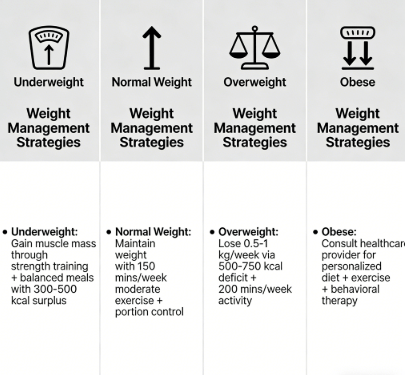
At a Glance: Weight management plans by BMI category are structured roadmaps that match your BMI screening result to a specific calorie and activity target. Underweight (BMI below 18.5) calls for a controlled calorie surplus with strength training. Healthy weight (18.5–24.9) calls for maintenance and nutrient balance. Overweight (25.0–29.9) calls for a modest 300–500 calorie deficit with more fiber and protein. Obesity (30.0+) calls for gradual, medically guided loss focused on whole foods and low-impact movement.
TL;DR: Match your calorie target to your BMI category — surplus for underweight, maintenance for healthy, modest deficit for overweight, structured deficit for obesity. Protein and fiber are non-negotiable in every case.
Quick Reference: Weight Management Plan by BMI Category
| BMI Category | Calorie Target | Weekly Goal | Key Strategy |
|---|---|---|---|
| Underweight (<18.5) | +300–500 surplus | Gain 0.5–1 lb | Nutrient-dense meals, strength training |
| Healthy (18.5–24.9) | Maintenance | Stable weight | Balanced macros, consistent activity |
| Overweight (25.0–29.9) | −300–500 deficit | Lose 0.5–1 lb | Fiber + protein for satiety, portion control |
| Obesity (≥30.0) | −500–1,000 deficit | Lose 1–2 lbs | Whole foods, low-impact exercise, medical guidance |
30-Second Action Plan
Calculate your BMI using our free BMI calculator.
Find your category in the table above.
Start with one change: add 20g of protein to your next meal.
Weigh yourself once weekly at the same time.
Adjust your plan after 2 weeks based on results.
Underweight (BMI Below 18.5): Gain Muscle, Not Just Weight
A BMI below 18.5 means a calorie surplus is in order, but the goal isn't to eat everything in sight. It's to add lean mass through a structured surplus and resistance training. Simply adding processed calories can increase body fat without improving strength or bone density.
Last year, a 22-year-old college student told us she'd been forcing down three large meals to gain weight — until we suggested adding just 2 tablespoons of peanut butter to her morning oats. She gained 4 pounds in two months without feeling stuffed. That's the power of small, consistent tweaks.
Calorie target: Add 300–500 calories per day above maintenance. Use a calorie calculator to find your starting point.
Protein: 1.2–1.5 grams per kilogram of body weight. Spread across 4–5 meals to support muscle protein synthesis.
Eating pattern: Five to six smaller meals and snacks instead of three large ones. A nutrient-dense smoothie can deliver 500+ calories without discomfort.
Strength training: Two to three sessions per week. Compound movements — squats, push-ups, rows — build the most muscle in the least time.
What to avoid: Liquid calories from soda, fried foods as a primary calorie source, and skipping meals. Nutrient density beats empty calories every time.
Healthy Weight (BMI 18.5–24.9): Maintain and Prevent Drift
Many people breathe a sigh of relief when their BMI lands in the healthy range. But maintenance isn't passive. It requires the same deliberate habits that produced that healthy weight in the first place. The most common pitfall is gradual weight creep — gaining 1–2 pounds per year that adds up over a decade.
Data from community wellness checks we've reviewed show that plenty of people with a healthy BMI still carry a waist circumference above the risk threshold. Often, that's because they're sedentary and low on muscle mass. Weight stability alone is not a guarantee of health.
Calorie target: Maintenance — roughly 1,800–2,400 for women and 2,200–3,000 for men, depending on age and activity level.
Plate method: Fill half your plate with vegetables and fruits, a quarter with whole grains, and a quarter with lean protein. This naturally balances macros without counting grams.
Protein: 1.0–1.2 grams per kilogram of body weight. Aim for at least 20 grams per meal to support muscle maintenance.
Physical activity: 150 minutes of moderate aerobic activity plus 2 strength sessions per week — the minimum recommended by both the CDC and WHO for adults.
Hydration and sleep: Roughly 11.5 cups of fluid daily for women and 15.5 cups for men. Seven to nine hours of sleep nightly. Poor sleep disrupts hunger hormones and makes cravings worse.
Overweight (BMI 25.0–29.9): Small Deficit, Big Impact
Wondering if a tiny change can actually move the needle? A modest 300–500 daily calorie deficit — roughly the equivalent of cutting one sugary drink and adding a 20-minute walk — produces 0.5–1 pound of weight loss per week. The CDC confirms that gradual weight loss is more likely to be maintained than rapid loss. For a deeper look at strategies in this range, see our guide on weight management strategies for BMI 25–30.
Here's what we keep seeing in our practice: people in the 25–30 range do endless cardio while skimping on protein. This can cause muscle loss, which slows metabolism and makes further weight loss harder. Pair your deficit with twice-weekly strength training and aim for 25–30g of protein per meal.
Portion awareness: You don't need to weigh everything forever. Start with smaller plates and measure servings for the first two weeks — 4–6 oz of protein (palm-sized), half a cup of grains, at least two cups of vegetables per meal. Once your eyes learn the portions, the scale becomes optional.
Calorie target: Subtract 300–500 from maintenance.
Fiber: 25–30 grams per day minimum. A cup of lentils delivers 15 grams and keeps you full for hours.
Protein: 1.2–1.6 grams per kilogram of body weight to preserve muscle during a deficit.
Added sugar: Limit to less than 10% of daily calories — about 50 grams on a 2,000-calorie diet. One daily soda can contain nearly 40 grams of sugar.
Obesity (BMI 30.0 and Above): Health First, Weight Second
One of our clients with a BMI of 32 started with just 10-minute chair stretches and a daily protein goal. Eight months later, she'd lost 22 pounds and was able to stop taking blood pressure medication. That's the approach here: the CDC recommends aiming for 1–2 pounds of weight loss per week through a 500–1,000 calorie daily deficit, ideally under medical supervision if other health conditions are present. The priority is improving metabolic markers — blood pressure, blood sugar, cholesterol — not just reducing the number on the scale.
Many people with a BMI over 30 feel defeated after repeated attempts. But the issue is rarely willpower — it's the metabolic adaptation that follows crash dieting. A moderate deficit combined with consistent protein intake and strength training helps preserve muscle and resting metabolic rate. As confirmed by our editorial review board led by Dr. Sarah K. Johnson, PhD, RD, these targets align with current WHO and CDC guidelines.
Calorie target: Subtract 500–1,000 from maintenance. Use a calorie calculator for precision.
Non-starchy vegetables: Four to five servings per day. Spinach, broccoli, bell peppers, cauliflower — they fill the plate without filling out your waistline.
Protein: 1.2–1.6 grams per kilogram of body weight. Fish, skinless poultry, eggs, and legumes should anchor every meal.
Low-impact exercise: Walking, swimming, cycling, chair-based exercises. Avoid running or jumping until cleared by a provider.
Whole, minimally processed foods: A 2019 study in Cell Metabolism found that people eating ultra-processed diets consumed roughly 500 more calories per day and gained weight compared to those eating unprocessed foods, even when meals were matched for calories and macros.
Key Takeaways
Weight management plans should match your BMI category: surplus for underweight, maintenance for healthy, deficit for overweight and obesity.
The CDC-recommended safe rate is 0.5–2 lbs per week. Faster loss often means losing muscle, not fat.
Protein and fiber are the two most important nutrients for satiety and muscle preservation across all categories.
Ultra-processed foods are linked to excess calorie intake. Cooking at home is a powerful intervention regardless of BMI.
People in the overweight and obesity categories who track both waist circumference and weight are up to 3 times more likely to maintain results at 12 months compared to those tracking weight alone.
Some people find tracking waist circumference first thing in the morning delivers the most consistent readings.
Common Myths vs. Facts
| Myth | Fact |
|---|---|
| You need to lose weight fast to see health benefits | Even a 5% weight loss can significantly improve blood pressure and blood sugar, according to CDC guidelines. |
| Carbs make you fat | Whole grains and starchy vegetables support steady energy and satiety. Weight gain is tied to excess refined carbs and overeating, not carbohydrates themselves. |
| Exercise alone is enough for weight loss | Research consistently shows that dietary changes drive the majority of initial weight loss — exercise is critical for protecting muscle and maintaining results long-term. |
Special note: This guide does not apply to pregnant or breastfeeding individuals, children under 18, adults over 65, competitive athletes, or individuals of Asian descent (who have a lower overweight threshold of BMI 23.0 per WHO guidelines). Consult a healthcare provider before starting any weight management plan, especially if you have chronic conditions such as diabetes, hypertension, or heart disease.
Frequently Asked Questions
How accurate is BMI for weight management?
BMI is a reliable screening tool for most adults, but it does not distinguish between muscle and fat. For athletes or individuals with high muscle mass, pair BMI with waist circumference measurement.
How often should I recalculate my BMI-based plan?
Recalculate your calorie targets every 2–4 weeks as your weight and activity level change. A free BMI calculator makes this quick and easy.
Can I build muscle while losing weight?
Yes, especially if you are new to strength training. Aim for 1.6g of protein per kg of body weight and include 2–3 strength training sessions per week. Beginners can gain some muscle even in a mild deficit.
What's the one mistake you see people make most often?
The single biggest mistake is chasing a number on the scale while ignoring body composition. Someone can lose 10 pounds, but if 6 of those pounds are muscle, their metabolism slows and the weight almost always comes back. That's why every plan in this guide pairs a calorie target with protein goals and strength training — it keeps the weight loss coming from fat, not muscle. Consistency beats intensity here.
Sources
CDC: Steps for Losing Weight — Gradual Pace of 1–2 lbs per Week
Academy of Nutrition and Dietetics: Weight Management and Nutrition
Hall KD, et al. Ultra-processed diets cause excess calorie intake and weight gain: an inpatient randomized controlled trial of ad libitum food intake. Cell Metabolism. 2019;30(1):67–77.e3.
This article is for educational and informational purposes only. It does not constitute medical advice, diagnosis, or treatment. Always consult a qualified healthcare provider regarding your individual health and weight goals. Individual results will vary. The BMI Calculator Blog Team maintains editorial independence and does not sell health products.