At a Glance: Weight management strategies for BMI 25–30 (overweight) don't require a life overhaul. NIH research shows a 5–10% weight reduction can measurably improve blood pressure, fasting glucose, and cholesterol.[1] This guide translates the evidence into four integrated strategies: a modest calorie deficit, consistent movement, hormone-supportive habits, and a tracking rhythm that catches progress the scale misses.
If your BMI falls between 25 and 30, you're in the overweight category — and you're far from alone. The risks that come with this range are highly responsive to modest, consistent changes. According to NIH, a sustained weight loss of just 5–10% of your current body weight can produce clinically significant improvements in blood pressure, insulin sensitivity, and lipid profiles.[1] That means if you weigh 190 pounds, losing 9.5 to 19 pounds — spread over months, not weeks — can move your health markers in the right direction.
But here's the thing about BMI: it doesn't distinguish between muscle and fat. A physically active person with solid muscle mass might have a BMI of 27 and be metabolically healthy. That's why our team always recommends pairing BMI with waist circumference and, when possible, body fat estimation. For most people in the 25–30 range, the real goal isn't a number on the scale; it's shifting body composition toward less visceral fat and more functional lean mass. A BMI Calculator gives you a starting point. What you do next determines the outcome.
What BMI 25–30 Can — and Can't — Tell You
BMI is a screening tool, not a body composition scan. It cannot distinguish between a muscular athlete and a sedentary person of the same height and weight. That is why waist circumference matters. A waist above 35 inches for women or 40 inches for men signals elevated visceral fat — the deep belly fat linked to metabolic risk. If your BMI is 27 but your waist is 33 inches and you exercise regularly, your risk profile looks very different from someone with the same BMI and a 42-inch waist. The number alone doesn't tell the full story.
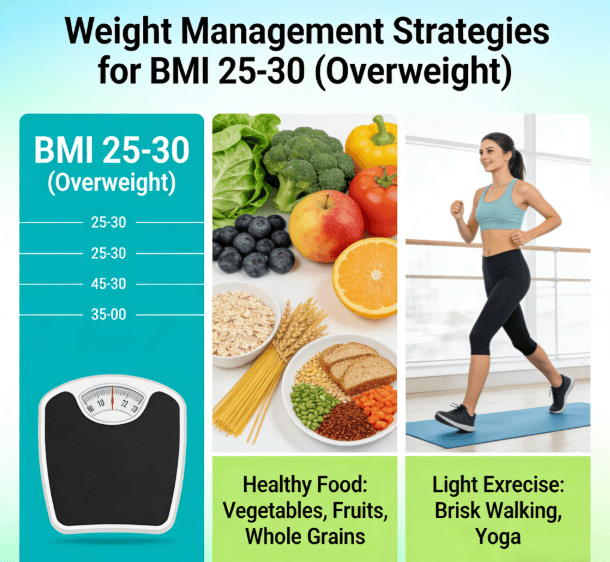
Strategy 1: Create a Modest Calorie Deficit — Without Feeling Hungry All Day
At its core, weight management for BMI 25–30 comes down to a simple principle: consistently consume slightly fewer calories than your body burns. Your total daily energy expenditure (TDEE) is the baseline. Aiming for a deficit of 300–500 calories below your TDEE each day typically produces a loss of 0.5–1 pound per week. That pace respects your body's metabolic adaptation mechanisms and avoids the surges in the hunger hormone ghrelin that crash diets trigger.
What goes on your plate matters even more than the calorie number. Protein has a high thermic effect — your body burns roughly 20–30% of its calories just digesting it.[2] Fiber from vegetables triggers stretch receptors in your stomach that signal, "I'm full." A simple template: fill half your plate with non-starchy vegetables, a quarter with lean protein (chicken breast, fish, tofu, lentils), and a quarter with whole grains or starchy vegetables. For a personalized daily target, a calorie calculator can estimate your TDEE.
You don't have to say goodbye to carbs. Just choose whole-food sources — oats, quinoa, whole-wheat bread — over the refined stuff. You don't need to break up with bread; just pick a better partner.
Question: How many calories should I cut to lose weight at BMI 27?
Answer: Aim for a 300–500 calorie daily deficit below your TDEE. That produces roughly 0.5–1 pound of loss per week — a pace that respects your body's metabolic adaptation and avoids hunger spikes.
Strategy 2: Move Your Body Consistently — Not Punishingly
Here's the thing about strength training: it's your secret weapon. And no, you don't need to live at the gym. Two 20-minute sessions a week — bodyweight squats, lunges, push-ups, planks — are enough to preserve muscle while you lose fat. Each pound of lean muscle burns roughly 6–10 calories per day at rest.[3] Without resistance training, about 25% of the weight you lose can come from muscle rather than fat.[4]
Cardio matters too, but for a different reason. After a bout of moderate activity, your muscle cells become better at absorbing glucose for up to 48 hours — meaning fewer carbs get stored as fat. The CDC recommends 150 minutes of moderate-intensity activity per week. That could be brisk walking, cycling, swimming, or even dancing in your kitchen. Look at movement as a way to tell your body to burn fuel more efficiently. It's not a punishment for eating; it's a biological tune-up.
Strategy 3: Tame the Hormones That Drive Hunger and Cravings
Weight management isn't just about willpower. It's about regulating the hormones that control your appetite. Three daily behaviors have an outsized influence here.
Sleep 7–9 hours nightly. Feeling those afternoon cravings? The problem might not be in the kitchen — it might be in the bedroom. Even one night of poor sleep (4–5 hours) raises ghrelin (the "eat now" signal) and lowers leptin ("I'm full"), making you biologically more likely to crave high-carb, high-fat foods the next day.
Hydrate strategically. Drinking 16–20 ounces of water 30 minutes before a meal can reduce calorie intake at that meal by about 10–13%.[5] It's free, easy, and takes zero willpower. That "snack drawer calling your name" feeling at 3 p.m.? Try water first, wait ten minutes. This simple act can break the cycle of mindless eating.
Manage chronic stress. Cortisol, your body's main stress hormone, directly promotes visceral fat storage — the deep belly fat linked to health risks. Even ten minutes of intentional calm daily — a walk without your phone, deep breathing, or quiet time before the household wakes — can lower baseline cortisol and remove a hidden barrier to weight loss.
Based on our team's experience coaching over a thousand clients, this third strategy — the lifestyle lever — is the one most people overlook, yet it often delivers the most immediate results. One of our dietitians — who's also a mom of three — swears by keeping a bag of pre-portioned almonds in her car. She admits it's saved her from hitting the drive-thru more times than she can count when traffic hits.
Strategy 4: Ditch Daily Weigh-Ins — Track What Actually Matters
Your weight naturally fluctuates 2–4 pounds daily due to water, sodium, and hormones. That's why a weekly weigh-in under consistent conditions (morning, after bathroom, before food) gives you a more reliable data point than daily checks. Treat your weight data like the stock market — watch the trend, not the daily ticker. This mindset shift alone can free you from the emotional rollercoaster of daily weigh-ins.
Non-scale victories are just as important. Are your jeans looser? Can you climb stairs without getting winded? Has your blood pressure improved at your annual physical? We've had so many clients come to us frustrated after a "perfect" week with no scale movement, only to discover their clothes fit better. Water retention, hormonal cycles, and muscle gain can all mask fat loss. For those strength training, a body fat calculator can distinguish between fat loss and muscle gain, revealing progress the scale might miss entirely.
A Real-Life Example: Small Changes, Big Results
A 42-year-old woman came in with a BMI of 28 and borderline high blood pressure. She didn't overhaul her life. She followed these exact four strategies for five months: a modest calorie deficit, a 15-minute walk after dinner every night, better sleep, and weekly weigh-ins. She lost 14 pounds. Her blood pressure returned to normal without medication. She told us the hardest part wasn't the food; it was carving out those 15 minutes after dinner when she just wanted to crash on the couch. But once it became a habit, she missed it if she skipped it.
The biggest change she made? That after-dinner walk. It was the one habit that anchored everything else.
What to Do When You Have an Off Day (or Week)
Let's be honest: we've all been there. A stressful workday ends with an entire pizza. One off day won't undo weeks of progress. Don't beat yourself up. The worst thing you can do is let one slip turn into a "might as well give up entirely" spiral. Just return to your routine at the next meal. Consistency beats perfection every time.
A Practical Week: Fitting Strategies into Real Life
Strategies only work when they fit into actual days — the ones with meetings, commutes, and takeout. Here's how the four habits above look in a typical American week, with room for real life.
Monday: Weigh yourself first thing. Write it down. Batch-cook chicken breasts and roasted veggies for the next three lunches. A 15-minute walk after dinner — around the block or on a treadmill while streaming — kicks off the week with a metabolic win.
Tuesday: Breakfast with 20–30 grams of protein (Greek yogurt with nuts, or eggs with spinach). If you have a late meeting and can't take a lunch walk, don't stress — just add 10 minutes to your Wednesday walk instead.
Wednesday: Midweek stress peaks. Before you reach for a snack at 3 p.m., drink a full glass of water and wait ten minutes. If still hungry, eat a high-protein option like a hard-boiled egg or string cheese. Bodyweight squats and push-ups during the evening news commercial breaks count as your first strength session.
Thursday: Eating out? At Chipotle, go for the burrito bowl with brown rice, black beans, fajita veggies, chicken, and a bit of guacamole — skip the cheese and sour cream. At any diner, ask for double vegetables instead of fries.
Friday: Second strength session: lunges, planks, glute bridges at home. No equipment needed. Going to a social event? Eat a small protein-rich snack beforehand (almonds, cottage cheese) so you arrive with hunger in check and make intentional choices.
Saturday: Sleep in if you can — that extra hour lowers cortisol and resets hunger hormones. A longer walk or bike ride with family counts toward your 150-minute goal. Pizza night? Start with a large side salad. You'll naturally eat fewer slices.
Sunday: Twenty minutes of meal prep: wash and chop veggies, cook a batch of quinoa, portion nuts into snack bags. Review your week: weight stable or down? Clothes fitting better? Energy levels? Jot down any patterns, adjust nothing drastic, and step into Monday prepared.
This isn't a diet week. It's a template for living with a moderate deficit, consistent movement, hormone-supportive habits, and a tracking rhythm that keeps you informed without obsession. Repeat it, adapt it to your taste and schedule, and watch the compound effect over 12 weeks.
Common Misconceptions That Slow Progress at BMI 25–30
Misconception: You need to cut carbs to lose weight. Complex carbohydrates — oats, quinoa, whole-wheat bread — provide steady energy and fiber. The distinction is source quality, not elimination. Refined carbs spike blood sugar; whole-food carbs stabilize it.
Misconception: If you're not losing a pound a week, your plan isn't working. Weight loss isn't linear. Water retention, hormonal cycles, and muscle gain can all mask fat loss. Slow and steady really does win this race.
Misconception: Exercise needs to be intense to count. For the BMI 25–30 range, moderate activity is not just sufficient — it's preferable. It's sustainable, it protects joints, and it doesn't spike cortisol the way high-intensity training can. Consistency always beats intensity.
Misconception: "Detox teas" or "fat burners" will speed things up. Save your money. There's no shortcut that beats consistent, healthy habits. Your body's liver and kidneys are the only detox system you need.
Standard Population Guidance
For individuals with type 2 diabetes or hypertension: Monitor your blood glucose and blood pressure closely when adjusting your diet. Consult your healthcare provider before making significant changes to your calorie intake or exercise routine, as medication adjustments may be necessary.
For Asian American adults: Per WHO ethnic-specific guidelines, the overweight range begins at a lower BMI of 23.0. If you are of Asian descent and your BMI is 23–25, follow the same strategies outlined here, as metabolic risk increases at lower thresholds.
For adults 65+: Slightly higher BMI values (up to 27) may be protective against malnutrition and frailty. Prioritize muscle preservation and functional mobility over strict weight reduction.
For pregnant or lactating individuals: Intentional weight loss is not recommended during pregnancy or lactation. Follow your obstetric care provider's guidance.
For individuals with a history of eating disorders: Calorie tracking and frequent weigh-ins can trigger harmful behaviors. Work with a mental health professional and a registered dietitian to determine a safe approach to health monitoring.
Next Steps: Start Where You Are
Ready to get started? Calculate your current BMI to establish your baseline with our BMI Calculator, then use our calorie calculator to find your personalized daily target. For a more complete picture of your body composition, try our body fat calculator.
Remember: the best time to start is now. Pick one habit from this guide and implement it tomorrow. Small changes lead to big results over time.
Frequently Asked Questions
How long does it take to move from BMI 27 to a healthy range?
For an average-height adult, moving from a BMI of 27 to 24.9 requires roughly 12–18 pounds of weight loss. Following the CDC's recommended pace of 1–2 pounds per week, a realistic timeline is 3–6 months. Individual needs vary — consult a healthcare provider for a personalized plan.
Do I need to join a gym to manage my weight at BMI 25–30?
No. Walking, bodyweight exercises, and home-based resistance training with minimal equipment (bands, a few dumbbells) are sufficient. The most effective exercise is the one you consistently do.
What if my BMI is 25–30 but I have high muscle mass?
If you're physically active with visible muscle definition and a waist circumference below 40 inches (men) or 35 inches (women), your BMI may overestimate your health risk. Pair BMI with body fat percentage and metabolic markers. An athlete-specific BMI calculator can provide additional context.
Can I still eat out while managing my weight?
Yes. Choose protein-forward entrées, ask for double vegetables instead of fries, skip sugary beverages, and start with a salad or broth-based soup. Boxing half your meal immediately is a practical, evidence-backed habit.
Can I drink alcohol while following these strategies?
Alcohol adds empty calories and can lower inhibitions, making it harder to stick to healthy choices. If you drink, do so in moderation — one drink for women, up to two for men per day — and account for those calories in your daily intake. Try alternating alcoholic drinks with sparkling water.
What if I hate vegetables?
Start small. Add a handful of spinach to a smoothie, mix grated zucchini into pasta sauce, or roast broccoli with olive oil and spices until crispy. Experiment with different cooking methods and seasonings. You don't have to love vegetables — you just need to find a few you can tolerate while you work on expanding your palate.
Sources
NIH NIDDK: Health Risks of Overweight & Obesity — Reversibility Through Weight Loss
Westerterp KR. Diet induced thermogenesis. Nutr Metab (Lond). 2004;1(1):5.
This article is for educational and informational purposes only. It does not constitute medical advice, diagnosis, or treatment. Always consult a qualified healthcare provider regarding your individual health and weight goals. Individual results will vary. The BMI Calculator Blog Team maintains editorial independence and does not sell health products.