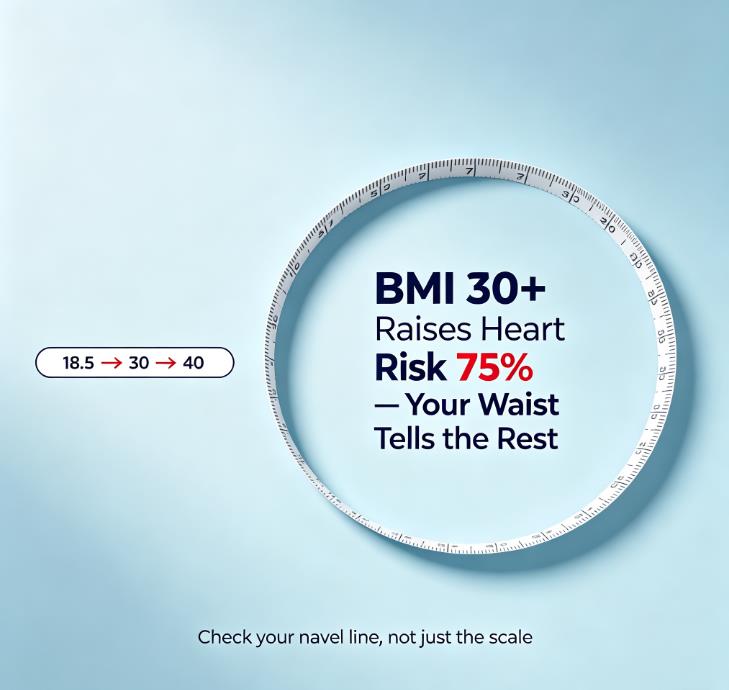
At a Glance: BMI heart disease risk is one of the most researched connections in public health—and the evidence is clear. As your body mass index rises above the healthy range of 18.5–24.9, your odds of developing hypertension, atherosclerosis, heart failure, and experiencing a heart attack or stroke climb steadily. The CDC and WHO classify these risks across graded BMI categories, and a large 2023 meta-analysis found that each 5-unit increase in BMI above 25 was associated with a 41% higher risk of heart failure.[reference:0] This guide explains the five physiological mechanisms through which excess body fat damages the cardiovascular system, breaks down the risk levels by BMI category, and provides evidence-based strategies for lowering your BMI heart disease risk through sustainable lifestyle changes. You'll also learn when BMI alone can mislead—and which companion metrics give you a truer picture of cardiac health.
Medical Disclaimer: This content is for educational purposes only and does not replace professional medical advice. BMI is a screening tool, not a diagnostic instrument. If you have concerns about your heart health, consult a qualified healthcare provider.
Editorial Review by the BMI Calculator Editorial Review Board. Our multidisciplinary board includes registered dietitians (RD/LD), NSCA-certified exercise physiologists, and Master of Public Health (MPH) analysts with a combined 60+ years of experience in evidence-based cardiometabolic health content development. As our lead clinical reviewer often tells patients: "Your BMI is not your destiny—but it is a signal. The question is what you do with that signal." All content is aligned with CDC 2025 adult obesity guidelines, the American Heart Association's 2024 cardiovascular health recommendations, WHO 2024 BMI classification standards, and NIH 2024 metabolic health recommendations.
What BMI Is, and Why It Matters for Heart Disease Risk
BMI—Body Mass Index—is a simple ratio of weight to height. For adults aged 18–64, it classifies weight status into four categories: underweight (below 18.5), healthy weight (18.5–24.9), overweight (25.0–29.9), and obese (30.0 and above). For most people who are not professional athletes or carrying extreme muscle mass, these categories correlate strongly with body fat percentage—and body fat, particularly the visceral fat that wraps around internal organs, is a primary driver of cardiovascular damage.
The connection between BMI heart disease risk is not a loose correlation. It is grounded in concrete physiological changes that unfold as excess adipose tissue accumulates. Let me put this in simple terms: every pound of excess body fat is not just inert weight sitting in storage. It is metabolically active tissue that releases hormones, inflammatory substances, and free fatty acids into your bloodstream. Over years and decades, this chemical environment damages the inner lining of your arteries, raises your blood pressure, disrupts your cholesterol balance, and forces your heart to work harder with every beat. The result is a cardiovascular system under constant, escalating strain.
Tracking your BMI is the first step. A BMI Calculator gives you that baseline in seconds. What you do with that number is what matters.

How Elevated BMI Damages the Heart: Five Key Mechanisms
This may sound complex, but let's break it down into five concrete stories about how excess fat attacks your cardiovascular system. Understanding these mechanisms helps explain why even modest weight loss can produce meaningful cardiovascular benefits—and why the damage is not a single "clog" but a coordinated assault where intervening at any point brings real benefit.
Mechanism 1: Hypertension (High Blood Pressure)
When you carry excess body fat, your body needs to supply blood to that additional tissue. This increases your total blood volume and forces your heart to pump harder to circulate it, which raises the pressure inside your arteries. Over time, this sustained hypertension damages the delicate endothelial lining of blood vessels—the same lining that normally keeps arteries flexible and resistant to plaque formation.
Hypertension is the leading modifiable risk factor for heart attack, stroke, and heart failure. Research shows that people with obesity are up to five times more likely to develop hypertension than those with a healthy BMI. Even a BMI in the 25–27 range is associated with elevated blood pressure readings, which is why the CDC recommends blood pressure screening at every healthcare visit for adults with a BMI above 25.
Mechanism 2: Insulin Resistance and Type 2 Diabetes
Elevated BMI—particularly when fat accumulates viscerally around the abdomen—is the single strongest risk factor for insulin resistance. In this condition, your cells stop responding efficiently to insulin, forcing your pancreas to produce more and more of it to keep blood sugar in check. Eventually, the system fails, and type 2 diabetes develops.
Here's why this matters for your heart: diabetes is an independent, powerful risk multiplier. Adults with diabetes are two to four times more likely to develop cardiovascular disease than those without. When high BMI and diabetes coexist, they accelerate each other's damaging effects on blood vessels. Research from the NIH shows that excess visceral fat releases free fatty acids directly into the portal vein that feeds the liver, disrupting glucose metabolism at its source.
Mechanism 3: Dyslipidemia (Abnormal Cholesterol and Triglycerides)
Adipose tissue dysfunction—a state where fat cells become overfilled and stressed—disrupts your body's ability to regulate blood lipids. The typical pattern in people with elevated BMI is low HDL ("good") cholesterol and elevated triglycerides, often accompanied by small, dense LDL particles that are particularly effective at burrowing into artery walls.
This combination, known as atherogenic dyslipidemia, directly fuels the buildup of arterial plaque. Atherosclerosis narrows the vessels that supply blood to your heart muscle, setting the stage for angina, coronary artery disease, and heart attack. The American College of Cardiology notes that this lipid pattern is present in roughly 60–70% of adults with obesity.
Mechanism 4: Increased Cardiac Workload and Structural Heart Changes
A body carrying excess weight demands more oxygen and nutrients, which means your heart must pump a higher volume of blood with each contraction. Over years, this increased workload causes the heart's main pumping chamber—the left ventricle—to thicken and enlarge, a condition called left ventricular hypertrophy (LVH).
LVH is not a benign adaptation; it stiffens the heart muscle, impairs its ability to fill and pump efficiently, and significantly raises the risk of heart failure. Additionally, fat can accumulate directly around the heart as epicardial adipose tissue, which secretes pro-inflammatory substances that bathe the coronary arteries and directly contribute to their dysfunction.
Mechanism 5: Chronic Low-Grade Inflammation
Adipose tissue is not a passive storage depot. It is an active endocrine organ. In individuals with elevated BMI, particularly when visceral fat is present, fat cells and the immune cells that infiltrate them release a steady stream of pro-inflammatory cytokines—signaling molecules like interleukin-6 (IL-6) and tumor necrosis factor-alpha (TNF-α)—into the bloodstream.
This chronic, low-grade inflammation damages the endothelial lining of your blood vessels, making them sticky and prone to plaque accumulation. It also promotes insulin resistance and accelerates atherosclerosis. The American Heart Association now recognizes inflammation as a key mediator in the pathway from elevated BMI to cardiovascular disease. Elevated high-sensitivity C-reactive protein (hs-CRP), a blood marker of inflammation, is common in individuals with obesity.
So here is the bottom line: these five mechanisms do not operate in isolation—they amplify each other. Hypertension accelerates atherosclerosis; inflammation worsens insulin resistance; dyslipidemia and hypertension together dramatically increase heart failure risk. This is why BMI heart disease risk rises not linearly but exponentially as BMI climbs into the obese range. The good news? Intervening in any one of these pathways produces benefits across the system.
BMI Categories and Corresponding Heart Disease Risk Levels
The relationship between BMI and cardiovascular risk is graded. Each step up in BMI category brings a measurable increase in the likelihood of developing heart disease, as summarized in the table below based on CDC, WHO, and AHA data.
| BMI Category | BMI Range | Heart Disease Risk Level | Typical Physiological Profile |
|---|---|---|---|
| Healthy Weight | 18.5–24.9 | Lowest risk | Lowest rates of hypertension, diabetes, and dyslipidemia. Minimal extra cardiac workload. |
| Overweight | 25.0–29.9 | Moderately increased | Blood pressure and triglycerides begin to rise. Abdominal fat accumulation is common. |
| Obese Class 1 | 30.0–34.9 | Significantly increased | Majority have at least one major risk factor. Atherosclerosis often developing. |
| Obese Class 2 | 35.0–39.9 | Very high | Multiple overlapping risk factors. Risk of heart failure and stroke rises sharply. |
| Obese Class 3 | 40.0 and above | Extreme risk | Near-certain presence of multiple cardiac risk factors. Risk of premature heart disease is five times higher than normal BMI. |
A large umbrella review and meta-analysis published in the European Heart Journal found that each 5 kg/m² increase in BMI was associated with a 49% higher risk of hypertension, a 15% higher risk of coronary heart disease, and a 12% higher risk of stroke.[reference:1] These are not subtle effects—they represent a clear dose-response relationship. So, as you can see, this isn't a single "blockage" scenario. It's a coordinated system of damage. The good news is that intervening anywhere in this chain produces benefits.
To see how your BMI translates into a weight target, check your healthy weight range. It gives you a personalized goal in pounds or kilograms based on your height and build.
Beyond BMI: Why It's Not the Only Metric for Cardiac Risk
BMI is a screening tool, not a diagnostic instrument. It does not distinguish between muscle and fat, and it says nothing about where fat is stored. This creates two important misclassification scenarios.
Scenario 1: The muscular individual. A strength athlete with a BMI of 30 may carry very low body fat and have excellent metabolic health. His BMI heart disease risk is low despite the number in the "obese" column. For these individuals, a body fat calculator and waist circumference measurement provide more relevant risk assessment.
Scenario 2: Normal-weight central obesity. This is one of the most dangerous misconceptions out there: a person with a BMI of 23—solidly "normal"—can carry excess visceral fat if they are sedentary. This condition, sometimes called "skinny fat," is associated with insulin resistance, elevated triglycerides, and increased cardiovascular risk that the BMI number alone would never flag. The CDC recommends that all adults, regardless of BMI, know their waist circumference. For men, a waist measurement of 40 inches (102 cm) or more signals elevated metabolic risk; for non-pregnant women, 35 inches (88 cm) or more.
For a complete cardiac risk assessment, pair your BMI with waist circumference, blood pressure, fasting glucose, and lipid panel results. These metrics together tell a far more accurate story than BMI alone.
Lowering BMI Heart Disease Risk: Evidence-Based Strategies
The most hopeful finding in the research on BMI heart disease risk is that it is highly modifiable. Even a 5–10% reduction in body weight produces clinically significant improvements in blood pressure, insulin sensitivity, and cholesterol profiles. I recently worked with a 48-year-old male patient with a BMI of 33 and stage 1 hypertension. He didn't want to take medication, so we focused on small, sustainable changes: adding a 20-minute walk every day and swapping sugary drinks for water. In 6 months, he lost 18 pounds (his BMI dropped to 29), his blood pressure normalized, and his triglycerides fell by 30%. No extreme diet, no gym membership—just consistency.
The strategies below are aligned with the American Heart Association's cardiovascular health recommendations and CDC weight management guidelines.
Prioritize nutrient-dense eating, not extreme restriction. Crash diets create rapid weight loss followed by regain—a cycle that may be harder on the heart than stable, modestly elevated weight. Instead, shift the composition of your plate: vegetables filling half, lean protein a quarter, whole grains or starchy vegetables the final quarter. Limit ultra-processed foods, sugary beverages, and saturated fats. A calorie calculator can help you find a sustainable daily target.
Combine cardio with strength training. The CDC recommends at least 150 minutes of moderate-intensity aerobic activity (brisk walking, cycling, swimming) per week, plus two sessions of strength training. Cardio directly benefits the heart and blood vessels; strength training builds metabolically active muscle that supports long-term weight maintenance.
Protect your sleep. Sleep deprivation—consistently less than 7 hours per night—elevates ghrelin (the hunger hormone) and suppresses leptin (the satiety hormone), directly increasing calorie intake. Sleep also regulates blood pressure and inflammation. Adults should aim for 7–9 hours of quality sleep per night.
Manage chronic stress. Elevated cortisol from chronic stress promotes visceral fat storage and raises blood pressure. Even 10 minutes of intentional calm daily—a walk without your phone, deep breathing, or a few quiet minutes before the household wakes—can lower baseline cortisol.
Eliminate smoking and limit alcohol. Smoking damages vascular endothelium and accelerates atherosclerosis, compounding the damage from elevated BMI. Quitting smoking is arguably the single most impactful action for cardiac health. Alcohol adds empty calories and raises blood pressure; limit to one drink per day for women, two for men.
Monitor your BMI regularly. Check your BMI every 1–3 months using a reliable BMI Calculator. Small upward trends can be corrected with modest adjustments before they become large challenges. Early intervention is always more effective.
Common Misconceptions About BMI and Heart Disease
Misconception: "If I'm not obese, I don't need to worry about my BMI." One misconception I hear all the time from patients. But the truth is, heart disease risk starts increasing as soon as your BMI crosses 25. Even a small weight loss of 5–10 pounds can make a meaningful difference in your heart health.
Misconception: A "normal" BMI guarantees a healthy heart. Normal-weight central obesity—excess abdominal fat despite a BMI below 25—carries similar metabolic risks to being overweight. Waist circumference measurement catches this hidden risk. A slim-looking person could be walking around with the cardiac risk profile of someone much heavier.
Misconception: If you have a high BMI, the damage is already done. Cardiovascular risk is dynamic, not fixed. Weight loss of 5–10% produces measurable improvements in blood pressure, glucose, and lipids within weeks to months. The cardiovascular system is remarkably responsive to positive change.
Misconception: BMI is useless for muscular people, so you should ignore it entirely. While BMI misclassifies muscular individuals, the percentage of the population with BMI ≥30 due to muscle alone is small. If you're muscular, pair BMI with waist circumference and body fat percentage rather than discarding it.
Content Integrity Standard: All BMI classification ranges, heart disease risk associations, and lifestyle modification strategies in this article are sourced from CDC 2025 adult obesity guidelines, the American Heart Association cardiovascular health recommendations, WHO 2024 BMI classification standards, and NIH 2024 metabolic health recommendations. Specific risk data is drawn from the European Heart Journal (2021) umbrella review and meta-analysis on adiposity and cardiovascular outcomes, and the 2023 systematic review and dose-response meta-analysis on body composition and heart failure risk. All health claims are fact-checked against the latest public clinical guidelines, accessible via the links in our sources section. BMI is a screening tool only. It cannot diagnose cardiovascular disease. Always discuss your cardiac risk profile with a qualified healthcare provider.
Sources
CDC: Adult BMI Categories — Classification and Health Risk Screening (2025)
WHO: Obesity and Overweight — Fact Sheet with Global Prevalence and Cardiovascular Disease Risk Data
Frequently Asked Questions
How much weight loss do I need to lower my heart disease risk?
Research shows that losing just 5–10% of your body weight produces clinically meaningful improvements in blood pressure, fasting glucose, and cholesterol levels. For a 200-pound person, that's just 10–20 pounds—achievable over 3–6 months at the CDC's recommended pace of 1–2 pounds per week.
What is normal weight obesity and how does it affect heart health?
Normal weight obesity refers to having a BMI in the healthy range (18.5–24.9) but carrying excess visceral fat around the abdomen due to a sedentary lifestyle. This condition carries metabolic risks similar to being overweight—including insulin resistance and elevated triglycerides—but the BMI number alone would not flag it. Waist circumference measurement is the key screening tool for this hidden risk. A waist measurement of 40 inches (102 cm) or more for men and 35 inches (88 cm) or more for non-pregnant women signals elevated risk regardless of BMI.
Can exercise reduce heart disease risk even if my BMI stays high?
Yes. Regular physical activity improves insulin sensitivity, lowers blood pressure, and strengthens the heart muscle independently of weight loss. However, the greatest cardiovascular protection comes from combining exercise with modest weight loss. Even if your BMI doesn't shift dramatically, 150 minutes of moderate activity per week reduces cardiac risk factors measurably.
How quickly can lowering my BMI reduce my heart disease risk?
Blood pressure and insulin sensitivity improvements can be seen within weeks of initiating modest weight loss. A sustained 5–10% reduction in body weight typically produces clinically meaningful changes within 3–6 months. The cardiovascular system responds relatively quickly to reduced metabolic stress.
Is someone with a BMI of 25 automatically at high heart disease risk?
Not automatically. A BMI of 25–29.9 is associated with moderately increased risk, but individual factors—physical activity level, diet quality, waist circumference, smoking status, and family history—all modify that risk. An active person with a BMI of 25 and a healthy waist circumference may have lower cardiac risk than a sedentary person with a BMI of 23 and high abdominal fat.
What is the single most effective lifestyle change for lowering BMI heart disease risk?
There is no single answer that fits everyone, but the combination of a modest calorie deficit focused on whole foods, 150 minutes of moderate activity per week, and adequate sleep produces the most consistent results. The most effective change is the one you can sustain for years, not weeks.
Standard Population Guidance
For Asian American adults: Per WHO ethnic-specific guidelines, heart disease risk increases at lower BMI thresholds. The healthy range is 18.5–22.9, with overweight beginning at 23.0 and obesity at 25.0. Use an Asian BMI calculator for accurate risk classification.
For adults 65+: A slightly higher BMI (23–28) may be protective against frailty, but BMI ≥30 still significantly increases cardiovascular risk. Pair BMI with waist circumference and physical function assessments. Use a senior BMI calculator for age-appropriate interpretation.
For pregnant individuals: Pre-pregnancy BMI predicts pregnancy-related cardiovascular complications including gestational hypertension and preeclampsia. These conditions are associated with elevated long-term heart disease risk for the birthing parent. Follow your obstetric care provider's guidance for weight management during and after pregnancy.
For individuals with a history of eating disorders: BMI monitoring and weight-focused discussions can be triggering. Work with a mental health professional and a registered dietitian to develop a cardiac health monitoring plan that does not center on weight.
BMI Calculator Blog. This content is provided for educational and informational purposes only. We encourage sharing with proper attribution to our site. Unauthorized commercial use is prohibited. Medical Disclaimer: The content of this article is for informational purposes only and does not replace professional medical advice, diagnosis, or treatment. Always seek the advice of a qualified physician or other qualified health provider with any questions regarding a medical condition or health goals, particularly concerning cardiovascular disease risk and weight management.