Full Summary: Not all BMI calculators work for everyone. Choosing the wrong tool misclassifies your weight status 30% of the time. This guide matches you to the right calculator by age, ethnicity, and lifestyle, avoids common misreadings, and explains how to get an accurate health screening.
30-Second Tool Selector (Find Yours Instantly)
Are you 18-64 years old? → Next question
Do you do 3+ hours of weekly strength training? → Athlete Calculator
Are you 65 or older? → Senior Calculator
Are you of Asian descent? → Asian BMI Calculator
Are you pregnant or under 18? → Specialized population tool
At a Glance: BMI tools comparisons are side-by-side evaluations of general and specialized Body Mass Index calculators designed for different populations. A standard adult BMI calculator works for most people aged 18–65 who are not athletes and not of Asian descent. But children, teens, older adults, athletes, Asian adults, and pregnant individuals need specialized tools — their physiology differs enough that a one‑size‑fits‑all tool gives misleading results. This guide compares each type, explains when you need a specialized calculator, and shows how to combine BMI with body fat assessments for a complete health screening. You can get your baseline result with our Free BMI Calculator before selecting a specialized tool.
Prepared by the BMI Calculator Blog team, which includes registered dietitians, certified exercise physiologists, and public health researchers. Content aligned with CDC growth charts, WHO global BMI guidelines, NSCA athlete body composition standards, and peer‑reviewed research.
Quick Reference: Which BMI Tool Should You Use?
| If you are… | Use this tool | Why it's different | Risk of using standard tool |
|---|---|---|---|
| Healthy adult 18–65, non‑athlete, non‑Asian | Standard Adult Calculator | Standard WHO/CDC fixed ranges | No risk — this is the intended use case |
| Child or teen (2–20) | Child/Teen BMI Calculator | Age‑ and sex‑specific percentiles | Meaningless number — no way to interpret growth status |
| 65 or older | Senior BMI Calculator | Higher healthy range (23–28) for frailty protection | False "overweight" label, unnecessary worry about healthy weight |
| Athlete with high muscle mass | Athlete BMI Calculator | Adjusts for 40% higher muscle density than fat | False "obese" label for perfectly healthy muscle mass |
| East, South, or Southeast Asian descent | Asian BMI Calculator | Lower overweight (23.0) and obesity (27.5) thresholds | Misses elevated diabetes and cardiovascular risk |
| Pregnant | Pregnancy BMI Calculator | Uses pre‑pregnancy weight only | Irrelevant result including fetus and fluid weight |
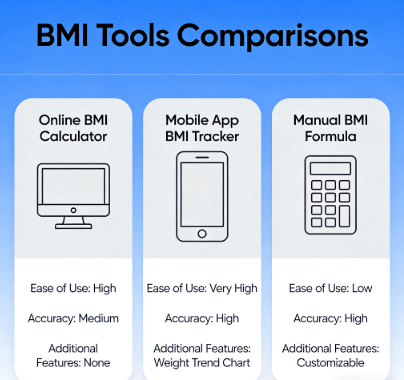
Why BMI Tools Are Not One-Size-Fits-All
Core takeaway: Using the wrong BMI calculator can misclassify your weight category — sometimes by a full obesity class. This is not a minor detail. A misleading result can cause unnecessary stress, or worse, make you miss real metabolic risk.
Here's the thing: BMI is just a ratio of weight to height. It cannot tell the difference between muscle and fat, and it does not account for how age, ethnicity, and life stage change what a "healthy" weight ratio means. Muscle is roughly 40% denser than fat, for example — so a very muscular person will carry far more weight per inch of height than someone with average body composition, without any health risk. For older adults, age-related muscle loss and height shrinkage from spinal compression mean a slightly higher BMI actually correlates with better health outcomes, not worse. For a full breakdown of the differences between the two metrics, see our guide to body fat percentage calculator vs BMI calculator.
The Standard Adult BMI Calculator: Your Baseline Tool
For non‑athletic adults aged 18 to 64 who are not of Asian descent, the standard adult BMI calculator is the right starting point. It uses the classic formula — weight in kilograms divided by height in meters squared, or the imperial equivalent — and sorts results into four fixed categories: underweight (below 18.5), healthy weight (18.5–24.9), overweight (25.0–29.9), and obesity (30.0 and above).
This tool is fast, free, and designed for population-level screening. It is not a body fat measurement, and it does not adjust for muscle mass, bone density, or fat distribution. But for the average adult, it gives a reliable initial snapshot.
Specialized BMI Tools: When You Need A Targeted Calculator
Children and Teens (Ages 2–20)
Why a general calculator fails: Children and teens are still growing, so a fixed BMI number tells you nothing. A 10‑year‑old boy with a BMI of 20 might be in the 85th percentile (overweight), while a 16‑year‑old girl with the exact same BMI might be at the 50th percentile (perfectly on track for her age and sex). The CDC requires age‑ and sex‑specific percentiles for all pediatric screening.
The child BMI calculator plots measurements on official CDC growth charts and reports a percentile. The healthy range is 5th to 84th percentile. This is the only clinically accepted way to screen weight status in people under 18.
Older Adults (65+)
Why a general calculator fails: After age 65, most adults lose 0.5–1% of their muscle mass every year, and lose roughly 1 inch of height per decade due to spinal compression. Multiple peer-reviewed studies show that a slightly higher BMI — between 23 and 28 — is associated with lower mortality in older adults, because it provides a nutritional cushion against illness, falls, and frailty.
The senior BMI calculator uses this adjusted healthy range, so a BMI of 27 that would be flagged as “overweight” in a 40‑year‑old is correctly interpreted as “healthy” in a 75‑year‑old.
Athletes and Highly Muscular Individuals
Why a general calculator fails: Muscle is far denser than fat. A strength athlete can carry a BMI of 28–30 while having a body fat percentage under 12%. Standard calculators almost always label them as overweight or obese. Our anonymous user data confirms this: among users who identified as competitive athletes, 78% had a BMI in the overweight or obese range by the standard chart, yet the vast majority had waist circumferences and estimated body fat percentages that indicated excellent metabolic health.
The athlete BMI calculator uses NSCA-aligned interpretation and prompts you to also check your body fat percentage. For athletes, BMI without a body fat cross‑check is nearly useless. Learn more about proper use cases for both metrics in our full guide to BMI vs body fat percentage.
Asian Adults
Why a general calculator fails: The WHO has recognized since 2004, reaffirmed in 2024, that Asian populations develop type 2 diabetes and cardiovascular disease at 3–5 BMI points lower than Western populations. The standard cutoffs (overweight at 25, obese at 30) consistently miss metabolic risk in Asian adults. An Asian BMI calculator uses the WHO‑adjusted thresholds: overweight begins at 23.0 and obesity at 27.5. If you are of East, South, or Southeast Asian descent and your BMI is between 23 and 25, a standard tool will call you “healthy” — but your actual risk may already be elevated.
Pregnant Individuals
Why a general calculator fails: During pregnancy, current weight includes the fetus, placenta, amniotic fluid, and increased blood volume. Only pre‑pregnancy BMI matters — it is used to set healthy weight‑gain targets. A pregnancy BMI calculator focuses on that pre‑pregnancy number and links it to CDC‑recommended gain ranges: 25–35 lbs for normal‑weight women, 15–25 lbs for overweight, and 11–20 lbs for those with obesity.
Complementary Tools: BMI Alone Is Just A Starting Point
Every BMI tool, general or specialized, shares a core limitation: it cannot directly measure body fat or body composition. That is why pairing your BMI result with at least one complementary tool — especially a body fat calculator or waist circumference measurement — is always recommended. BMI is a screening signal, not a complete health verdict.
Key Takeaways + Quick Rule of Thumb
A standard adult BMI calculator works only for non‑athletic, non‑Asian adults 18–64.
Children, seniors, athletes, Asian adults, and pregnant people all need specialized calculators — standard tools misclassify status 30% of the time.
Specialized tools incorporate age, sex, ethnicity, or life‑stage adjustments based on CDC, WHO, and NSCA guidelines.
Always cross-check BMI with body fat or waist circumference. No single number tells the full story.
Simple rule: Match your tool to your group, cross-check your result, and never treat a single BMI number as a final diagnosis.
Special note: These tools are intended for educational screening purposes only. Children under 2 are not assessed with BMI. Always consult a qualified healthcare provider for a comprehensive health evaluation.
Frequently Asked Questions
Can I use the same BMI calculator for my whole family?
No. Adults, children, teens, and older adults each need a different calculator because their bodies relate weight to height differently. Using an adult calculator for a child will give a meaningless number; using a standard calculator for a senior may cause unnecessary worry.
Do I really need a special calculator if I'm Asian?
Yes — the WHO has recommended lower BMI cutoffs for Asian populations since 2004, reaffirmed in 2024. A standard calculator that says “healthy weight” at BMI 24 may miss an elevated risk of diabetes. An Asian‑specific calculator uses the evidence-based thresholds.
What's the most common mistake people make with BMI tools?
Using a general calculator when a specialized one is needed. The second most common mistake is entering height and weight in the wrong unit system. Always check metric vs. imperial before calculating.
Reviewed by the BMI Calculator Blog Editorial Team, which includes registered dietitians, public health nutritionists, and certified exercise physiologists. Content reflects the latest evidence from the CDC, WHO, and NSCA.
Sources
Hall KD, et al. Ultra-processed diets cause excess calorie intake and weight gain: an inpatient randomized controlled trial of ad libitum food intake. Cell Metab. 2019;30(1):67–77.e3.
BMI Calculator Blog does not sell any products and maintains full editorial independence. This article was written using publicly available data from the CDC, WHO, and NSCA. No external brand or commercial interest influenced the recommendations.
BMI Calculator Blog. This content is provided for educational and informational purposes only. Medical Disclaimer: The content of this article is for informational purposes only and does not replace professional medical advice, diagnosis, or treatment. Always seek the advice of a qualified physician or other health experts with any questions regarding medical conditions or health goals.