Key Takeaways (30‑second read):
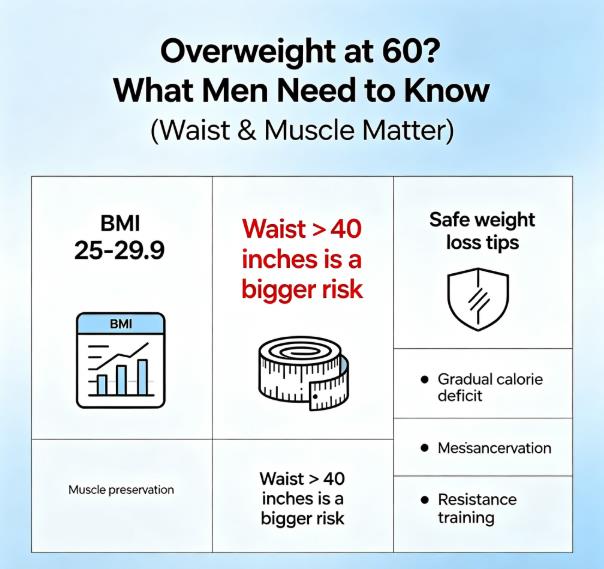
✅ For a 60‑year‑old male, overweight is BMI 25–29.9, but waist over 40 inches (102 cm) is a stronger risk signal.
✅ Moderate weight loss (5–10%) improves blood pressure, blood sugar, and joint pain – even without reaching “ideal” weight.
✅ Muscle preservation through protein and resistance training is more important than rapid weight loss.
✅ Older adults should avoid aggressive calorie cutting; aim for weight maintenance or slow loss (0.5–1 lb/week).
✅ Asian American men have lower risk thresholds: BMI ≥23 and waist ≥35.4 inches (90 cm) signal increased metabolic danger.
Let’s say you’re a 60‑year‑old man, 5'10" (178 cm), 185 lb (84 kg). Your BMI is 26.5 – technically “overweight.” But what does that actually mean for your health at this age? The short answer: it depends on your waist size and muscle mass more than the number on the scale.
Here’s a truth many doctors don’t say out loud: For men over 60, losing weight too fast is often more dangerous than staying moderately “overweight.” I’ve seen plenty of men crash‑diet to hit a “normal” BMI, only to lose muscle, feel exhausted, and regain the weight – plus extra fat.
What is “overweight” for a 60‑year‑old male?
Overweight is defined by the CDC and WHO as a BMI of 25.0 to 29.9. That same range applies to all adults, regardless of age. But for men over 60, two things change: muscle mass naturally declines (sarcopenia), and fat tends to shift to the belly. So a 60‑year‑old man with a BMI of 26 could be metabolically healthy if his waist is below 40 inches (102 cm) and he stays active. Or he could be at high risk if his waist is 42 inches (107 cm) and he has lost muscle.
Special note for Asian American men: The WHO recommends a lower overweight threshold for Asian populations (BMI ≥23.0) because Asian men develop type 2 diabetes and heart disease at BMI levels 2–3 points lower than white men. For Asian men aged 60, a healthy waist circumference is below 35.4 inches (90 cm) – not 40 inches. If you are of Asian descent and your BMI is 23–25 or your waist is near 90 cm, it’s worth discussing metabolic screening with your healthcare provider.
Special note for African American men: Research shows that African American men have a higher risk of type 2 diabetes and hypertension at lower BMI levels than white men. A waist circumference over 39 inches (99 cm) is considered high risk for African American men, even if your BMI is in the normal range. If you are African American and your waist is 39 inches or more, talk to your doctor about metabolic screening regardless of your weight.
For a deeper understanding of BMI categories, see overweight definition and what is considered overweight.
Why BMI alone is misleading for men over 60
As a practitioner, I’ve seen many fit older men get upset when a BMI chart calls them “overweight” – completely ignoring their decades of healthy habits. BMI doesn’t distinguish between muscle and fat. A 60‑year‑old man who has been active his whole life might weigh more due to muscle, yet have low body fat. Conversely, a sedentary man with the same BMI could have high body fat and low muscle – a condition called sarcopenic obesity.
Key muscle loss data: After age 50, men who do not perform resistance training lose 1–2% of their muscle mass per year. That loss slows metabolism by 2–3% per decade, meaning you gain fat more easily even if you eat the same amount as before.
Research shows that waist circumference is a better predictor of heart disease and diabetes risk than BMI in older adults. According to the National Institutes of Health (NIH), a waist over 40 inches (102 cm) for men doubles the risk of metabolic syndrome regardless of BMI.
For a visual comparison of how BMI charts work for men, check bmi chart men to see why muscular or active men are often mislabeled.
Health risks of being overweight at age 60 – and why the “obesity paradox” is misunderstood
Carrying extra weight at 60 is linked to several conditions, but the degree of risk depends on how long you’ve been overweight and where you carry fat. The table below gives a clear risk breakdown:
| Health Metric | Low Risk | Moderate Risk | High Risk |
|---|---|---|---|
| BMI | 18.5–24.9 | 25.0–29.9 | ≥30.0 |
| Waist circumference (men) | <37 inches=""> | 37–40 inches (94–102 cm) | >40 inches (102 cm) |
| Body fat % (60+ men) | 18–24% | 25–28% | ≥29% |
| Weight loss goal | Maintain weight | Lose 5–10% of body weight | Lose 10–15% under medical guidance |
Important – the “obesity paradox” explained correctly: Some studies show that older adults with a BMI of 23–27 live longer than those with a BMI under 22. This protective effect likely comes from having energy reserves during illness. However, this paradox only applies to BMI<30 and="" normal="" waist="" circumference="">. If your BMI is 30 or higher, or your waist exceeds 40 inches, your risks of heart disease, diabetes, and cancer far outweigh any potential protective benefit. So don’t use the paradox as an excuse to avoid healthy changes.
Specific risks linked to excess weight at age 60:
-
Type 2 diabetes: Excess belly fat increases insulin resistance. A 5–7% weight loss reduces diabetes risk by 58% (CDC).
-
High blood pressure: Every 10 lb (4.5 kg) of excess weight can raise systolic pressure by 2–3 mmHg.
-
Joint pain (knees, hips): Each extra pound adds about 4 lb (1.8 kg) of pressure on knee joints.
-
Sleep apnea: Fat around the neck narrows airways, leading to poor sleep and daytime fatigue.
-
Heart disease and stroke: Visceral fat releases inflammatory chemicals that damage arteries.
But here’s good news: even modest weight loss (5–10% of your body weight) significantly lowers these risks. For a 200 lb (91 kg) man, that’s just 10–20 lb (4.5–9 kg).
The optimal weight range for a 60‑year‑old male
A 2014 meta‑analysis in the American Journal of Clinical Nutrition (Winter et al., doi:10.3945/ajcn.113.068122) found that a BMI of 23–27 was associated with the lowest risk of death in older adults. That means being “overweight” by strict BMI standards may be protective for some older men, providing energy reserves during illness. So don’t panic if your BMI is 26 or 27 – focus on waist and strength instead.
To find your healthy weight range, use a Free BMI Calculator to see where you fall, then check your waist.
Quick decision guide for men over 60
| If you are a 60‑year‑old man with… | Your next best step |
|---|---|
| BMI 25–27, waist<37 inches=""> | Maintain current habits, recheck annually |
| BMI 25–29, waist 37–40 inches | Add daily walking and 2x/week resistance training |
| BMI 25–29, waist >40 inches | Consult your doctor about a structured weight loss plan |
| BMI ≥30, any waist size | Seek medical guidance for safe weight management |
Step‑by‑step: How to assess your health as an overweight 60‑year‑old male
Step 1: Measure your waist
Stand, breathe out, measure at navel level. Below 37 inches (94 cm) is low risk; 37–40 inches (94–102 cm) is moderate; above 40 inches (102 cm) is high risk. If your waist is above 40 inches, prioritize reducing it – even if your BMI is only 25.
Step 2: Estimate your body fat or muscle mass
If possible, get a body fat measurement. For men 60+, healthy body fat is roughly 18–24%. A simple home method: use a body fat calculator that uses neck and waist measurements.
Step 3: Check your strength and mobility
Can you get up from a chair without using your hands? Can you carry a 10 lb (4.5 kg) grocery bag? Good muscle function matters more than the scale.
Step 4: Review recent blood work
If your fasting glucose, blood pressure, or cholesterol are elevated, weight loss becomes more urgent. If they are normal and you feel strong, you may not need to lose weight – just maintain.
Safe weight loss strategies for men over 60
I always tell the men I work with: if you’re hungry all the time, you’re doing it wrong. The goal is to lose fat, not starve yourself. That’s why protein is so important—it keeps you full longer and protects your muscle.
Aggressive dieting is dangerous for older adults. It accelerates muscle loss, weakens bones, and can lead to nutrient deficiencies. Instead, follow these evidence‑based guidelines:
-
Aim for slow loss: 0.5–1 lb (0.2–0.45 kg) per week. That’s a deficit of 250–500 calories per day.
-
Prioritize protein: Eat 1.2–1.6 g of protein per kg of body weight daily. For a 200 lb (91 kg) man, that’s 110–145 g per day. Good sources: eggs, Greek yogurt, fish, chicken, tofu.
-
Do resistance training twice weekly: Bodyweight squats, push‑ups (or wall push‑ups), band rows, and lunges preserve muscle.
-
Walk daily: Aim for 7,000–10,000 steps. Walking after meals lowers blood sugar spikes.
-
Limit added sugar and ultra‑processed foods: Cut soda, sweet tea, packaged snacks, and fast food. Swap with whole fruits, nuts, and vegetables.
-
Stay hydrated: Thirst is often mistaken for hunger, especially in older adults.
To calculate your personal calorie target, use a calorie calculator based on your current weight and activity level.
Myth vs. Fact: Weight Loss After 60
-
Myth: Older adults should drastically cut calories to lose weight.
Fact: Extreme calorie cutting speeds muscle loss. A modest deficit of 250–500 calories works better and is safer. -
Myth: You can’t build muscle after 60.
Fact: Resistance training increases muscle mass at any age – just more slowly. Even small gains improve metabolism and function.
Sample day of eating for a 60‑year‑old overweight male (approx. 1,700 calories, moderately active)
-
Breakfast (260 cal): 2 scrambled eggs + 1 slice whole‑grain toast + ½ cup blueberries.
-
Mid‑morning snack (120 cal): ½ cup non‑fat Greek yogurt + 1 tbsp chia seeds.
-
Lunch (340 cal): 4 oz grilled chicken breast + 2 cups mixed greens + ¼ avocado + 2 tbsp olive oil vinaigrette.
-
Afternoon snack (190 cal): 1 medium apple + 1 tbsp natural peanut butter.
-
Dinner (560 cal): 5 oz baked salmon + 1 cup roasted broccoli + 1 cup cooked quinoa + 1 tbsp olive oil.
-
Evening snack (165 cal): 1 oz dry‑roasted almonds (small handful).
Total: ~1,635 calories, ~120g protein, 35g fiber. For a more active man aiming for 1,800 calories, add a small banana (105 cal) or increase quinoa to 1.5 cups.
Daily calorie targets by activity level for 60‑year‑old men:
-
Sedentary (little to no exercise): 1,500–1,700 calories/day
-
Moderately active (30–60 min walking or light activity daily): 1,700–1,900 calories/day
-
Active (60+ min daily including resistance training): 1,900–2,100 calories/day
When being “overweight” is not a problem
If you are 60+, have a BMI of 26–27, a waist below 37 inches (94 cm), normal blood pressure and glucose, and you stay active – you are likely healthy. The label “overweight” alone does not dictate your health.
Case example (anonymized): John, 62, BMI 26.8, waist 41 inches (104 cm). He had pre‑diabetes (HbA1c 6.1%) and mild knee pain. He started walking 8,000 steps daily, added two protein shakes (30g each), and did bodyweight squats twice a week. In 3 months, his waist dropped to 38.5 inches (98 cm), HbA1c fell to 5.7%, and knee pain reduced by half. He lost only 6 lb (2.7 kg) – but his health improved dramatically because he lost visceral fat and preserved muscle.
Final Takeaway from Our Team
At 60, the goal isn’t to win a race to the lowest weight. It’s to win the long game for health and independence. Start with one thing from this guide—measure your waist today, add a protein‑rich food to your next meal, or take a 10‑minute walk. Small, consistent steps that preserve your muscle will yield the most meaningful and lasting health benefits.
Expert insight – National Institute on Aging (NIA) perspective: “For older adults, maintaining muscle strength and function is as important as weight control. A modest weight loss of 5–10% can improve metabolic health, but the goal should always be to preserve lean mass through adequate protein and resistance exercise.” – Based on NIA guidelines for healthy aging.
Frequently Asked Questions (FAQ)
Is it harder to lose weight at 60 than at 40?
Yes, because of lower testosterone, slower metabolism, and natural muscle loss. But it’s still possible. Focus on protein, resistance training, and slow loss (0.5–1 lb/week). Crash diets fail at any age, especially after 60.
Many 60‑year‑old men ask me: ‘Should I aim for a BMI of 22 like when I was younger?’
Not necessarily. Research shows older adults have lower mortality in the BMI 23–27 range. Aiming for a very low BMI (under 22) may increase risk of frailty and falls. Work with your doctor to set a realistic target.
What are the best protein sources for a 60‑year‑old man with high cholesterol?
Lean poultry, fish (especially salmon and tuna for omega‑3s), plant proteins like lentils, chickpeas, and tofu, and low‑fat dairy like Greek yogurt and cottage cheese. Limit red meat and avoid processed meats.
How can I start strength training at 60 if I have never done it before?
Start with bodyweight exercises: sit‑to‑stand from a chair, wall push‑ups, standing leg raises, and resistance bands. Aim for 2 sessions per week, 15 minutes each. Watch free videos online or join a senior fitness class. Always warm up with 5 minutes of walking first.
What if my BMI is 28 but my waist is 36 inches?
You are likely muscular and healthy. Ignore the BMI label. Focus on maintaining strength and keeping your waist stable. For a more accurate assessment, measure body fat percentage with a body fat calculator.
One question I get every single week: ‘I’ve been overweight for 20 years. Is it too late to make a difference?’
Absolutely not. I had a 68‑year‑old client who lost 12 pounds in 6 months by just walking after dinner and adding a protein shake to his breakfast. His blood pressure dropped 15 points, and he no longer needed his knee pain medication. It’s never too late to start.
Sources
-
NIH/NHLBI: Assessing Your Weight and Health Risk – Waist circumference thresholds
-
WHO: Obesity and overweight – Global classifications and Asian BMI cutoffs
-
Winter JE, MacInnis RJ, Wattanapenpaiboon N, Nowson CA. BMI and all‑cause mortality in older adults: a meta‑analysis. Am J Clin Nutr. 2014;99(4):875-890. doi:10.3945/ajcn.113.068122
-
National Institute on Aging: Healthy eating after 50 – protein and muscle preservation
-
Gallagher D, et al. Healthy body fat percentage ranges for older adults. Am J Clin Nutr. 2000;72(3):694-701.
Content Integrity Review: This article has been reviewed by the BMI Calculator Blog editorial team for alignment with CDC, NIH, WHO, and NIA guidelines on overweight classification, older adult weight management, and metabolic risk assessment. Individual health decisions should always be made with a qualified healthcare provider.
BMI Calculator Blog. This content is provided for educational and informational purposes only. Medical Disclaimer: The content of this article is for informational purposes only and does not replace professional medical advice, diagnosis, or treatment. Always seek the advice of a qualified physician or other health experts with any questions regarding medical conditions or health goals.