Global BMI guideline changes in the last five years have not touched the formula. Weight in kilograms divided by height in meters squared still produces the same number it produced in 1972. What shifted is the reading layer: Asian action points at 23.0 and 27.5, a 2025 Lancet Commission recommendation for a second measurement beyond BMI, and cohort evidence placing the lowest mortality for adults over 65 at a higher BMI than 18.5–24.9. All three are already in screening guidance. Most calculators have not caught up.
Standard adult categories: still the baseline
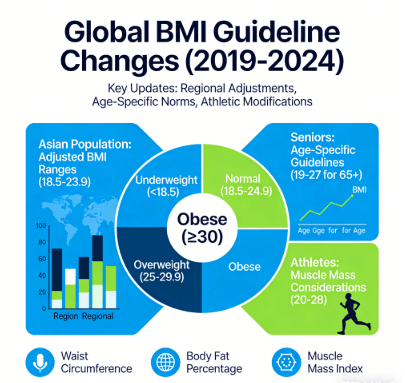
The standard adult categories are unchanged. CDC still publishes underweight below 18.5, healthy weight 18.5 to less than 25, overweight 25 to less than 30, and obesity 30 or greater, with obesity split into Class 1 (30–34.9), Class 2 (35–39.9), and Class 3 (40+). Those cutoffs apply to every adult 20 and older regardless of age, sex, or race.
The interpretation layer has moved. A WHO-aligned BMI screening tool still gives you the standard number. The three updates below tell you what to do with it.
Asian populations: action points at 23.0 and 27.5, not a redefinition of obesity
The 2004 WHO expert consultation reviewed evidence that Asian populations carry a higher percentage of body fat at the same BMI as European populations, and that type 2 diabetes and cardiovascular risk appear at lower BMI values. It did not redraw the global 25 and 30 lines. It identified further public health action points at 23.0, 27.5, 32.5, and 37.5 kg/m² along the BMI continuum, while retaining the standard international classifications.
In practice, many Asian health systems use 23.0 as the overweight action point and 27.5 as the obesity action point. A BMI of 24 reads “healthy” on the standard chart and “increased risk” under the adjusted frame. An Asian BMI reference applies those lower action points.
A 2022 pooled analysis of 1,472,819 adults found that BMI cutoffs for diabetes risk varied by ethnicity: approximately 23.9 in South Asian populations, with similarly lower thresholds in Chinese and other Asian subgroups compared with White European populations. That study is one reason the 23.0 action point has gained traction in screening protocols.
One clarification that circulates widely and is wrong: CDC has not formally adopted 23 as its adult overweight cutoff. The agency’s adult categories remain 18.5 / 25 / 30 for all adults regardless of ethnicity. The organization that recommends screening Asian Americans for diabetes at BMI 23 is the American Diabetes Association, not CDC. Screening practice varies; the guideline table does not.
The 2025 Lancet Commission: excess adiposity assessment now requires more than BMI
This is the most structural change in decades. The Lancet Diabetes & Endocrinology Commission, published in 2025, recommended that excess adiposity assessment require at least one anthropometric measurement beyond BMI — waist circumference, waist-to-hip ratio, or waist-to-height ratio — or at least two such measurements regardless of BMI. BMI alone is no longer sufficient to confirm excess adiposity.
The rationale is the gap BMI has always had. The quotient cannot separate visceral fat from subcutaneous fat. It also fails to distinguish lean muscle from fat mass. Two people at BMI 27 can carry completely different metabolic risk depending on where the fat sits and how much muscle surrounds it. The Commission’s recommendation turns that known limitation into an assessment requirement.
NHLBI draws the added-risk waist line at more than 35 inches (88 cm) for women and more than 40 inches (102 cm) for men. Above those thresholds, cardiometabolic risk rises regardless of BMI category. A reader wrote in last spring after her primary care visit flagged nothing: BMI 23, all labs normal. She had measured her waist at 37 inches the week before and mentioned it almost in passing. That measurement changed the conversation more than the BMI printout did. We see this pattern in our calculator logs regularly.
Adults over 65: the mortality curve moves up, but CDC does not publish a separate table
This is where a lot of misinformation circulates. CDC does not issue a distinct BMI range for adults over 65. Its adult categories apply at every age. What the research shows is a different mortality pattern.
A 2014 meta-analysis of 32 prospective cohorts, covering 197,940 adults aged 65 and older, found that using BMI 23.0–23.9 as the reference, mortality risk was lowest at BMI 27.0–27.9 (HR 0.90), and being in the overweight range was not associated with increased mortality in this group. Risk rose again below BMI 23 and above BMI 33.
That does not mean a 72-year-old should aim for BMI 27. It means a BMI of 26 at 72 does not carry the same interpretation it carries at 35. An age-adjusted senior BMI checker places the same reading against those cohort-specific bands rather than the young-adult row.
Children, athletes, and pregnancy: three frames that never used the adult table
Children and teens. Fixed BMI categories do not apply under 18. CDC uses sex-specific BMI-for-age percentiles: underweight below the 5th, healthy weight 5th to under the 85th, overweight 85th to under the 95th, and obesity at or above the 95th. In 2022, CDC released Extended BMI-for-Age Growth Charts adding percentile curves at the 98th, 99th, 99.9th, and 99.99th for children with very high BMIs — the first pediatric chart update in over two decades.
Athletes. BMI cannot distinguish lean mass from fat mass. Strength-trained adults frequently register above 25 with low body fat and a waist well under the risk threshold. The NSCA notes that BMI cannot tell a trained lineman from a sedentary adult of the same weight. Waist circumference and body-fat percentage are the relevant screens for this group. A composition-aware estimator gives the fat-versus-lean breakdown BMI cannot provide.
Pregnancy. Pre-pregnancy BMI is the only baseline used for gestational weight-gain guidance. BMI during pregnancy is not a meaningful screening number on its own. Weight-gain targets follow obstetric guidance, not the open adult chart.
How to apply the updated frame to your own number
Start with the standard row. Run height and weight through a calculator and note the category. If you are of Asian descent, check the adjusted action points before you accept the label. If you are over 65, read the number against the age-specific mortality data rather than the young-adult table. Then measure your waist at the navel after a relaxed exhale — the 2025 Commission’s recommendation makes that second measurement a requirement, not a tip.
If the BMI row and the waist tape disagree, the tape usually has the more specific information. A BMI of 24 with a 38-inch waist is not the same metabolic picture as a BMI of 24 with a 31-inch waist, even though the row prints the same word. One operational wrinkle we have learned the hard way: don’t pull the tape too tight. Tape tension and angle can shift a reading nearly an inch on the same morning.
All screening guidance in this write-up stays consistent with the editorial review process led by Dr. Sarah K. Johnson, PhD, RD, so nothing here conflicts with current WHO and CDC publications.
Frequently Asked Questions
Did the BMI formula change in the last five years?
No. The formula — weight in kilograms divided by height in meters squared — is unchanged. What changed is how the output is interpreted: ethnicity-specific action points, age-specific mortality data, and the 2025 Lancet Commission’s recommendation for a second anthropometric measurement alongside BMI. The formula remains the same, but how you read the output requires a broader lens.
Did CDC adopt the Asian BMI cutoffs?
No. CDC’s adult categories remain 18.5 / 25 / 30 for all adults 20 and older regardless of age, sex, or race. The Asian action points at 23.0 and 27.5 come from the WHO 2004 consultation and are used by many Asian health systems and by the American Diabetes Association for diabetes screening in Asian Americans. CDC acknowledges the evidence but has not formally revised its adult table.
What exactly did the 2025 Lancet Commission recommend?
The Commission recommended that excess adiposity assessment require at least one anthropometric measurement beyond BMI, or at least two such measurements regardless of BMI. The acceptable measures are:
Waist circumference — measured at the navel after a relaxed exhale.
Waist-to-hip ratio — waist divided by hip circumference.
Waist-to-height ratio — waist divided by height, both in the same units.
BMI alone is no longer sufficient to confirm excess adiposity under this framework. The recommendation is an assessment standard, not a replacement for professional judgment.
Does the 65+ range apply to everyone over 65?
No. The 2014 meta-analysis describes a population-level mortality pattern: lowest risk at BMI 27.0–27.9 for adults 65 and older. That does not mean every 72-year-old should aim for BMI 27. A lifelong petite woman at BMI 23 with stable weight and good strength is not in the same risk category as someone whose BMI dropped from 26 to 23 unintentionally. Waist circumference and functional measures — grip strength, walking pace, the ability to carry groceries — carry more signal than the BMI number at this age.
Sources
Rubino F et al. (2025): Obesity Definition and Criteria — Lancet Diabetes & Endocrinology Commission
CDC: Adult BMI Categories — Standard Thresholds for Adults 20 and Older
CDC: Extended BMI-for-Age Growth Charts — 2022 Pediatric Update
This article is for informational and educational purposes only. It does not constitute medical advice or replace professional health assessment. Always consult a qualified healthcare provider regarding your individual health and weight-related goals. Individual results will vary. The BMI Calculator Blog Team maintains editorial independence and does not sell health products.
Related Articles
Last updated: October 19, 2026.