At a Glance: WHO BMI guidelines are the global gold standard for weight health assessment, defining universal BMI classifications for adults and tailored adjustments for Asian populations, seniors, children, and other special groups. This guide breaks down the core BMI ranges, explains the key limitations of BMI as a screening tool, and shows how to complement it with body fat percentage and waist circumference measurements for a complete health picture.


Editorial development: BMI Calculator Blog Team. Content aligned with WHO and CDC guidelines.


Why WHO BMI guidelines matter for your health

The WHO BMI guidelines stand as the global reference point for assessing weight-related health risks. Developed by the World Health Organization to standardize weight classifications across diverse populations, these guidelines provide a unified framework that healthcare providers, public health officials, and individuals worldwide use to evaluate body mass index and its link to chronic disease.

Let's be clear about what BMI actually is. It's a simple calculation—weight in kilograms divided by height in meters squared—that gives you a number falling into one of four categories. The Centers for Disease Control and Prevention (CDC) aligns with the WHO on these core ranges, making them the consistent standard used across American healthcare settings. While BMI doesn't measure body fat directly, the WHO's evidence-based guidelines ensure its use is consistent, meaningful, and aligned with global public health goals.

Here's a reality check from the ground: BMI is a starting point, not a final verdict. It works best when paired with other measurements and interpreted in the context of your age, ethnicity, and lifestyle. As the WHO states in its technical report on obesity, BMI should be used as an initial screening tool in combination with other clinical indicators—not as a standalone diagnostic measure. Below, we break down everything you need to know about using these guidelines effectively.

WHO BMI Guidelines for Global Weight Health Classification

Core Adult Classifications in the WHO BMI Guidelines

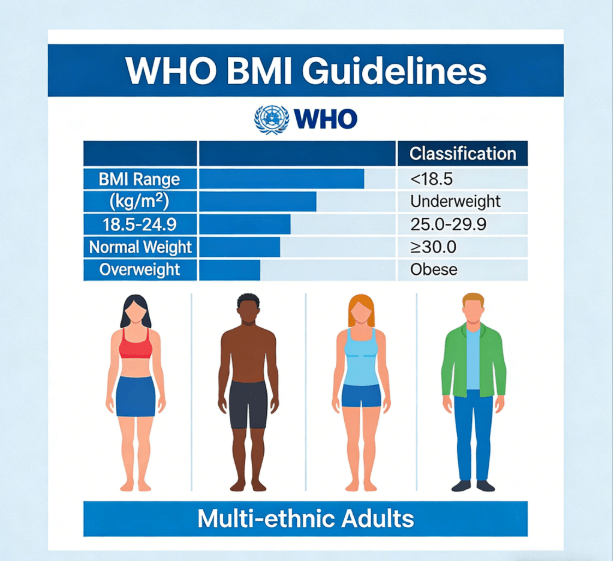
At the heart of the WHO BMI guidelines is a straightforward classification system for adults aged 18 to 65. This system categorizes BMI values into four key groups, each tied to a specific level of risk for obesity-related chronic conditions like type 2 diabetes, cardiovascular disease, and certain cancers:

  • Underweight: BMI below 18.5. Linked to increased risks of malnutrition, osteoporosis, and weakened immune function.

  • Normal weight: BMI 18.5 to 24.9. The range associated with the lowest risk of weight-related chronic diseases for most adults.

  • Overweight: BMI 25.0 to 29.9. Indicates elevated risk of developing chronic conditions, with lifestyle adjustments recommended.

  • Obese: BMI 30 and above. Classified into three subcategories—Class I (30.0–34.9), Class II (35.0–39.9), Class III (40.0 and above). Carries a high risk of severe chronic disease.

These ranges are gender-neutral for the general adult population. The WHO's research found no significant physiological differences in weight-height ratios that warrant separate male and female cutoffs for basic screening. A BMI calculator gives you your number in seconds—but interpreting that number takes context.

Key Limitations of the WHO BMI Guidelines (And How to Address Them)

While the WHO BMI guidelines are invaluable for large-scale screening, the WHO itself emphasizes that BMI is a screening tool, not a diagnostic one. The critical limitation: BMI measures total body weight, not body composition. It cannot distinguish between muscle mass, bone density, and fat mass.

Picture two men, both 5'10" and 200 pounds—a BMI of 28.7 for both. One is a sedentary office worker who hasn't exercised in years. The other is a firefighter who strength trains four times a week and runs calls for 10-hour shifts. Same BMI, completely different health profiles. This is exactly why the WHO recommends athletes and muscular individuals look beyond BMI.

The reverse is equally troubling. Someone with a "normal" BMI can carry dangerous levels of visceral fat—the kind wrapped around internal organs—that the number completely misses. A 2023 CDC analysis found that roughly 24% of normal-weight American adults have metabolic abnormalities linked to high body fat.

To overcome these limitations, the WHO recommends pairing BMI with additional assessments. A body fat calculator that uses circumference measurements provides a more nuanced view of what your weight is actually made of. The WHO also advises measuring waist circumference alongside BMI: for adults, a waist over 94 cm (37 inches) for men and 80 cm (31.5 inches) for women signals increased chronic disease risk, even with a normal BMI. This combined approach—BMI plus waist circumference plus body fat percentage—is exactly what turns a basic screening number into actionable health intelligence, aligning with the WHO's core recommendation that BMI should be paired with other clinical indicators for a complete assessment.

WHO BMI Guidelines for Special Populations: Tailored Adjustments

The WHO recognizes that one-size-fits-all ranges don't work for every group. For special populations, evidence-based adjustments account for physiological, cultural, and developmental differences that impact weight health.

Asian Populations

Asian adults face a higher risk of developing chronic disease at lower BMI values than Caucasian populations, due to differences in body composition—specifically, higher visceral fat at the same BMI. The WHO's regional guidelines for East, South, and Southeast Asia lower the overweight cutoff to 23 and the obesity cutoff to 25, with a normal weight range of 18.5 to 22.9. A 2004 WHO expert consultation published in The Lancet formally established these adjusted thresholds, which have since been validated by multiple large-scale cohort studies across the region.

Consider a practical example: an Asian-American woman in her 40s living in San Jose, California. Her BMI is 23.5—smack in the middle of "normal" by standard charts. But under the WHO's adjusted thresholds for Asian populations, she's already in the increased-risk category. Her doctor orders blood work and finds her fasting glucose is creeping up. This earlier warning—made possible by the adjusted guidelines—gives her time to adjust her diet and activity before a diagnosis. If you're of Asian descent, an Asian BMI calculator using these adjusted thresholds gives you a more accurate risk picture than the standard chart.

Children and Adolescents

For those under 18, the WHO rejects fixed BMI ranges entirely, instead recommending BMI-for-age percentiles. Children and teens are in constant developmental growth, so percentiles—which compare a child's BMI to peers of the same age and gender—are far more meaningful than fixed numbers. A BMI of 19 might be healthy for a 15-year-old but underweight for a 7-year-old. For kids, always use a pediatric BMI calculator that accounts for age and gender automatically.

Seniors (65+)

The WHO advises against strict adherence to the core adult BMI ranges for older adults. Research shows that a slightly higher BMI—roughly 23 to 28—is associated with lower mortality risk in seniors. A 2022 meta-analysis in the Journal of the American Geriatrics Society found that older adults with a BMI in this range had the lowest all-cause mortality over a 10-year follow-up. This adjustment accounts for age-related muscle loss (sarcopenia), height changes from spinal compression, and the need for a nutritional reserve to fight illness. An underweight BMI in seniors is linked to higher risks of falls, fractures, and infection. For older adults, a senior BMI calculator with age-adjusted ranges provides more relevant targets than the standard adult chart.

Pregnant and Lactating Women

BMI screening for pregnant people focuses on pre-pregnancy BMI, per WHO guidelines, with gestational weight gain recommendations tailored to this baseline. The universal adult ranges are used to classify pre-pregnancy BMI, and specific weight gain targets exist for underweight, normal, overweight, and obese pregnant people to support fetal health and reduce maternal chronic disease risk. If you're pregnant or planning to be, track your pre-pregnancy BMI with a standard calculator first—then discuss the result with your obstetrician to set a personalized weight gain plan based on your starting point.

Athletes and Highly Muscular Individuals

The WHO acknowledges that BMI is a poor indicator of health for athletes, as high muscle mass inflates BMI values. For this group, the recommendation is to prioritize body fat percentage and waist circumference over BMI, with no adjusted BMI ranges—health is assessed based on body composition and physical performance, not a number on a chart designed for the general population. An athlete BMI calculator can help provide context, but body composition testing remains the more relevant metric for this population.

How to Use the WHO BMI Guidelines Effectively

To get the most out of the WHO BMI guidelines, use them as part of a broader health assessment, not in isolation. Here are the key recommendations for both individuals and healthcare providers:

  • Use BMI as a starting point, not a final judgment. Pair it with body fat percentage, waist circumference, and blood work like blood sugar and cholesterol for a holistic view.

  • Consider your population group. If you are Asian, a senior, an athlete, or pregnant, use the tailored adjustments for your group instead of the universal adult ranges.

  • Track trends over time. A small change in BMI over a year is more meaningful than any single reading. If your BMI moves from 26 to 25 over six months, that's a positive trend—even if you haven't hit the "normal" range yet.

  • Consult a healthcare professional. A doctor or dietitian can interpret your BMI in the context of your overall health, medical history, and lifestyle.

  • Focus on sustainable habits. The WHO's guidelines promote healthy eating and regular physical activity that support a sustainable healthy weight over time—not crash diets or extreme measures.

Your 5-Minute WHO BMI Check

  • Step 1: Calculate your BMI using a tool that references WHO categories.

  • Step 2: Measure your waist circumference at the navel.

  • Step 3: Check your body fat percentage for a fuller picture. Reassess every three months.

Final Thoughts on the WHO BMI Guidelines

The WHO BMI guidelines are more than just a set of numbers—they are a cornerstone of global public health, providing a unified, accessible way to assess weight-related health risks and drive prevention efforts worldwide. While the guidelines have limitations, their strength lies in their scalability and adaptability: the core universal ranges work for the majority of adults, and the evidence-based adjustments for special populations ensure that BMI remains a useful tool for everyone.

When used alongside body composition measurements, waist circumference, and the advice of a healthcare professional, the WHO's BMI guidelines become a powerful tool for individual health management. Whether you're a healthcare provider designing a public health program or an individual looking to assess your own weight health, the WHO's standards offer a trusted, global framework to guide your decisions.


Content Integrity Review: The health information and classification standards in this article have been checked for alignment with current WHO BMI guidelines and CDC public health recommendations. Individual medical advice should always be obtained from your personal healthcare provider.


Prepared based on national health statistics, WHO guidelines, and CDC recommendations for adults in the U.S. All advice is adapted to reflect current global weight health standards and diverse population needs.


Sources


Frequently Asked Questions

Are WHO BMI guidelines different from CDC guidelines?
They are essentially aligned. The WHO and CDC use the same core adult BMI categories—underweight below 18.5, normal weight 18.5 to 24.9, overweight 25.0 to 29.9, and obese 30.0 and above. Both organizations also acknowledge the same limitations of BMI as a screening tool and recommend pairing it with waist circumference and body fat assessment. The WHO guidelines are applied globally, while the CDC applies them specifically within the U.S. healthcare context.

Why does the WHO recommend lower BMI cutoffs for Asian populations?
Decades of research show that Asian populations develop metabolic diseases like type 2 diabetes and hypertension at significantly lower BMI values compared to Western populations. A 2004 WHO expert consultation formally recommended the adjusted thresholds—overweight at 23 and obese at 25—because the standard cutoffs were missing millions of at-risk individuals. This adjustment enables earlier risk identification and preventive intervention.

Do WHO BMI guidelines apply to older adults over 65?
Yes, but with important caveats. The WHO advises against strict adherence to the standard adult BMI ranges for seniors. Research shows that a slightly higher BMI—roughly 23 to 28—is associated with lower mortality risk in older adults. This is because age-related muscle loss (sarcopenia) and the need for nutritional reserves change what "healthy" weight means. An underweight BMI in seniors carries higher risks of falls, fractures, and infection than a modestly elevated BMI. For personalized guidance, seniors should discuss their BMI with a healthcare provider who can interpret the number in the context of functional ability, muscle mass, and overall health.

Why doesn't BMI work well for athletes and muscular people?
BMI doesn't distinguish between muscle and fat. A pound of muscle weighs the same as a pound of fat, but they affect health in opposite directions. Athletes and people who strength train regularly often carry enough lean muscle mass to push their BMI into the "overweight" or even "obese" category, despite having low body fat and excellent metabolic health. This is why the WHO recommends athletes prioritize body fat percentage and waist circumference over BMI. If your BMI reads high but your waist is under 94 cm for men or 80 cm for women, muscle—not fat—is likely driving the number.

Is BMI still useful given all its limitations?
Yes. BMI remains valuable as a population-level screening tool—it's quick, free, and correlates with health risks for most people. The key is using it as a starting point, not a final diagnosis. Pair it with waist circumference, body fat percentage, and regular checkups for a complete picture. The WHO's guidelines explicitly position BMI as one piece of the assessment, not the whole story.

How often should I check my BMI against the WHO guidelines?
Once or twice a year is sufficient for most adults, or whenever your weight changes by 10 pounds or more. What's more valuable is tracking trends over time rather than obsessing over a single reading. If your BMI is moving in a healthier direction—even slowly—that's meaningful progress.


Copyright and Content Protection | BMI Calculator Blog. All educational content in this article is the exclusive property of BMI Calculator Blog. All advice, tips, and materials published on the blog are created for informational and educational purposes only for readers in the United States. Unauthorized copying, reproduction, distribution, or commercial use of this text in whole or in part is prohibited without prior written consent from the site administrator. Medical Disclaimer: The content of this article is for informational purposes only and does not replace professional medical advice, diagnosis, or treatment. Always seek the advice of a qualified physician or other health experts with any questions regarding medical conditions or health goals.