At a Glance: Standard BMI ranges don't apply evenly to everyone. Athletes, seniors, children, pregnant individuals, and Asian populations each need tailored BMI guidelines to avoid misclassification and misleading results. This guide explains how standard BMI falls short for these groups, how to use specialized calculators for accurate assessments, and how to pair BMI with other metrics like body fat percentage and waist circumference for a complete picture. All guidance follows CDC, WHO, ACSM, and AAP clinical standards.
Editorial development: BMI Calculator Blog Team — reviewed by in-house public health analysts, exercise physiology specialists, and certified nutrition professionals, including a registered dietitian nutritionist (RDN) with expertise in weight management across the lifespan and a certified strength and conditioning specialist (CSCS). Content fully aligned with CDC clinical guidelines, WHO global BMI standards, ACSM body composition recommendations, and AAP pediatric screening protocols. Last Reviewed: March 2026. This article is periodically reviewed and updated to reflect the latest clinical guidelines.
Why Standard BMI Fails for Special Populations
The Centers for Disease Control and Prevention (CDC) defines standard adult BMI ranges—18.5 to 24.9 for healthy weight, 25.0 to 29.9 for overweight, 30.0 and above for obese—based on population data from average, non-athletic adults aged 18 to 65. These ranges are effective screening tools for the general population, but they don't account for differences in body composition, growth patterns, or the physiological changes that set special populations apart.
A muscular athlete can register as overweight on a standard BMI calculator despite having single-digit body fat. A senior with age-related muscle loss might show a normal BMI while being at risk for malnutrition and frailty. A 15-year-old and a 5-year-old with identical BMI numbers can have completely different health profiles. Using the wrong guidelines leads to misclassification, unnecessary worry, and missed health signals. More critically, misapplied BMI can cause high-risk individuals to miss the window for early preventive intervention, while prompting unnecessary anxiety and interventions in low-risk individuals whose BMI is elevated for benign reasons—like high muscle mass.
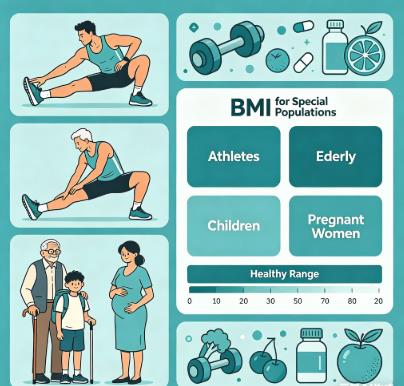
BMI for Athletes: When Muscle Confuses the Chart
Athletes—especially strength and power athletes like weightlifters, sprinters, or football players—carry high muscle mass, which is denser than fat. Their BMI often falls in the overweight or even obese range, even when body fat percentage is well within the optimal range for their sport. A male powerlifter with a BMI of 28 might be labeled overweight by standard metrics, but his body fat could be as low as 8 to 10 percent. This isn't a hypothetical edge case—it's a routine occurrence in strength sports and physically demanding professions. A competitive bodybuilder stepping on a standard scale during peak competition prep could see a BMI reading that places him in the overweight category, while his actual body composition sits in the elite athletic range.
The National Strength and Conditioning Association (NSCA) recommends focusing on body fat percentage over BMI for athletic populations. For male strength athletes, a body fat range of 6 to 13 percent is generally considered optimal; for female strength athletes, 14 to 20 percent. An athlete BMI calculator that accounts for muscle mass provides helpful context, and pairing BMI with a body fat calculator gives a far more accurate picture. Focus on how your body performs, not just the number on the chart.
BMI for Seniors: Adjusting for Age-Related Changes
For adults 65 and older, standard BMI ranges are too rigid. Seniors often experience sarcopenia—age-related muscle loss—along with reduced bone density and height loss from spinal compression, all of which affect BMI accuracy. A BMI of 25, classified as overweight for younger adults, is often protective for seniors, serving as a nutritional buffer against illness and reducing fall risk.
The CDC recommends a modified healthy BMI range for seniors of approximately 21.0 to 27.0. This range balances the risks of malnutrition—which increases when BMI falls below 21—against the chronic disease risks associated with a BMI above 30. A senior BMI calculator that accounts for age-related changes provides more meaningful results than the standard adult chart. Measure current height, not young-adult height, to avoid inflating BMI. Pair BMI with waist circumference and mobility checks for a more complete health picture.
BMI for Children and Teens: Percentiles Over Fixed Ranges
Children and teens are still growing, so fixed BMI numbers don't apply. Their bodies change rapidly with age and puberty, and a healthy BMI for a 5-year-old is very different from a healthy BMI for a 15-year-old. Pediatric BMI assessment uses percentiles, which compare a child's BMI to other children of the same age and gender.
The CDC classifies child BMI percentiles as follows: below the 5th percentile for underweight, 5th to 84th for healthy weight, 85th to 94th for overweight, and at or above the 95th for obese. A child BMI calculator automatically calculates these percentiles, making it easy to track growth over time. The American Academy of Pediatrics (AAP) recommends tracking BMI trends every 6 to 12 months rather than focusing on single measurements. A sudden jump or drop in percentiles is more significant than an isolated reading. Athletic kids may have higher percentiles due to muscle—consult a pediatrician to avoid misclassification.
BMI for Pregnant and Postpartum Individuals
BMI during pregnancy isn't about achieving a healthy weight in the traditional sense. The focus shifts to pre-pregnancy BMI, which is used to guide safe weight gain throughout pregnancy. Your pre-pregnancy BMI category determines how much weight you should gain to support fetal health and lower the risk of complications like gestational diabetes or preterm birth.
A pregnancy BMI calculator uses pre-pregnancy weight and height to recommend appropriate weight gain ranges aligned with CDC and ACOG guidelines: 25 to 35 pounds for those with a normal pre-pregnancy BMI (18.5–24.9), 15 to 25 pounds for overweight individuals, and 11 to 20 pounds for those with obesity. Postpartum, aim to return to a healthy BMI gradually—approximately 1 to 2 pounds per week—without crash dieting, especially if breastfeeding.
BMI for Asian Populations: Lower Thresholds for Chronic Disease Risk
Asian populations—including East, South, and Southeast Asian adults—tend to have different body composition than Western populations, specifically higher visceral fat at lower BMIs. This means they face elevated risks for chronic diseases such as type 2 diabetes and hypertension at BMI values that standard Western charts classify as normal. According to a 2004 WHO expert consultation published in The Lancet, Asian populations at a BMI of 23 to 25 have a risk of type 2 diabetes comparable to that of white populations at a BMI of 30. This is not a marginal difference—it means that millions of Asian adults walking around with a "normal" BMI by Western standards are, in fact, at meaningfully elevated metabolic risk.
Consider a 38-year-old Asian office worker in California. His BMI is 24.5—comfortably normal by the standard chart. But under the WHO-recommended Asian-specific thresholds, overweight begins at 23. That same number, which his standard calculator flagged as fine, now signals a need for closer monitoring of blood glucose and waist circumference. The World Health Organization (WHO) recommends a modified healthy BMI range for Asian populations: 18.5 to 22.9, with overweight beginning at 23 and obesity at 25. An Asian BMI calculator applies these ethnic-specific thresholds. Pairing BMI with waist circumference—the WHO recommends thresholds of 90 cm or greater for Asian men and 80 cm or greater for Asian women—further improves risk assessment.
Final Tips for Using BMI for Special Populations
BMI is a starting point, not a final health diagnosis—and that's especially true for special populations. Always use population-specific calculators rather than generic adult tools. Pair your BMI results with other metrics: body fat percentage for athletes, waist circumference for Asian populations, mobility and nutritional assessments for seniors, and growth percentiles for children. Discuss results with a healthcare provider for personalized interpretation. Focus on trends over time, not a single number, to make informed health decisions.
Find the right BMI calculator for your body type.
Use our specialized tools for athletes, seniors, children, pregnant individuals, or Asian adults to get a reading that accounts for your age, ethnicity, and life stage.
Content Integrity Review: The population-specific BMI guidance in this article has been checked for alignment with current CDC clinical guidelines, WHO global BMI standards, ACSM body composition recommendations, and AAP pediatric screening protocols. Individual medical advice should always be obtained from your personal healthcare provider or a qualified specialist for your population group.
Prepared based on CDC adult and pediatric BMI guidelines, WHO global and ethnic-specific BMI standards, ACSM body composition position stands, AAP clinical recommendations, ACOG prenatal weight gain guidelines, and peer-reviewed body composition research.
Sources
Frequently Asked Questions
Why does BMI misclassify athletes as overweight?
BMI doesn't distinguish between muscle and fat. Muscle is denser than fat, so athletes with high muscle mass often have a higher BMI despite low body fat. For this group, body fat percentage is a far more meaningful metric. The NSCA recommends prioritizing body composition testing over BMI alone for athletic populations.
What BMI range is healthy for seniors?
The CDC recommends a modified healthy BMI range of approximately 21.0 to 27.0 for adults 65 and older, which is higher than the standard 18.5 to 24.9 range for younger adults. A slightly higher BMI provides nutritional reserves that protect against frailty, falls, and infection. For personalized guidance, seniors should use an age-adjusted BMI calculator and discuss results with their healthcare provider.
Should children use the same BMI calculator as adults?
No. Children and teens require BMI percentiles based on age and gender, not fixed adult ranges. A BMI of 18 might be healthy for a 15-year-old but underweight for a 7-year-old. Always use a pediatric BMI calculator for anyone under 20, and focus on tracking percentile trends over time rather than single readings.
How does pre-pregnancy BMI affect pregnancy health?
Pre-pregnancy BMI is used to determine recommended weight gain during pregnancy. The CDC and ACOG provide specific weight gain ranges for each pre-pregnancy BMI category to support fetal health and reduce the risk of complications. BMI during pregnancy itself is not a meaningful measure—the focus is on pre-pregnancy baseline and healthy gestational weight gain.
Do Asian adults need a separate BMI chart from Western standards?
Yes. The WHO recommends lower BMI thresholds for Asian populations because metabolic disease risk increases at significantly lower BMI values. For Asian adults, the healthy BMI range is 18.5 to 22.9, with overweight beginning at 23 and obesity at 25—compared to 25 and 30 for Western populations. Using an ethnicity-specific BMI calculator that applies these adjusted thresholds catches risks that the standard chart would miss.
Can athletic children be misclassified as overweight on standard BMI?
Yes. Just like adult athletes, athletic children and teens—especially those involved in strength-based sports like gymnastics, wrestling, or football—often have higher BMIs due to increased muscle mass. A standard BMI chart may place them in the overweight or even obese percentile range despite healthy body composition. In these cases, a pediatrician may use additional assessments like body fat measurement or waist circumference to determine whether the elevated BMI reflects excess fat or lean muscle. The key is to avoid labeling an active, healthy child based on BMI alone.
Why shouldn't seniors use the same BMI range as young adults?
Seniors undergo age-related changes—specifically sarcopenia (muscle loss), height loss from spinal compression, and altered fat distribution—that make the standard adult BMI range both too narrow and potentially misleading. A BMI of 25, classified as overweight for a 30-year-old, is often protective for a 75-year-old, providing nutritional reserves that reduce the risk of frailty and falls. Research published in the Journal of the American Geriatrics Society found that older adults with a BMI between 23 and 30 had the lowest mortality risk over a 10-year follow-up. For seniors, the clinical conversation shifts from a specific BMI target to preserving muscle mass, maintaining mobility, and ensuring adequate nutrition.
BMI Calculator Blog. This content is provided for educational and informational purposes only. We encourage sharing with proper attribution to our site. Unauthorized commercial use is prohibited. Medical Disclaimer: The content of this article is for informational purposes only and does not replace professional medical advice, diagnosis, or treatment. Always seek the advice of a qualified physician or other health experts with any questions regarding medical conditions or health goals.