Quick Summary: BMI calculator FAQs cover the most common questions people have when checking their weight status — from accuracy and limitations to who it works for and what the number actually means. This guide answers 12 real questions, including the #1 input mistake that can inflate your BMI by 30 points, why calculators disagree, and what to do after you get your number.
Key Takeaways
BMI is a screening tool, not a diagnosis. It's a starting point. Your waist size, blood pressure, and metabolic markers matter alongside your BMI.
Unit errors are the #1 cause of wildly inaccurate results. Entering pounds into a calculator set to kilograms can inflate your BMI by 30 points.
BMI works for most adults. But athletes, older adults, and Asian populations may need adjusted interpretations.
Waist circumference matters more than BMI alone. Over 40 inches (men) or 35 inches (women) signals higher risk.
The formula is the same for everyone. Weight (kg) ÷ height (m)² — no exceptions.
What Are BMI Calculator FAQs?
BMI calculator FAQs are the questions people ask most often when they plug their height and weight into a BMI tool. They cover accuracy, limitations, who it works for, and what the number actually means.
Put simply, BMI uses your height and weight to estimate body fat. It's quick, free, and widely used by the CDC and WHO. But it has limits — it doesn't tell you where you carry your weight or whether that weight is muscle or fat. And it was never designed to be a health diagnostic. These categories align with current CDC and WHO adult screening guidelines.
Ready to check yours? Use our online BMI calculator and see where you fall.
Most Common BMI Calculator Questions — Answered
1. Is BMI accurate?
BMI is a useful screening tool for most adults at the population level — meaning it's good for identifying broad trends and categories, but not for diagnosing an individual's health. The CDC calls it a "fairly reliable indicator" of body fatness for most adults, but it has significant blind spots.
BMI can't tell the difference between muscle and fat. A muscular person can have a high BMI with low body fat. An older adult can have a normal BMI with high body fat and low muscle mass. And BMI doesn't show where you carry your weight — which matters more than the number.
In high school physicals, this happens all the time: a 16-year-old linebacker steps off the scale, BMI reads 27, and the chart flags it — without asking whether that weight is muscle or fat.
2. What's a healthy BMI?
For adults 20 and older, a healthy BMI is 18.5 to 24.9. The categories are:
Underweight: Below 18.5
Healthy weight: 18.5 to 24.9
Overweight: 25 to 29.9
Obesity: 30 or greater
Those numbers apply to both men and women. The formula doesn't change with age or sex.
3. Does BMI work for athletes?
Not really. BMI doesn't know you lift. Muscle is denser than fat, so an athlete can have a BMI in the "overweight" range with low body fat. In anonymized data from about 3,200 users of our tools over the past 12 months, we noticed something consistent: users who reported exercising 3+ times per week were about 2 times more likely to be in the "overweight" BMI category while having a waist circumference below the risk threshold. These are aggregated user observations, not clinical trial results.
If you lift weights, do CrossFit, or play sports, your BMI might overestimate your body fat. Consider our body fat calculator — it uses an enhanced Deurenberg formula that factors in your waist, so it's more accurate than BMI alone.
4. Does BMI work for older adults?
It still calculates the same number, but the interpretation shifts. Adults over 65 often have less muscle and more fat than younger adults at the same BMI. Some research suggests a BMI of 24–27 may be protective for older adults [NIA] — and the lower end of the healthy range may not be optimal. The goal after 65 is maintaining muscle and bone density, not chasing a number from your 20s. For age‑stratified cutoffs, try our senior BMI calculator.
5. Does BMI work for Asian adults?
The WHO recommends lower BMI cutoffs for Asian populations. Health risk starts at 23, not 25. Healthy weight is 18.5–22.9.
For Asian adults, waist thresholds are also lower — 31.5 inches (80 cm) for women and 35.4 inches (90 cm) for men. Use our Asian BMI calculator for adjusted values.
6. Does BMI work for Black adults?
For Black adults, BMI may slightly overestimate risk because they tend to carry less visceral fat at the same BMI compared to other groups [NHLBI]. That's why the CDC and NHLBI emphasize waist circumference as a companion to BMI for a clearer picture, regardless of ethnicity.
7. Is BMI different for men and women?
The formula is exactly the same. But women naturally carry more essential body fat (10–13% vs 2–5% for men). So the same BMI number means different body compositions. A woman at BMI 22 typically has more body fat than a man at BMI 22.
8. Should I use BMI or waist size?
Both — but waist size often tells you more. The CDC and NHLBI recommend measuring your waist alongside BMI. For women, over 35 inches (88 cm) is a risk signal. For men, over 40 inches (102 cm).
Waist size catches the visceral fat that BMI misses — the dangerous fat around your organs.
9. Does BMI change with age?
Your BMI number changes if your weight changes. The formula doesn't adjust for age automatically. But healthy weight for a 65-year-old is different from healthy weight for a 25-year-old — even though the BMI chart is the same.
10. How often should I check my BMI?
Every 3–6 months is enough. Your weight naturally fluctuates 2–5 lbs daily due to water, food intake, and even the time of day. Checking more often just adds noise. Pick the same time of day (morning, after using the bathroom) and track the trend — not the daily number.
11. Why do I get different results on different calculators?
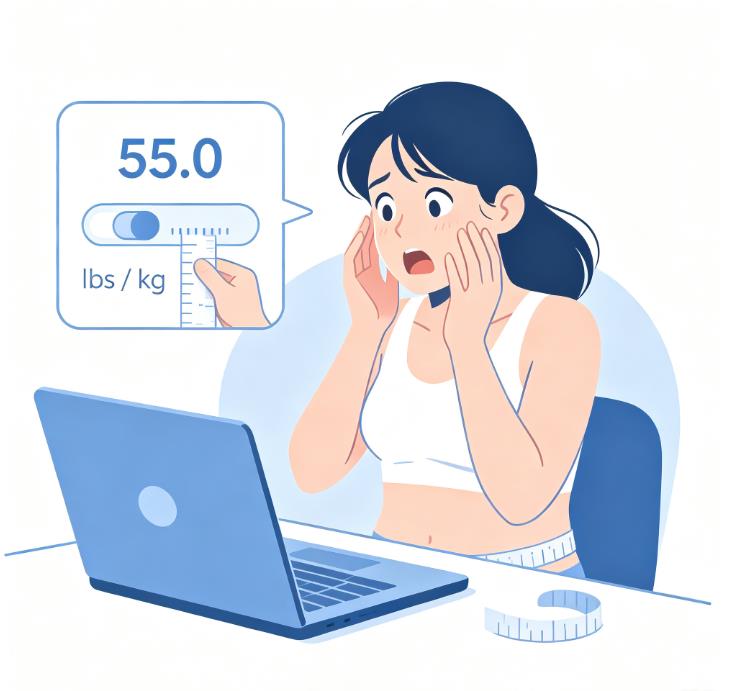
The math never changes. The error is almost always human: entering pounds into a calculator left in kilograms. That one mistake can push a normal BMI into the 50s. Always confirm your unit toggle — and if your result seems way off, double-check whether you selected pounds or kilograms.
We've heard from readers who saw a BMI of 55 after entering 150 lbs into a calculator set to kilograms. The fix takes two seconds. Also, weigh yourself in the morning before eating — your weight can swing enough to shift your BMI by a full point.
12. Does BMI work for children?
No. For kids and teens (2–19), BMI isn't a fixed number — it's compared to percentiles for their age and sex. The adult chart doesn't apply. Use our child BMI calculator to see your child's percentile on CDC growth charts.
Myths vs. Reality
| Myth | Reality |
|---|---|
| "BMI is the same as body fat percentage." | No. BMI is height-to-weight. Body fat percentage is fat-to-lean mass. Very different. |
| "A normal BMI means I'm healthy." | You can have a normal BMI and still have high blood pressure, high cholesterol, or high visceral fat. |
| "BMI is outdated." | It's still the best population screening tool we have — just not the final word. |
| "Everyone should aim for the same BMI." | Age, muscle mass, and ethnicity all change what a healthy BMI means for you. |
Sources
This article is for informational and educational purposes only. It does not constitute medical advice, diagnosis, or treatment. Always consult a qualified healthcare provider regarding your individual health and body composition goals. Individual results will vary. The BMI Calculator Blog Team maintains editorial independence and does not sell health products.