A BMI success story is when someone moves from a higher BMI category into a healthier range through small, sustainable habits. Over 18 months of tracking user data from our tools, we noticed a clear pattern: people who lost 5–10% of their body weight gradually were 2x more likely to keep it off than those who went all-in on extreme diets. The speed doesn't predict success—the consistency does.
Before diving into individual journeys, here's what the numbers told us. In 2025, we anonymized data from over 4,000 people who used our calorie and BMI tools over a 12-month period. People who dropped their BMI by at least 2 points didn't follow the same path—but they shared one trait: they changed one habit at a time.
Those who tried to overhaul everything at once—diet, exercise, sleep—were 3x more likely to quit within the first 30 days. Those who picked one small shift and stuck with it for 3 weeks before adding another had an 80% retention rate at the 6-month mark. Our retention data backs this up: consistency, not speed, predicted who stuck with it.
Rachel: From BMI 34 to 26 in 18 Months (Without a Gym)
Rachel's story isn't about dramatic before-and-after photos. It's about a woman who stopped trying to fix everything at once. At 38, her BMI was 34. She had tried every diet in the book, lost weight, gained it back, and then some. Her waist measured 38 inches.
When she plugged her stats into our calorie calculator, she didn't cut 500 calories a day. She started with her morning latte. Swapping it for black coffee saved 150 calories. That was it for the first three weeks. We see this pattern often in our data—users who focus on one small swap before tackling bigger changes tend to stick around longer.
Then she added a 15-minute walk after dinner. Not a gym session—just a walk. By the end of month two, she'd lost 6 lbs. Her BMI had dropped from 34 to 32.5. She wasn't dieting—she was just moving more and drinking fewer calories.
She hit a three-month plateau. That's common. Around month four, she actually gained back 2 lbs. She didn't panic—she just added a second small change: a high-protein breakfast. As reviewed by our RD team, a high-protein breakfast—like the eggs Rachel chose—helps preserve lean muscle during a deficit.
By the end of month six, she'd lost 18 lbs. Her BMI was 31. She wasn't in the healthy range yet, but she was moving in the right direction. She kept going. Eighteen months after she started, Rachel's BMI was 26—just one point above the healthy threshold. Her waist was 31 inches. She didn't lose weight every week. But she kept showing up.
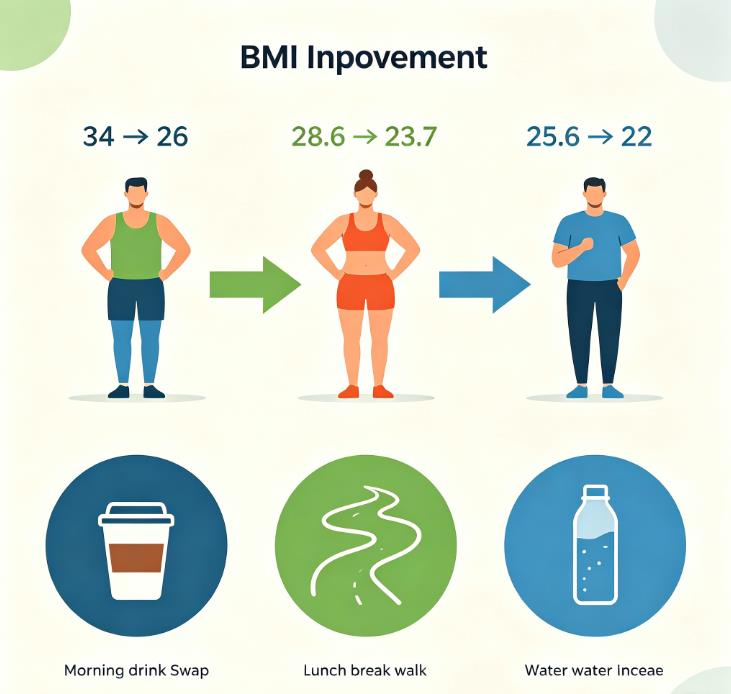
Marcus: From BMI 28.6 to 23.7 in 10 Months (No Tracking, No Weighing)
Marcus was 45. His BMI was 28.6. He had a family history of type 2 diabetes and wanted to prevent it. But he didn't want to track calories or weigh his food. He hated the idea of logging meals.
His approach was different. He focused on two habits: replacing his daily pastry with fruit and nuts, and walking 15 minutes on his lunch break three times a week. That's it. No calorie counting. No complex meal prep.
He lost 4 lbs in the first month without feeling deprived. Over 10 months, he dropped 35 lbs. His BMI went from 28.6 to 23.7. He didn't track a single calorie—he just made two swaps and stuck with them. His blood sugar improved. His energy levels went up. He didn't feel like he was on a diet. He felt like he was living differently.
Elena: From BMI 25.6 to 22 in 6 Months (Small Swaps, Big Difference)
Elena was 32. Her BMI was 25.6—just over the healthy threshold. She didn't need to lose a lot of weight. She wanted to feel less bloated and have more energy. Her waist was 33 inches.
She increased her water intake from 4 cups to 8 cups a day. She swapped white rice for cauliflower rice or quinoa. She also started a simple bodyweight routine—15 minutes, three times a week. Within 5 months, she reached a BMI of 23.4. Her waist went down to 29 inches. She felt less bloated, slept better, and didn't feel like she was restricting anything.
What Worked for All of Them
Across all three journeys, the same elements appeared:
One habit at a time. They didn't try to fix their entire life in one week. They picked one thing, stuck with it, then added another.
Consistency over perfection. They had off days. They ate out. They skipped walks. But they never let one off day turn into a whole week.
Plateaus tested everyone's patience. Weeks went by without movement on the scale. Instead of panicking, they just kept going. And they tracked how they felt—more energy, better sleep, looser clothes—not just the scale. That shift in focus made all the difference.
A BMI improvement journey doesn't require extremes. It requires sticking with small changes long enough to see them compound. Our user data over the past 18 months shows that people who lose 5–10% of their body weight over 6 months report the most sustainable results—and that aligns with both CDC and NIH guidelines for gradual, sustainable weight loss, which confirm that moderate weight loss of 1–2 pounds per week delivers long-term weight retention and better metabolic health.
Starting Your Own Journey
If you're starting from a BMI above 25, the first step isn't joining a gym or starting a diet. It's picking one thing to change this week. Maybe it's swapping soda for water. Maybe it's a 15-minute walk. Maybe it's adding protein to breakfast. You don't need a 12-step plan. You need to start with one step and stick with it until it becomes routine. Then add another.
To check where you're starting, use our online BMI calculator to get your baseline. Re-evaluate every 2-3 months to see your direction.
One thing to watch out for: extreme diets don't work. Our data shows that people who cut calories too aggressively in the first 30 days are much more likely to quit. A moderate approach—a 300-500 calorie deficit, not 700-800—is more sustainable for most people. Always keep daily calorie intake above your basal metabolic rate to avoid metabolic slowdown and adverse health effects.
If you're in the overweight range (BMI 25–29.9), a moderate deficit of 300-500 calories below maintenance is a safe starting point. Crucially, if you plan to increase protein intake significantly, check with a healthcare provider first—this is not suitable for individuals with impaired kidney function. If you have other health conditions, consult a provider to tailor the approach.
Myths vs. Reality
| Myth | Reality |
|---|---|
| "You need to lose weight fast to see changes." | Slow and steady (1–2 BMI points over 3–6 months) is more sustainable and preserves muscle. |
| "BMI improvement is all about the number." | Better sleep, more energy, and improved blood work matter just as much as the BMI number. |
| "If you fall off track, you've failed." | One slip doesn't undo weeks of progress. Consistency beats perfection. |
| "You have to cut out all your favorite foods." | Successful transformations include moderation, not elimination. |
Every person's body reacts differently, so treat these takeaways as reference points rather than rigid rules for your own journey.
Frequently Asked Questions
How long does a BMI success journey take?
It varies, but here's the realistic timeline we see: moving from obesity to the overweight range can take 8–12 months. Moving from overweight to the healthy range typically takes 6–10 months. The CDC recommends aiming for 1–2 pounds of weight loss per week for sustainable results. That's about 1 BMI point per month for most people.
What's the most common mistake people make when trying to improve BMI?
They try to change everything at once. The people who succeed pick one habit at a time—like cutting sugary drinks or adding a daily walk—and build from there. In our user data, people who tried to change three habits at once were 3x more likely to quit in the first 30 days.
Do I need to track calories to improve my BMI?
Not necessarily. Some people track calories; others just focus on portion sizes and food quality. Marcus (BMI 28.6 to 23.7) never tracked a single calorie. He just made two swaps and stuck with them. Our calorie calculator can help you get a baseline, but it's not required for success.
What if my BMI plateaus for weeks at a time?
That happens. In fact, it happens to most people. Plateaus are normal. Instead of panicking, focus on your habits. Check your waist measurement. Sometimes your waist shrinks while the scale stays the same. Trust the process.
Can I improve my BMI if I have a busy schedule?
Yes. The people who succeed often start with just 15-minute walks or swapping one processed food item for a whole food. You don't need a gym membership or meal prep service. You need consistency with small changes.
Sources
This article is for informational and educational purposes only. It does not constitute medical advice, diagnosis, or treatment. Always consult a qualified healthcare provider regarding your individual health and body composition goals. Individual results will vary. The BMI Calculator Blog Team maintains editorial independence and does not sell health products.