At a Glance: About 35% of U.S. adults are considered overweight people with a BMI between 25 and 29.9. This guide breaks down what that label actually means, the real health risks, and why waist size and body fat tell a bigger story than a single number.
Who counts as an overweight person?
A 45-year-old high school teacher in Ohio stepped on her doctor's office scale during a routine checkup last month. Her BMI came back 27.2 — technically, she falls into the 35% of U.S. adults classified as overweight. She walks her golden retriever for 40 minutes daily, her waist measures 34 inches, and her recent bloodwork came back normal. By contrast, a 50-year-old long-haul truck driver with the identical BMI carries more belly fat; his waist hits 42 inches and his blood pressure is slightly elevated. Same BMI label, yet vastly different health outlook.
That's the challenge with the term "overweight people." The CDC and WHO define overweight as having a Body Mass Index (BMI) between 25.0 and 29.9. It's a screening tool based on weight-to-height ratio — not a measure of body fat, and not a medical assessment.
BMI categories at a glance
| BMI Range | Category | What It Means |
|---|---|---|
| Below 18.5 | Underweight | May indicate malnutrition or illness |
| 18.5 – 24.9 | Healthy weight | Lowest health risk for most adults |
| 25.0 – 29.9 | Overweight | Increased risk of some conditions; context matters |
| 30.0 and above | Obese | Significantly elevated health risk |
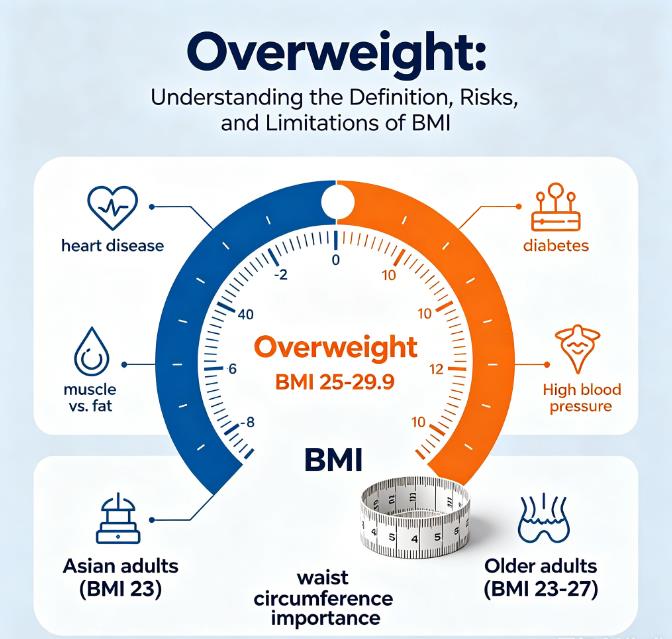
The infographic below summarizes BMI categories, health risks, and special BMI guidance for Asian adults, seniors and athletes.
How many overweight people are there?
The numbers are striking. CDC data shows about 35% of U.S. adults fall into the overweight BMI bracket (25.0–29.9). Add in obesity (27.4%) and severe obesity (5.7%), and nearly 3 in 4 American adults carry extra weight. Globally, the WHO reports 2.5 billion adults were overweight in 2022 — that's 43% of all adults worldwide.
Health risks linked to overweight people
Carrying extra weight does raise the stakes for several conditions. Research consistently links the overweight range to higher rates of:
High blood pressure and high cholesterol — both major drivers of heart disease and stroke.
Type 2 diabetes — nearly 9 out of 10 people with newly diagnosed type 2 diabetes are overweight or have obesity.
Certain cancers — including colon, breast, and kidney cancers.
Joint problems like osteoarthritis, from added mechanical stress on knees and hips.
Sleep apnea and asthma — extra tissue around the airway and chest can disrupt breathing.
Depression and anxiety — partly biological, partly driven by weight stigma.
Obesity (BMI 30+) carries 2–4 times the risk of type 2 diabetes and heart disease compared to overweight. But the longer weight is carried — and the more visceral fat involved — the higher the health toll.
Why BMI alone doesn't define overweight people
BMI was built for population studies, not individual assessments. It can't tell muscle from fat, and it ignores where fat sits on your body. A 2016 meta-analysis in The Lancet found that physical fitness modifies the relationship between BMI and mortality risk. An active person with BMI 27 may have lower risk than a sedentary person with BMI 23.
BMI has blind spots. Here are the big ones:
Muscle vs. fat: A muscular athlete can hit BMI 28 with single-digit body fat. The scale can't tell the difference.
Fat distribution: Two people with identical BMIs can have completely different risks depending on whether fat sits under the skin or wraps around internal organs.
Age and sex: Older adults naturally lose muscle, which can push BMI up even as body fat stays steady.
Special populations: when the rules change
Asian adults
The WHO recommends a lower overweight threshold — BMI 23.0 instead of 25.0 — for East, South, and Southeast Asian adults. At lower BMIs, these populations face higher metabolic risks, including diabetes and heart disease, compared to white adults with the same BMI.
Adults 65 and older
A BMI between 23 and 27 may actually be protective for older adults. Research shows this range is linked to better survival, likely because the extra reserves help buffer against frailty, illness, and falls. The goal shifts from weight loss to maintaining strength and mobility.
Athletes and muscular individuals
Many muscular athletes receive an "overweight" classification when assessed using BMI. This limitation comes from the formula's inability to differentiate muscle mass from body fat. A body fat calculator or waist measurement gives a far more accurate picture for this group. Many professional athletes land in the "overweight" category on paper while having elite metabolic health.
Waist circumference: the missing piece
The NIH recommends checking waist size alongside BMI. Here's why: a waist over 35 inches for women or 40 inches for men signals dangerous visceral fat, regardless of what the BMI says. That deep belly fat pumps inflammatory compounds into your bloodstream and drives insulin resistance.
To measure correctly: wrap a tape measure around your bare midsection just above the hipbones, exhale normally, and don't suck in. Do it the same way each time for a consistent read.
Metabolically healthy overweight: does it exist?
Yes — some overweight people maintain normal blood pressure, cholesterol, and blood sugar. It's called "metabolically healthy overweight." But long-term studies show they still face a 20–30% higher risk of cardiovascular events compared to healthy-weight peers. Cardiorespiratory fitness helps, but it doesn't erase the risk completely. The label is real, but it's not a free pass.
Common myths about overweight people
Myth: Everyone with a BMI over 25 needs to lose weight. Fact: If your waist is under the NIH threshold and your blood work is normal, your weight may reflect muscle or a larger frame — not excess fat.
Myth: Being overweight always means being unhealthy. Fact: Overall cardiorespiratory fitness is a stronger predictor of long-term survival than BMI classification. Many people with an overweight BMI who maintain regular activity have better health outcomes than sedentary peers within the healthy BMI bracket.
Myth: The overweight definition is the same for everyone. Fact: The WHO recommends lower BMI cutoffs for Asian populations. Seniors may have lower mortality with a modestly higher BMI. Athletes are frequently misclassified.
Small changes that move the needle
You don't need to drop to a "normal" BMI to see benefits. Health professionals recommend aiming for 5% to 10% weight loss over about six months. Even losing just 3% to 5% of your current weight can lower triglycerides and blood sugar, cutting your type 2 diabetes risk. Beyond that, losing more can improve blood pressure and LDL cholesterol.
Start small. Swap one daily sugary drink for water. Take a 15-minute walk after lunch. None of these are dramatic — but they compound.
Check your starting point with our BMI calculator, then get a fuller picture using our body fat calculator. For a deeper dive into sustainable habits, see our guide on weight management strategies for BMI 25-30.
Frequently Asked Questions About Overweight People
What is the definition of an overweight person?
An adult with a BMI between 25.0 and 29.9 is classified as overweight by both the CDC and WHO. BMI is a screening measure calculated from height and weight — it flags potential risk but doesn't confirm health status.
What percentage of U.S. adults are overweight?
About 35% of American adults have a BMI in the 25.0–29.9 range, per CDC data. Globally, 43% of adults (2.5 billion people) were overweight in 2022, according to the WHO.
Can overweight people be healthy?
A subset of overweight adults have normal blood pressure, cholesterol and blood work, often referred to as metabolically healthy overweight. Even with normal lab results, long-term research indicates their cardiovascular risk remains moderately elevated compared to adults in the healthy BMI group. Waist circumference and regular movement are often better markers of your actual health risk than BMI alone.
Is BMI accurate for athletes?
Not really. BMI can't distinguish muscle from fat, so muscular athletes often get labeled overweight despite having low body fat. For this group, body fat percentage and waist circumference are far better indicators.
What is a healthy BMI for Asian adults?
The WHO sets the overweight threshold at BMI 23.0 for Asian adults, lower than the standard 25.0, due to higher metabolic risk at lower body weights in these populations.
Should older adults worry about being overweight?
For adults 65+, a BMI between 23 and 27 may actually be protective. The focus should be on mobility, strength, and overall wellness rather than hitting a lower number on the scale.
What waist size is too big?
Per NIH guidelines, a waist over 35 inches for women or over 40 inches for men increases health risks regardless of BMI. That extra belly fat is a stronger predictor of heart disease and diabetes than BMI alone.
How much weight should an overweight person lose?
Aim for 5% to 10% of your starting weight over six months. Even 3% to 5% can improve triglycerides and blood sugar. The key is sustainable change, not crash dieting.
References & Sources
CDC: Disability and Obesity — Overweight and Obesity Definitions
WHO: Obesity and Overweight — Global Prevalence and Definitions
NIH/NHLBI: Aim for a Healthy Weight — Waist Circumference and Health Risks
Global BMI Mortality Collaboration. Body-mass index and all-cause mortality: individual-participant-data meta-analysis of 239 prospective studies in four continents. Lancet. 2016;388(10046):776-786. DOI
BMI Calculator Blog. This content is provided for educational and informational purposes only. Medical Disclaimer: The content of this article is for informational purposes only and does not replace professional medical advice, diagnosis, or treatment. Always seek the advice of a qualified physician or other health experts with any questions regarding your body composition, weight status, or health goals.