At a Glance: The medical overweight definition is a BMI between 25.0 and 29.9, but that number alone doesn't tell your full health story. Here's what the official definition says — and where it falls short. This guide explains why muscular people can be mislabeled, and how waist size and body fat percentage give a clearer picture of your actual risk.
The word that means different things to different people
A 48-year-old man in Chicago stepped on his home bathroom scale last week and got a BMI reading of 27.0 — officially "overweight." He hits the gym four times weekly for strength training, keeps his waist at 36 inches, and his recent blood pressure check came back normal. His neighbor — same height, same weight — sits at a desk all day, has a 42-inch waist, and has elevated cholesterol levels. The same BMI label — "overweight" — applies to both. But their health risks are worlds apart.
A 32-year-old female CrossFit coach also hits BMI 26. Her waist measures 29 inches, and her annual blood work shows perfect lipid levels. Different story entirely.
That's the problem with the term "overweight." It's a useful screening category, but it doesn't tell the whole story. The Centers for Disease Control and Prevention (CDC) defines overweight using Body Mass Index (BMI), a simple weight-to-height ratio. But as you'll see, that definition has blind spots.
The official medical definition of overweight
What is the medical definition of overweight?
For adults, overweight is defined as a BMI between 25.0 and 29.9, according to the CDC and WHO. This range indicates weight higher than what is considered healthy for a given height, but not as severe as obesity.
The World Health Organization (WHO) and CDC use the same classification system. Here's the full BMI breakdown for adults:
| BMI Range | Category | What It Means |
|---|---|---|
| Below 18.5 | Underweight | May indicate malnutrition or illness |
| 18.5 – 24.9 | Normal weight | Lowest health risk for most adults |
| 25.0 – 29.9 | Overweight | Increased risk of some health conditions; but context matters |
| 30.0 and above | Obese | Significantly elevated health risk |
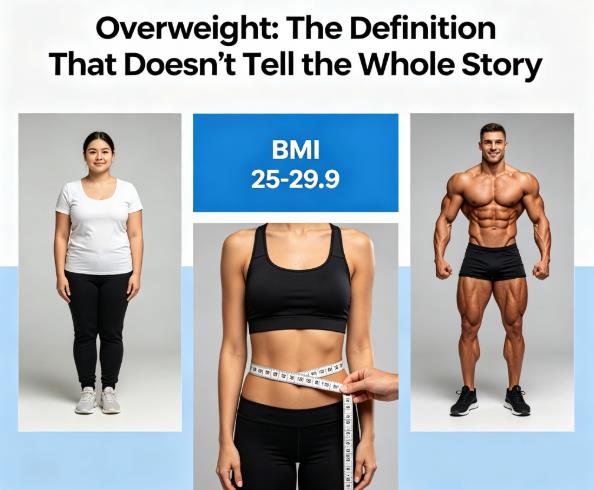
So if your BMI falls between 25 and 29.9, you meet the technical overweight definition. But here's the crucial nuance: that definition was developed using data from sedentary, average-framed adults. It was not designed for athletes, older adults, or people with high muscle mass.
Where the overweight definition came from (and its limits)
The BMI categories we use today were largely established by the World Health Organization in the 1990s, based on population studies linking BMI to mortality. They're useful for tracking trends across large groups. But for individuals, the story is messier.
A National Institutes of Health (NIH) analysis highlights that BMI alone doesn't distinguish between fat and muscle, nor does it tell you where fat is stored. That's why two people with the same BMI can have completely different metabolic risks.
Take a 5'10" male with a BMI of 27. If he's sedentary and has a 40-inch waist, he's likely at elevated risk for heart disease and diabetes. If he's active, lifts weights, and has a 34-inch waist, his risk is much lower — even though both are "overweight" by BMI.
Experts recommend using BMI as a starting point, not a final judgment. If your BMI falls in the overweight range, the next steps are to measure your waist and assess your lifestyle.
When the overweight label is a red flag
Being overweight (BMI 25-29.9) does carry some health risks for the average person. Research shows that people in this category have higher rates of high blood pressure, high cholesterol, and type 2 diabetes compared to those with normal BMIs. A 2016 meta-analysis in The Lancet (Global BMI Mortality Collaboration, Vol. 388, Issue 10046, pp. 776-786) found that overweight was associated with increased risk of several cancers, including colon and breast cancer, though the increase is modest compared to obesity.
But the risk isn't uniform. The same study noted that physical fitness dramatically changes the equation. A fit person with a BMI of 27 may have lower mortality risk than an unfit person with a BMI of 23.
The most important signal is your waist. If it measures over 40 inches for men or 35 inches for women, that indicates dangerous visceral fat regardless of BMI. Visceral fat drives much of this elevated risk, even among people who fall within the overweight BMI bracket.
You're sedentary — lack of exercise amplifies metabolic risk.
You have other risk factors — high blood pressure, high blood sugar, or a family history of heart disease.
Your weight has been climbing steadily — a trend upward over several years is a warning sign even if you're not yet in the obese category.
When the overweight label is misleading
For many people, especially active ones, being "overweight" by BMI doesn't mean you're unhealthy. Here are common scenarios where the label doesn't fit:
Muscular athletes and bodybuilders: An athlete BMI calculator shows that many strength athletes have BMIs over 25 with body fat in the single digits. Their weight is muscle, not fat.
Older adults (65+): A BMI of 25-27 may actually be protective. Research including the Winter et al. meta-analysis (2014) found that older adults with BMI in the 23-27 range had the lowest mortality — not those in the "normal" 18.5-24.9 range.
Large-framed individuals: People with broader bones and more muscle naturally carry more weight. Frame size adjustments suggest adding 5-10% to ideal body weight formulas, which often lands them in the overweight BMI category while still being lean.
If you're active, have a waist under 37 inches (men) or 31 inches (women), and your blood work is normal, being in the overweight BMI range is probably not a health concern.
How to tell if your overweight status is risky
Don't rely on BMI alone. Use this simple three-step check:
Step 1: Measure your waist
At navel, after exhaling. Under 37" (men) / 31" (women) = low risk. Over 40" (men) / 35" (women) = high risk.
Step 2: Estimate body fat
Use a body fat calculator. Under 20% (men) = likely fine even with higher BMI.
Step 3: Assess fitness
≥150 min moderate activity/week (per CDC physical activity guidelines)? Climb stairs without getting winded? Fitness reduces risk dramatically.
Check all three boxes? That overweight label is probably not worth worrying about. If two risk flags show up, consider discussing it with a qualified professional.
What to do if you're truly overfat
If your BMI is over 25, your waist is over 40 inches (men) or 35 (women), and your body fat is high, then the overweight definition is pointing to a real issue. The solution isn't crash dieting — it's sustainable change:
Add resistance training: Two to three sessions per week preserve muscle while you lose fat.
Prioritize protein: Aim for roughly 0.7 grams per pound of body weight (Academy of Nutrition and Dietetics recommendation) to maintain satiety and muscle.
Increase daily movement: Walking, stairs, parking farther away — small changes add up.
Cut one high-calorie habit: Replace a daily soda or large sugary coffee with water. That alone can drop 5-10 pounds over a year.
Don't try to drop to the bottom of the "normal" BMI range if you're muscular — aim for a body composition that gives you energy and health markers, not a specific number.
Common myths about the overweight definition
Myth: Anyone with BMI over 25 is unhealthy. Fact: Many active, muscular people are perfectly healthy at BMI 26-28. Waist size and fitness matter more.
Myth: Being overweight always leads to obesity. Fact: Many people maintain stable weight in the overweight range for decades without progressing.
Myth: Losing weight is always the right goal for overweight individuals. Fact: Age changes the equation. A 2014 meta-analysis found adults over 65 with BMI 23-27 had the lowest mortality — not those in the "normal" range. For older adults and some athletes, maintaining weight while improving fitness is often a better goal.
Myth: The overweight definition is the same for all ethnicities. Fact: WHO recommends lower BMI thresholds (overweight ≥23) for Asian populations due to higher metabolic risk at lower BMIs.
Key Takeaways
BMI 25.0–29.9 gets you the "overweight" label. But that label can't tell muscle from fat. Want a clearer read on your health? Check your waist, your activity level, and your blood work — not just the number on the scale.
Frequently Asked Questions About Overweight Definition
What is the clinical definition of overweight?
For adults aged 20 and older, the clinical cutoff for overweight is a BMI of 25.0 to 29.9. This standard is used by both the CDC and WHO as a population-level screening tool, not a personal diagnosis.
Can you be overweight but healthy?
Absolutely. A 32-year-old female CrossFit coach with a BMI of 26 may have excellent metabolic health, a 29-inch waist, and clean blood work. The BMI label alone does not dictate your individual wellness — body composition and lifestyle are what count.
Is BMI the only way to define overweight?
No. Many clinicians also use waist circumference — above 40 inches for men or 35 inches for women — as a standalone indicator of abdominal obesity risk, even when BMI appears normal.
What BMI is considered overweight for Asians?
For Asian adults, the WHO sets the overweight threshold at BMI 23.0 rather than 25.0. This adjustment reflects epidemiological data showing higher diabetes and heart disease risk at lower body weights in these populations.
What should I do if my BMI says I'm overweight?
Look at your waist size, body fat percentage, and fitness level. If those markers are healthy and you feel well, the BMI label alone does not dictate action. If waist circumference is high and fitness is low, start with small sustainable changes like resistance training and daily walks.
References & Sources
NIH: Aim for a Healthy Weight – waist circumference as risk factor
Winter JE, et al. BMI and all-cause mortality in older adults: a meta-analysis. Am J Clin Nutr. 2014;99(4):875-890. Found lowest mortality risk for older adults in BMI 23-27 range. DOI
WHO Expert Consultation. Appropriate body-mass index for Asian populations. Lancet. 2004;363(9403):157-163. Established lower BMI cutoffs (overweight ≥23) for Asian adults. DOI
Global BMI Mortality Collaboration. Body-mass index and all-cause mortality: individual-participant-data meta-analysis of 239 prospective studies in four continents. Lancet. 2016;388(10046):776-786. DOI
BMI Calculator Blog. This content is provided for educational and informational purposes only. Medical Disclaimer: The content of this article is for informational purposes only and does not replace professional medical advice, diagnosis, or treatment. Always seek the advice of a qualified physician or other health experts with any questions regarding medical conditions or health goals.