Two people can be 5'10" and 185 pounds, same BMI, completely different body composition — that mismatch is why "ideal weight" was never one number. Hamwi, Devine, Robinson, and Miller spread 11 lb on the same height; the CDC BMI band gives a 45-lb range. This guide walks you through the most trusted formulas, explains why muscle and age matter, and gives you a practical method to find your own ideal weight — not someone else's.
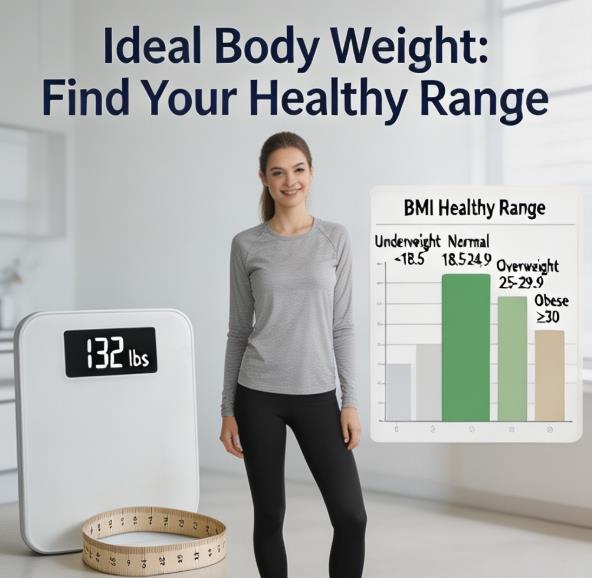
Common formulas for calculating ideal body weight
Doctors and researchers have developed several formulas over the years. They all give slightly different numbers, which tells you something important: the "right" weight is a range, not a precise point.
| Formula | Men | Women |
|---|---|---|
| Hamwi (1964) | 106 lb for 5ft + 6 lb per inch over | 100 lb for 5ft + 5 lb per inch over |
| Devine (1974) | 50 kg (110 lb) for 5ft + 2.3 kg (5 lb) per inch over | 45.5 kg (100 lb) for 5ft + 2.3 kg (5 lb) per inch over |
| Robinson (1983) | 52 kg (115 lb) + 1.9 kg (4.2 lb) per inch over 5ft | 49 kg (108 lb) + 1.7 kg (3.7 lb) per inch over 5ft |
| Miller (1983) | 56.2 kg (124 lb) + 1.41 kg (3.1 lb) per inch over 5ft | 53.1 kg (117 lb) + 1.36 kg (3 lb) per inch over 5ft |
Let us run an example for a 5'10" (70 inches) man:
Hamwi: 106 + (6 × 10) = 166 lb
Devine: 110 + (5 × 10) = 160 lb
Robinson: 115 + (4.2 × 10) = 157 lb
Miller: 124 + (3.1 × 10) = 155 lb
That is an 11-pound range — all considered "ideal" by different standards. So which one is right? None of them, exactly. They are starting points. A 2000 review in Annals of Pharmacotherapy traced the origin of these formulas and concluded that none were built as personal healthy-weight targets — most were created for estimating drug dosages in hospital settings. Treat them as rough guides. In our tool's anonymized data, most people fall roughly 5–8 lbs above the Devine formula result — and that is completely normal.
Why your ideal weight changes with age
A 25-year-old and a 65-year-old can have the same height and weight but very different health profiles. As adults age, they naturally lose muscle (sarcopenia) and may gain fat even if the scale does not move. The CDC notes that BMI categories stay the same across adulthood, but body composition does not.
Metabolic rate also slows: resting energy expenditure drops by roughly 1-2% per decade after age 20. A person who could eat 2,500 calories at 30 without gaining may need only 2,200 at 50 to maintain the same weight. That is why weight often creeps up even when eating habits do not change.
For older adults, a slightly higher weight can actually be protective. An observational meta-analysis in the American Journal of Clinical Nutrition found that older adults (65 years and older) with a BMI in the 23-27 range had the lowest mortality risk — not the standard 18.5-24.9. The study concluded that carrying a few extra pounds provides nutritional reserves against illness, falls, and frailty.
So your ideal weight at 30 (maybe 165 lb at 5'10") might become 175 lb at 70 — and that could be perfectly healthy.
The missing piece: frame size and muscle mass
Two people can be 5'10" and 170 pounds. One has a small frame, narrow shoulders, and low muscle — they might actually be overfat. The other has a large frame, broad shoulders, and carries muscle — they could be lean and healthy.
That is why the formulas above use a simple height-weight calculation but ignore frame. A quick way to estimate your frame size: wrap your thumb and middle finger around your opposite wrist. If they overlap, you have a small frame. If they just touch, medium. If they do not touch, large frame.
For a large-framed man, add 5-10% to the formula numbers. For a small-framed man, subtract 5-10%.
Muscle mass is even more important. A body fat calculator gives you a better picture than any weight formula. For men, a healthy body fat range is roughly 15-20% for fitness, 21-25% for acceptable. If your body fat is in check, do not worry if your weight is slightly above a formula's "ideal."
A simpler method: BMI-based ideal weight range
Because BMI has well-defined healthy ranges (18.5-24.9), you can reverse-engineer an ideal weight range from your height. Here is how:
Lower bound (BMI 18.5): 18.5 × (height in meters)²
Upper bound (BMI 24.9): 24.9 × (height in meters)²
For a 5'10" man (1.78 m):
Lower: 18.5 × (1.78 × 1.78) = 18.5 × 3.17 = 58.6 kg ≈ 129 lb
Upper: 24.9 × 3.17 = 78.9 kg ≈ 174 lb
That is a 45-pound range — much wider than the formula numbers. But it accounts for individual differences. Most healthy people at 5'10" fall between 145 and 175 pounds.
If you lift weights or have a large frame, aim for the higher end. If you are sedentary or small-framed, the lower end makes sense.
Four examples: finding your personal ideal weight
Here is how this plays out in real life. An active, muscular 40-year-old man at 5'10" might see the Devine formula say 160 lb, but he lifts weights, has a large frame, and 15% body fat. He feels great at 180 lb. His ideal weight is more like 175-185 lb. Ignore the lower numbers.
Now consider a sedentary desk worker, 45, same height. He does not exercise, has a small frame, and his body fat is 28%. The formula says 160 lb, but he is currently 190 lb. His target is 155-165 lb, while adding protein and resistance training to preserve muscle. Body composition always matters more than a single scale reading.
Walk into any primary care waiting room and you'll hear this one a lot. A 68-year-old man at 5'9" checks in — the Hamwi formula gives 160 lb. But he has good mobility, a 36-inch waist, and eats well. He is 175 lb. For his age, that weight is protective. No weight loss needed.
Finally, a 25-year-old collegiate swimmer at 6'1" — the Miller formula suggests 180 lb. He is 195 lb with 11% body fat. His ideal weight is actually higher than the formula because muscle matters. So treat the formula as a first draft, not a verdict.
The common thread: formulas are just starting points. You have to adjust for frame, muscle, age, and how you feel.
Putting it together
Instead of obsessing over one number, start with your BMI band. Use the reverse formula above or an online BMI calculator to get a healthy weight zone. Then layer in body fat or waist measurement. Use a body fat calculator, calipers, or a tape measure at the navel. If your body fat is in the fitness range (under 20% for men 30-50), you are likely fine even at the higher end of the BMI range. For waist, under 40 inches is generally considered low risk for men. Over 40 inches signals higher risk — weight loss and exercise become priorities. In our experience, most people skip the waist measurement step entirely, which is why BMI alone so often misleads. Re-check every 3-6 months. Your ideal weight may shift as you gain muscle or age.
Common myths about ideal body weight
There is one perfect weight for your height. A 30-pound range is normal and healthy, depending on frame and muscle. Two people at the same height can both be at their ideal weight while differing by 20 pounds or more.
Many people get stuck trying to match their high-school weight. Adults commonly add 10–20 lb through middle age; much of this comes from bone density and organ mass, not just fat. Striving for that old number often leads to unsustainable dieting that is hard to maintain long term.
Ideal weight formulas work for everyone. They were developed for specific populations, often in hospital settings, and do not account for athletes or older adults. For a muscular person, the formula may underestimate healthy weight by 20 pounds or more.
Losing weight is always the answer. For adults over 65, a stable weight in the higher range is often healthier than losing pounds and risking frailty. The goal shifts from weight loss to maintaining strength and function.
Final thoughts
Your healthy range shifts naturally as your body changes. Aim for a weight where you keep steady energy and comfortable movement. A waist measurement under 40 inches for men is one simple screening check; avoid extreme calorie cuts or overtraining just to hit a single target number.
Frequently Asked Questions About Ideal Body Weight
What is the most accurate ideal body weight formula?
None is perfectly accurate. The Devine formula is most commonly used in medicine, but it was originally developed to calculate drug dosages, not healthy weights. The BMI-based range is more flexible and accounts for individual variation.
How much should a 5'10" male weigh?
A healthy range is roughly 145-175 lb, but a muscular man can be 185 lb with low body fat. A sedentary man with a small frame might be healthiest at 150-160 lb. Use body fat percentage and waist size as your real guides.
Does ideal weight increase with age?
Yes, slightly. Most adults gain 1-2 pounds per year from early adulthood to middle age, partly due to metabolism slowing (1-2% per decade) and muscle loss. A weight that is healthy at 30 may be underweight at 70. For seniors, a BMI of 23-27 is often better than 18.5-24.9, as shown by the Winter et al. observational meta-analysis.
How do I know if I am at my ideal weight without a doctor?
Check three things:
Waist circumference: under 40 inches for men (lower risk)
Body fat percentage: under 22% for acceptable range
How you feel: energy, strength, and blood pressure if you know it
If those are good, do not worry about the scale.
Should I use ideal weight formulas if I am an athlete?
No. Those formulas will almost certainly underestimate your healthy weight because they do not account for muscle. Use body fat percentage (6-15% for male athletes is typical) and performance metrics instead.
Sources
NIH: Aim for a Healthy Weight — waist circumference and health risk
Academy of Nutrition and Dietetics — official position on weight management
Pai MP, Paloucek FP. The origin of the "ideal" body weight equations. Ann Pharmacother. 2000;34(9):1066-9. PMID: 10981254
Winter JE, et al. BMI and all-cause mortality in older adults: a meta-analysis. Am J Clin Nutr. 2014;99(4):875-90. PubMed search: Winter et al. 2014
BMI Calculator Blog. This content is provided for educational and informational purposes only. We encourage sharing with proper attribution to our site. Unauthorized commercial use is prohibited. This content does not replace professional medical advice. Consult a qualified healthcare provider for personal health decisions.
Related Articles
Your Ideal Body Weight: A Realistic Guide to Finding Your Healthy Range
What Is Ideal Body Weight? Why Formulas Give Different Numbers
Ideal Body Weight Based on Height: Why It's a Range, Not a Number
Last updated: October 15, 2026. This content is reviewed against current CDC, WHO, and NIH guidelines.