Article Summary: A standard BMI chart often misclassifies men over 35 — muscular guys get labeled "overweight," while a "normal" BMI can hide dangerous visceral fat. This guide gives you a monthly 5-minute tracking method, adds Asian-specific BMI and waist thresholds (18.5–22.9 BMI, waist < 35.4"), and shows exactly when to trust the chart and when to ignore it.
What a BMI chart for men actually shows — and where it misleads
A BMI chart for men is a simple lookup table: find your height and weight, get a BMI number (kg/m²). Under 18.5 = underweight, 18.5–24.9 = normal, 25–29.9 = overweight, 30+ = obese.
But the real problem is this: the chart does not see muscle versus fat, and it does not care where your fat sits. One BMI number can mean two completely opposite health realities.
Take a 42-year-old active man. Height 5'10" (178 cm), weight 195 lb (88.5 kg). BMI = 28.0 → "overweight." But his waist is 36 inches (91 cm), body fat 17%. His blood work is clean.
Now take a 44-year-old sedentary man. Same height, same BMI of 28.0. But his waist is 42 inches (107 cm), body fat 29%, and his fasting glucose is prediabetic. The BMI chart gave both men the same label.
That is the blind spot of a one-size-fits-all BMI chart for men. The CDC clearly states BMI is a screening tool, not a diagnostic one. For men over 35, ignoring this blind spot leads to either unnecessary worry or dangerous complacency.
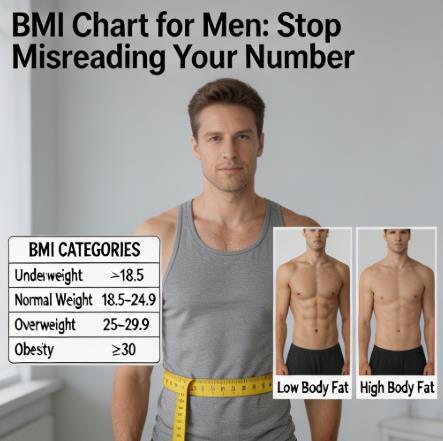
Exact numbers: how to read a BMI chart for men (and when to ignore it)
The standard BMI categories are identical for all adults. Here is what each range really means for a man — and when you should question the chart.
| BMI Range | Category | What It Means for Most Men | When to Question It |
|---|---|---|---|
| Below 18.5 | Underweight | Possible low muscle mass or illness | Rare for healthy men; usually valid |
| 18.5 – 24.9 | Normal weight | Generally healthy for sedentary men | May hide "normal-weight obesity" (low muscle, high fat) |
| 25.0 – 29.9 | Overweight | Needs further assessment | Very common for muscular, active men — check waist and body fat |
| 30.0 and above | Obese | Elevated health risk | Less likely misclassified, but possible for elite strength athletes |
Bottom line: The "overweight" bucket (25–29.9) is where most active men get mislabeled. If you lift weights or do physical labor, being in that range does not automatically mean trouble. But if you are sedentary and your waist is growing, that is a real warning sign.
Special note for Asian men: The WHO recommends a lower healthy BMI range for Asian populations: 18.5–22.9. Waist circumference threshold should also be lower — no more than 35.4 inches (90 cm) for Asian men. Asian men develop metabolic diseases at significantly lower BMI values than white men. If your BMI is 23–24.9 and your waist is near or above 90 cm, consider a deeper metabolic check even if the standard chart says "normal."
The hidden shift that changes everything after 35
Testosterone starts a slow, natural decline around age 30 — roughly 1% per year. Muscle protein synthesis slows. Fat storage shifts toward the belly. This is sarcopenia (muscle loss) plus rising visceral fat.
Here is what that means: you can weigh the same at 45 as you did at 25, but your body composition is quietly getting worse. A body fat calculator catches this change. The BMI chart does not.
The American Council on Exercise (ACE) publishes age-adjusted body fat norms for men. Use these instead of relying on BMI alone:
| Age | Essential Fat | Athletes | Fitness | Acceptable | Overfat |
|---|---|---|---|---|---|
| 20-29 | 2-5% | 6-13% | 14-17% | 18-21% | ≥22% |
| 30-39 | 2-5% | 8-15% | 16-19% | 20-24% | ≥25% |
| 40-49 | 2-5% | 9-16% | 17-20% | 21-25% | ≥26% |
| 50-59 | 2-5% | 10-17% | 18-22% | 23-27% | ≥28% |
| 60+ | 2-5% | 11-18% | 19-23% | 24-28% | ≥29% |
Notice the "acceptable" range goes up with age, but the "fitness" range for a 50-year-old (18-22%) is still leaner than the "acceptable" range for a 30-year-old (20-24%). Your goal: stay in fitness or acceptable for your decade.
Why waist circumference matters more than BMI for men over 40
Visceral fat — the deep fat wrapped around your liver and intestines — is metabolically toxic. It releases inflammatory chemicals that raise your risk of heart disease, type 2 diabetes, and certain cancers. Men store visceral fat more easily than women, especially after 40.
Critical Warning: A waist circumference over 40 inches (102 cm) doubles your risk of heart disease and type 2 diabetes — even if your BMI is completely normal. The National Institutes of Health (NIH) identifies this as an independent risk factor.
A 2020 study in the Journal of Clinical Endocrinology & Metabolism (Visser, M. et al., Vol. 105, Issue 4) found that men's visceral fat increased an average of 24% between ages 40 and 60, even among those whose total weight stayed stable. That is why waist measurement is critical.
Simple risk levels:
Waist under 37 inches (94 cm) → low visceral fat risk
Waist 37-40 inches (94-102 cm) → moderate risk, time to act
Waist over 40 inches (102 cm) → high risk, talk with your doctor
Four real-life cases: who should worry and who should not
Case 1 – The mislabeled athlete: 35-year-old CrossFitter, 5'11" (180 cm), 205 lb (93 kg). BMI 28.6 ("overweight"). Waist 34" (86 cm). Body fat 14% (fitness range). → Healthy. Ignore the BMI label.
Case 2 – Normal-weight obesity: 48-year-old office worker, sits 9+ hours a day, 5'10" (178 cm), 175 lb (79 kg). BMI 25.1 (just barely "overweight"). Waist 39" (99 cm). Body fat 27% (overfat). → Metabolic risk is real. Needs intervention.
Case 3 – Skinny-fat senior: 62-year-old retired man, 5'9" (175 cm), 165 lb (75 kg). BMI 24.4 ("normal"). Waist 37" (94 cm). Body fat 28% (overfat for his age). → Sarcopenic obesity. Needs resistance training, not weight loss.
Case 4 – Clear high risk: 55-year-old, 5'10" (178 cm), 240 lb (109 kg). BMI 34.4 ("obese"). Waist 46" (117 cm). Body fat 35%. → High risk. Action required.
Only case 4 should worry primarily about BMI. The rest need a deeper look using waist and body fat.
Your monthly 5-minute men's health check
Do this once a month. Same day, same time (morning, after bathroom).
Step 1 – Weight: Same scale, first thing in the morning.
Step 2 – Waist circumference: Measure at navel level after exhaling. No sucking in.
Step 3 – Estimate body fat: Use a body fat calculator (Navy tape method – needs neck and waist).
Step 4 – Compare to standards: BMI → see table 1. Body fat → see table 2 for your age. Waist → under 37" good, 37-40" caution, over 40" high risk.
Step 5 – Take action: If waist is rising or body fat is in the overfat category, add two resistance training sessions per week and clean up one meal per day. Recheck in 30 days.
That is it. No daily obsession. Just monthly data that tells you if you are gaining muscle, losing fat, or drifting the wrong way.
For a quick starting point, use our online BMI calculator — but always pair it with your waist measurement.
Common myths about BMI charts for men — busted
Myth: A "normal" BMI means you are healthy.
Fact: Normal-weight obesity affects roughly 1 in 4 American adults with a normal BMI. Low muscle plus high fat hides behind a healthy number. Always check waist and body fat.Myth: Any BMI over 25 is dangerous.
Fact: For active, muscular men, a BMI of 26-29 often reflects muscle, not fat. If your waist is under 37" and body fat is in the fitness range, you are fine.Myth: BMI charts for men and women are different.
Fact: The numbers are identical, but men carry more visceral fat at the same BMI. That is why waist circumference is especially important for men.Myth: You cannot lower body fat after 50.
Fact: Men over 50 can reduce body fat and build muscle with consistent resistance training and adequate protein (about 1.6 g per kg of body weight). The rate is slower, but the change is real.
For more detailed guidance, see our related articles: height and weight BMI chart and body fat percentage chart for men.
Final thought: the BMI chart is a starting line, not a finish line
The BMI chart for men is a cheap, fast population screening tool. But for you as an individual, it is incomplete. Add waist circumference and body fat percentage to your toolkit. Track trends, not single numbers.
Remember: the man who lifts and reads "overweight" on a chart is not the one who needs to worry. The real risk is the man with a normal BMI, a growing belly, and no muscle — quietly drifting toward trouble.
Use the BMI chart to know where to look deeper. Then look deeper.
Expert insight — American Council on Exercise (ACE) perspective: "Body fat percentage and waist circumference are far more predictive of metabolic health in men than BMI alone, especially after age 35. Men who maintain waist circumference below 37 inches and body fat within the ACE 'fitness' range for their age show significantly lower markers of inflammation and insulin resistance, regardless of their BMI category." — Based on ACE position statements on body composition assessment (2023).
Frequently Asked Questions About BMI Charts for Men
What is a healthy BMI for a man over 40?
The standard healthy BMI range (18.5-24.9) applies, but many healthy active men will have BMIs between 25 and 27. For men aged 40-60, waist below 37 inches (94 cm) and body fat under 23% (acceptable range for 40-49) are more meaningful than a strict BMI cutoff. A man with BMI 26, waist 36", and body fat 20% is not unhealthy regardless of the chart.
Why does BMI say I am overweight when I can see my abs?
Muscle is denser than fat — plain and simple. If you can see your abs, trust your eyes over the chart. This is especially common in men who strength train consistently.
How often should a man check his BMI?
Once a month is plenty. What matters more is the 3-6 month trend. For men over 40, check waist circumference monthly and body fat quarterly. BMI alone tells you very little about muscle loss or visceral fat gain.
Can a man have a normal BMI but too much belly fat?
Yes — normal-weight obesity. Example: a 45-year-old man with BMI 23.5 ("normal") but waist 38 inches (97 cm) and body fat 27% is at elevated metabolic risk. This "skinny fat" profile is common in sedentary men who are not overeating but are losing muscle. The fix is resistance training, not weight loss.
Should older men aim for a higher BMI to protect against frailty?
Some research suggests a BMI up to 27 may be protective for men over 65, as it provides nutritional reserves. But the key is preserving muscle. A 68-year-old with BMI 26, waist 35 inches (89 cm), and good mobility is healthy. The same BMI with low muscle and a 42-inch (107 cm) waist is not. Focus on strength and protein intake, not chasing a low BMI number.
Should I even bother checking my BMI anymore?
The answer is yes — but only as a starting point. Use it to flag potential issues, then immediately verify with waist and body fat. Never make a health decision based on BMI alone.
Content Integrity Review: This article has been reviewed for alignment with CDC, WHO, NIH, ACE, and ACSM guidelines on adult BMI classification, body composition assessment, and waist circumference risk thresholds. Individual health decisions should always be made with a qualified healthcare provider.
Developed using: CDC adult BMI screening standards, WHO Asian population thresholds, NIH waist circumference protocols, ACE body composition norms, and ACSM body composition guidelines.
References & Sources
CDC: About Adult BMI — official BMI classification guidelines
WHO: Obesity and Overweight Fact Sheet — global BMI standards
NIH: Assessing Your Weight and Health Risk — waist circumference thresholds
ACE: Percent Body Fat Calculator & Norms — age-adjusted body fat ranges
American College of Sports Medicine (ACSM): Body Composition Guidelines
Visser, M. et al. Visceral adipose tissue accumulation during aging: a 10-year longitudinal study. Journal of Clinical Endocrinology & Metabolism. 2020;105(4):dgz278. DOI: 10.1210/clinem/dgz278
WHO Expert Consultation. Appropriate body-mass index for Asian populations and its implications for policy and intervention strategies. Lancet. 2004;363(9403):157-163.
BMI Calculator Blog. This content is provided for educational and informational purposes only. We encourage sharing with proper attribution to our site. Unauthorized commercial use is prohibited. Medical Disclaimer: This content does not replace professional medical advice, diagnosis, or treatment. Always seek the advice of a qualified physician or other licensed health provider with any questions regarding your body composition, weight status, or health goals.