At a Glance: Ideal body weight for toddlers is not one number. Clinicians use WHO standards for children under 2 and CDC sex-specific BMI-for-age percentiles for ages 2 and older. A steady growth channel matters more than any single weigh-in.
A 2-year-old can weigh 24 pounds at 33 inches and be healthy. Another can weigh 31 pounds at 36 inches and also be healthy. Toddlers grow fast, so weight should be read with height, age, and sex on standardized growth charts. The useful output is a percentile range and a trend over time, not a fixed target weight.
Why "Ideal Weight" Is a Moving Target in Toddlerhood
Growth charts compare your child with a reference population of healthy children of the same age and sex. A percentile shows where your child falls in that group. A child at the 25th percentile weighs more than 25% of peers and less than 75%. A child at the 75th percentile weighs more than 75% and less than 25%. Neither number is "better" by itself.
From birth to 2 years, the World Health Organization Child Growth Standards are the usual reference for weight, length, weight-for-length, and head circumference. CDC guidance recommends WHO charts for U.S. infants birth to 2 years, then CDC charts at age 2 because BMI-for-age replaces weight-for-length as the main screening lens. CDC WHO growth standards usage guide explains the birth-to-2 protocol, and the CDC clinical growth charts portal covers the 2-plus transition and provides the official chart files.
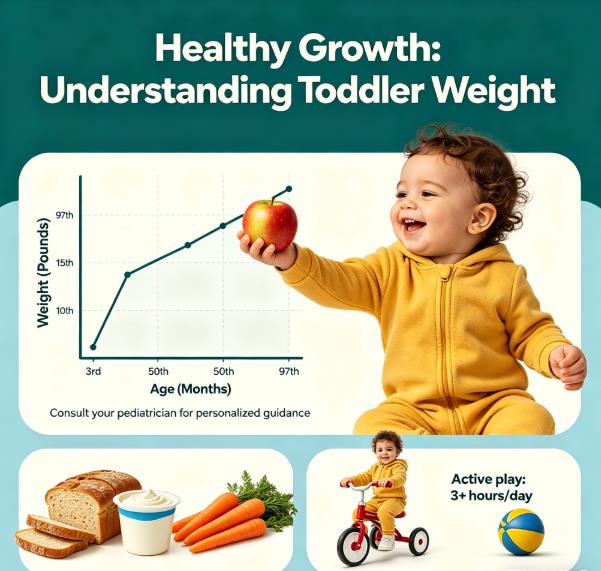
How Toddler Weight Is Assessed By Age
Under 2 years: pediatricians usually review weight-for-length or weight-for-height rather than BMI. There is no universal BMI cutoff for underweight, overweight, or obesity in this age group. The main question is whether the curve stays in a consistent channel and whether milestones, feeding, and sleep fit the child's pattern.
Once your child turns 2, the picture shifts. CDC and many pediatric guidelines use sex-specific BMI-for-age percentiles because BMI adds height context to weight. Common screening bands for ages 2-19 are below the 5th percentile for underweight, 5th to below 85th for healthy weight, 85th to below 95th for overweight, and 95th or higher for obesity. Severe obesity is assessed separately when BMI is very high. These bands are screening ranges, not a diagnosis. CDC child and teen BMI categories list the current cutoffs.
A "growth channel" is the band where measurements stay over months. A child tracking between the 10th and 25th percentile with steady height gain is not automatically underweight. A child who moves from the 25th to the 80th percentile in six months may need review even if both points look normal, because the pattern changed quickly.
Approximate Median Weights For Toddlers
Reference only: These median numbers are just benchmarks. Always evaluate growth trends, not a single weight value.
| Age | Girls | Boys |
|---|---|---|
| 12 months | 21.0 lb / 9.5 kg | 22.5 lb / 10.2 kg |
| 18 months | 24.0 lb / 10.9 kg | 25.5 lb / 11.6 kg |
| 24 months | 26.5 lb / 12.0 kg | 28.0 lb / 12.7 kg |
| 30 months | 29.0 lb / 13.2 kg | 30.5 lb / 13.8 kg |
| 36 months | 31.5 lb / 14.3 kg | 33.0 lb / 15.0 kg |
Here is what those numbers look like in practice. A 24-month-old girl near the 10th percentile may weigh about 22 pounds, while a peer near the 90th may weigh about 32 pounds. Both can be within a healthy pattern if height, gain, and milestones fit the same channel. For ongoing 2-plus tracking, a child BMI calculator can show BMI-for-age percentile without manual chart reading.
What Shapes A Toddler's Growth Pattern
Nutrition quality. Regular meals with fruits, vegetables, whole grains, dairy or suitable alternatives, eggs, legumes, fish, or lean meat support steady gain. Frequent sugary drinks, sweet snacks, and high processed-food intake are associated with faster weight gain and later obesity risk.
Active play. Most toddlers thrive with at least 60 minutes of active play spread throughout each day (think running, climbing, and outdoor play, not scheduled gym class).
Sleep. Sleep matters more than many parents expect. Short sleep disrupts hunger and satiety hormones and is linked with higher obesity risk in early childhood. Toddlers commonly need about 11-14 hours in 24 hours including naps, though individual needs vary.
Feeding dynamics. A division-of-responsibility style works well for many families: parents choose what and when food is offered, and the child decides how much to eat. Pressure to finish plates or using sweets as rewards can make mealtimes harder and weaken self-regulation.
Practical Parent Steps
Track the curve, not one weigh-in. Ask the clinician for height, weight, and BMI-for-age percentile at well-child visits, then compare with previous visits. A steady growth curve matters more than a single number on the scale.
Watch large percentile crossings. A move across two or more major lines up or down over months is more important than a single high or low number. If you see a big shift, bring it up with your provider.
Keep food routines simple. Offer nutrient-dense foods, water instead of sweet drinks, and regular family meals. Avoid calorie-restricted diets for toddlers unless a clinician plans them.
Support sleep and play. Consistent bedtime, limited screen time, and daily active play are easier to sustain than repeated home weigh-ins.
Review extremes with a clinician. Below the 5th BMI-for-age percentile at 2-plus, above the 95th, unusual stagnation in weight or height, or rapid crossing of channels can be discussed at a pediatric visit.
One thing worth remembering: the goal isn't to hit a specific number on the scale. It's to give your child steady fuel, plenty of movement, and enough rest so their body can do what it's already designed to do — grow at its own pace.
One growth log stood out recently: a 20-month-old who tracked the 20th percentile for a year dropped toward the 8th over four months after a feeding transition. The parents were worried because he seemed "smaller" than his playgroup friends. The log didn't diagnose anything, but it gave the pediatrician a trend to interpret. Adjusting texture (moving from purees to soft solids), timing (adding a small high-calorie snack before bed), and focusing on calorie-dense foods like avocado and nut butters solved most of the concern within two months. A single home weigh-in would never have told that story.
Common Myths About Toddler Weight
A heavier toddler is a healthier toddler
Fact: Rapid gain is not the goal. A steady percentile channel with good energy, appetite, and milestones is more useful than a high number on the scale. Weight-for-length under 2 and BMI-for-age at 2-plus are better screens than weight alone.
A low percentile always means underweight
Fact: Not always. A child steadily tracking at the 15th or 20th can be healthy. Underweight screening usually starts below the 5th BMI-for-age percentile for ages 2 and older, with full height and trend context.
Adult BMI charts work for toddlers
Fact: They do not. Children need age- and sex-specific pediatric charts. Under 2, weight-for-length or weight-for-height is usually preferred over BMI. We have seen this confusion in parent forums when someone posts an adult BMI result for a 3-year-old; the chart simply does not apply.
Daily home weighing shows ideal weight
Fact: Home scales and one-off weights often create anxiety. Standardized clinic measurements over time give a better growth picture. This is one of the most common worries pediatric providers hear in clinic, and the usual answer is to look at the trend, not the daily number.
Frequently Asked Questions
What is a normal weight for a 2-year-old?
At the 50th percentile, a 2-year-old girl is about 26.5 lb / 12.0 kg and a boy about 28.0 lb / 12.7 kg. But "normal" is not a single point. For ages 2 and older, BMI-for-age from the 5th to below 85th percentile is commonly considered healthy. Height, trend, and clinical context always matter more than the raw number.
How do I know if my toddler is overweight?
For ages 2 and older, overweight usually means BMI-for-age at or above the 85th and below the 95th percentile. Under 2, clinicians use weight-for-length or weight-for-height rather than fixed overweight labels. A single high reading should be reviewed with the trend, not treated as a diagnosis. We have seen parents bring logs showing a child steady at the 90th percentile for two years—that kind of consistency is exactly what pediatricians look for. A sudden jump from the 50th to the 90th in six months is a different story and worth discussing with your provider.
Should I worry if my toddler is in a low percentile?
Not every low percentile is a problem. We have seen parents bring logs showing a child steady at the 15th for two years; that kind of consistency is exactly what pediatricians like to see. What raises concern is a drop across two or more major lines over months, stalled height gain, or BMI below the 5th at 2-plus. Ask the clinician to compare current percentiles with earlier visits. A child who is active, meeting milestones, and eating well is likely fine even at a lower percentile.
When are WHO charts used instead of CDC charts?
WHO standards are commonly used from birth to 2 years for international child growth references, including weight-for-length and length-for-age. CDC BMI-for-age charts are commonly used from age 2 in the United States. Some clinics transition at 24 months; exact timing can vary by practice and chart system. During this switch, a child's percentile may shift because the measurement changes from weight-for-length to BMI-for-age, not because their health status changed overnight.
Can I use an adult BMI calculator for my toddler?
No. Adult BMI categories start at age 20 and do not adjust for growth spurts, sex, and age the way pediatric charts do. Under 2 use WHO weight-for-length or length-for-age; at 2-plus use CDC or WHO BMI-for-age percentiles depending on the clinic's protocol. A toddler's body composition changes too fast for adult standards to be meaningful.
How often should my toddler be weighed?
Well-child visit schedule matters more than home weighing. Many toddlers are measured at 12, 18, 24, 30, and 36 months, then annually after age 3. Your pediatrician may recommend more frequent checks after illness, poor gain, or large percentile crossings. The goal is a series of standardized measurements, not daily weights. One parent we know tracked her son every six months using our percentile tool; this pace works far better than obsessing over daily weight fluctuations.
Sources
WHO: Weight-for-length, weight-for-height, length/height and BMI standards
Koletzko, B. et al. Is Growth in Early Childhood a Window of Opportunity for Programming Long-Term Health? Annals of Nutrition and Metabolism. 2024; 80(Suppl 1): 29-38.
This article is for educational and informational purposes only. It does not provide medical advice, diagnosis, or treatment. Growth charts are screening tools, not pass-or-fail scores. Always discuss your toddler's weight, height, BMI percentile, and growth pattern with a qualified pediatrician or healthcare provider.